The Sandbox Pact (2014)
The playground at Oak Creek Elementary was divided by an invisible line that every six-year-old recognized without speaking. On one side stood the tall metal jungle gyms and tire swings where the fastest, loudest kids ran until their knees were scraped raw. On the other side, near the wooden border of the mulch pit, was the sandbox—quiet, warm in the September sun, and mostly empty.
That was where I first met Benny.
I was clutching a battered plastic shovel, feeling entirely overwhelmed by the sheer noise of the first grade. My mother had carefully braided my hair that morning, securing the ends with bright yellow ribbons, but by recess, one of the braids was unraveling. I sat on the wooden timber edge, close to tears, wishing my mother hadn’t driven away after dropping me off.
Then a soft, muffled thump landed in the sand beside my sneakers.
I looked down. It was a plush purple dinosaur with frayed green felt spots and a crooked stitched smile. Standing two feet away was a boy in a green polo shirt and oversized khaki pants. His round cheeks were flushed pink from the breeze, his almond-shaped eyes sparkled with cautious curiosity, and his hands were tucked securely against his chest.
“His name Barnaby,” the boy announced with absolute certainty, his voice thick and slightly slurred, but ringing with pure warmth.
“I’m Elena,” I whispered.
He took a step forward, beamed so wide that his eyes nearly disappeared, and pointed to his own chest. “Benny. You sad?”
“A little,” I admitted.
Without hesitation, Benny picked up Barnaby, dusted off the grains of sand clinging to the dinosaur’s tail, and placed the stuffed animal directly into my lap. “Barnaby hug. He makes good hugs.”
That single gesture altered the course of my entire childhood.
In the weeks that followed, Benny and I became an inseparable unit. While other children formed shifting alliances based on who had the best trading cards or who ran the fastest during tag, Benny and I existed in our own world of shared laughter and quiet understanding. Benny had Down syndrome, a phrase the teachers used in hushed, polite tones whenever they spoke to his mother at the classroom door. To me, that diagnosis meant nothing. Benny was simply the boy who could name every locomotive ever manufactured, the boy who would share his apple slices without being asked, and the boy who noticed whenever someone in the room was having a bad day before anyone else did.
One afternoon toward the end of our first-grade year, our teacher read us a fairy tale about princes, princesses, and a royal grand ball. During craft time, with glitter glue sticking to our fingers, I turned to Benny while he carefully drew a purple crown on Barnaby’s head.
“When we grow up, Benny,” I said with the solemn gravity only a six-year-old could muster, “we’re going to the big high school dance together. The prom. Just like the prince and princess.”
Benny stopped his crayon mid-stroke. He looked up at me, his eyes wide and serious. “Prom? Music? Dancing?”
“Yes. We’ll dress up really fancy. You’ll wear a suit, and I’ll wear a pink dress with sparkles.”
He dropped the purple crayon, picked up Barnaby by the arm, and held out his small hand. “Promise, El?”
“Promise,” I replied, wrapping my pinky finger around his.
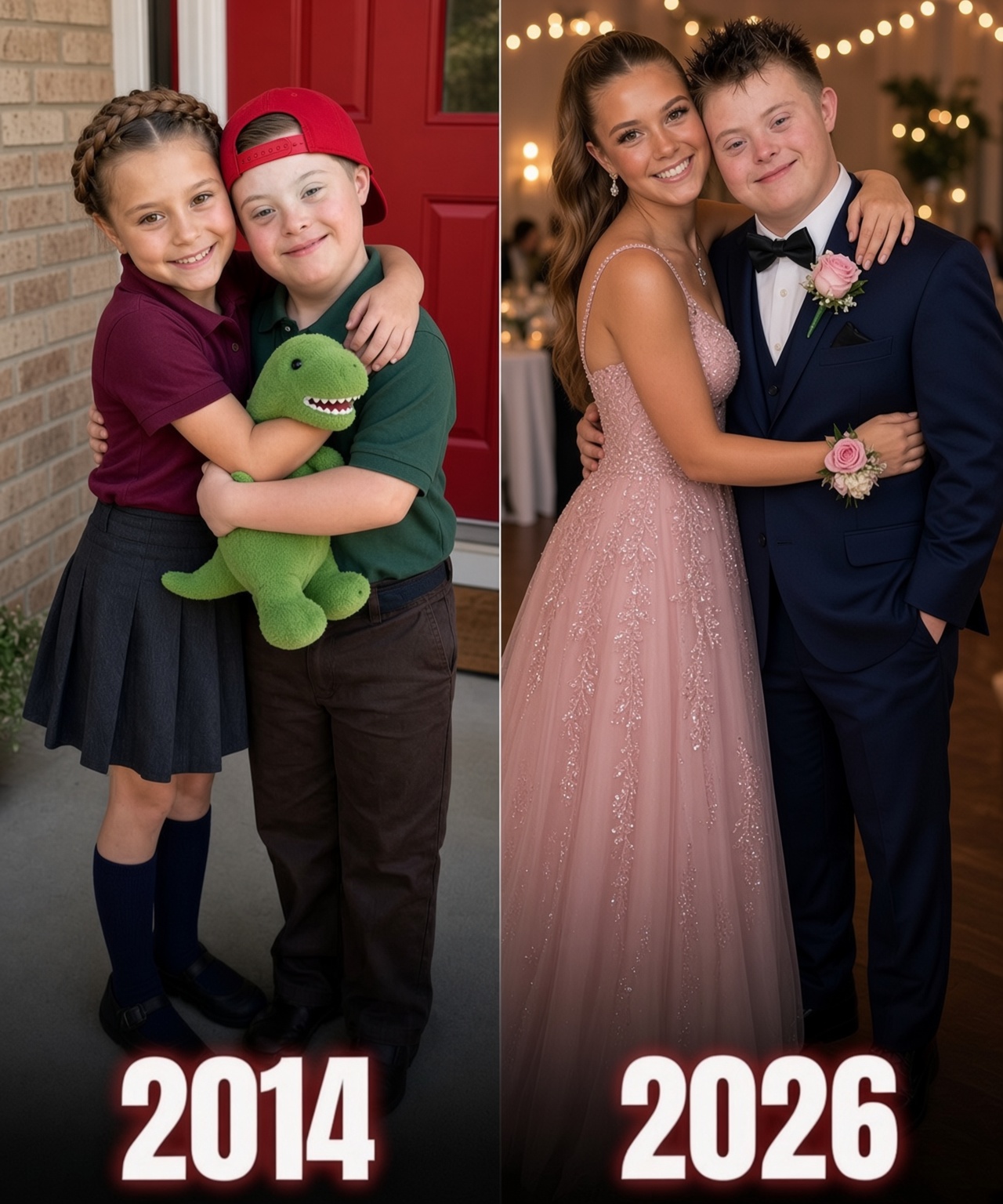
Our mothers took a picture of us that very afternoon in front of Benny’s front door. I had my braids freshly redone, smiling proudly with my arm wrapped tightly around Benny’s shoulder, while he held Barnaby against his stomach, wearing that trademark crooked smile that could melt the coldest room. None of the adults standing on that porch took our little pact seriously. To them, it was just the sweet, fleeting innocence of two children playing make-believe.
They didn’t know that to Benny and me, a promise made with pinkies and a purple dinosaur was set in stone.
Growing Up in Each Other’s Shadows
Growing up has a cruel way of sifting through childhood friendships. By middle school, the playground borders expanded into social hierarchies defined by sports teams, clothing brands, and awkward social media statuses. Kids became self-conscious, desperate to fit in, and terrified of standing out for the wrong reasons.
Benny didn’t care about trends. He remained stubbornly, beautifully himself.
He still carried Barnaby tucked inside his backpack, though his older brother had warned him that middle schoolers would tease him. He still greeted the bus driver every morning with an enthusiastic wave, and he still saved the seat next to him for me every single day.
There were times, I must confess, when the crushing weight of adolescent peer pressure made me hesitate. In seventh grade, when groups of girls giggled in the hallway and pointed whenever Benny tried to give them a high-five, a part of me felt a sick, anxious knot in my stomach. I wanted to be liked. I wanted to sit at the lunch table with the girls who wore lip gloss and discussed the boys on the track team.
One Tuesday, I sat two tables away from Benny during lunch, trying to blend in with the popular crowd. I pretended not to see him sitting alone at the corner table, diligently unwrapping his peanut butter sandwich. But when a boy from the eighth-grade football team deliberately bumped Benny’s tray, sending his juice carton spilling across the linoleum, the entire cafeteria went quiet, waiting for the punchline.
Benny didn’t yell. He didn’t cry. He just looked down at his soaked napkins with a bewildered, wounded expression that tore straight through my chest.
Before my brain could calculate the social cost, I was on my feet. I walked straight past the girls who were smirking, grabbed a fistful of paper towels from the dispenser, and knelt beside Benny’s chair.
“Hey, Benny,” I said loudly enough for the whole row to hear. “Looks like you need an assistant.”
He looked down at me, and that sudden, radiant smile wiped every trace of hurt from his face. “Hey, El. Sticky juice.”
“Very sticky,” I laughed, wiping down his tray.
I didn’t care that the other kids were staring. In that moment, I realized something fundamental: popularity was fickle and hollow, but the loyalty between Benny and me was real. From that day forward, I never hid our friendship again. I joined the school’s Unified Sports program, where students with and without intellectual disabilities competed together on the track. Benny was our team’s anchor runner—not because he was the fastest, but because he never finished a race without turning around to cheer for the person trailing behind him.
Through middle school and into high school, while my classmates navigated messy breakups, shifting cliques, and endless teenage drama, Benny and I had our weekend movie nights, our Saturday walks around the neighborhood, and our unwavering ritual: every year on our birthdays, we would recreate our handshake from first grade and check in on the promise.
“Prom’s coming, El,” he would remind me with a grin as we entered high school. “I gotta learn how to spin.”
“You’ve got time, Benny,” I’d tell him. “Just make sure your shoes are polished.”
The Weight of Senior Year (2026)
By the spring of 2026, the halls of Oak Creek High School were buzzing with a single topic: Senior Prom.
It was treated like the coronation of our youth. Girls spent months searching for the perfect dress, scrolling through boutique catalogs during chemistry class, while boys orchestrated elaborate, public “promposals” with giant cardboard signs, bouquets of roses, and serenades in the quad.
I didn’t need a lavish proposal. As far as I was concerned, my date had been decided twelve years ago in a sandbox.
Then the complications began.
Around mid-April, Lucas Harrison started lingering by my locker. Lucas was everything high school society praised: captain of the varsity soccer team, effortlessly charming, with a messy wave of brown hair and an easy smile that made half the senior class swoon. For months, we had shared friendly banter in AP Literature, but as the dance drew closer, his visits became deliberate.
“So, Elena,” Lucas said one Thursday afternoon, leaning against the red metal lockers with his hands casually jammed into his jacket pockets. “Everyone’s asking who you’re going with.”
I shut my locker and shouldered my backpack. “I already have a date, Lucas.”
Lucas raised an eyebrow, clearly surprised. “Really? Who? I haven’t seen anyone ask you.”
“Benny,” I said simply.
His casual smirk wavered for a split second, replaced by confusion. “Benny? You mean Benny from the vocational wing? Your neighbor?”
“My best friend,” I clarified, looking him dead in the eye.
Lucas rubbed the back of his neck, his posture shifting awkwardly. “Oh. That’s… that’s really nice of you, Elena. Seriously, it’s sweet. But come on. It’s senior prom. Don’t you want, like, a real date? We could get a party bus with the rest of the team. It’d be legendary.”
The word hit me like a splash of freezing water: real date. As if Benny were merely an obligation, a charity project I had taken on to feel good about myself.
“He is a real date,” I said, my voice hardening. “And we’ve had plans for this night since we were six years old. I’m not breaking that for a party bus.”
I turned and walked down the hallway before he could respond. But as I walked away, I felt a knot of anger and anxiety twisting in my gut. I hadn’t realized that while I viewed our pact as an honor, others viewed it as a compromise—a sacrifice I was making out of pity.
Over the next week, the whispers started. They weren’t overtly cruel, which somehow made them worse. They were patronizing. Girls in the bathroom would say, “Elena is so brave,” or “It’s so selfless of her to give up her senior night.” In the cafeteria, people cast pitying glances in my direction.
I ignored them with everything I had. But what I didn’t realize was that teenagers aren’t the only ones who hear whispers in school corridors. Benny heard them, too.
The Unspoken Distance
About two weeks before prom, something changed in Benny.
It wasn’t dramatic at first. He still waved when he saw me, and he still asked about my classes, but his usual bubbling energy had dimmed. Whenever I brought up details about the dance—what color corsage he wanted, what time his brother would drive us, what songs we should request—he gave short, evasive answers.
“Whatever you like, El,” he would say, staring down at his sneakers.
“Benny, we need to pick out your bowtie,” I said one Friday after school while sitting on his back porch. The afternoon sun was warm, filtering through the maple trees, but Benny seemed miles away. “My dress is blush pink. Do you want to match the pink, or go classic black with a navy suit?”
“Black is fine,” he mumbled, his thumbs anxiously picking at a thread on the hem of his jeans.
“Are you feeling okay?” I asked, leaning closer to catch his eye. “You’re not catching a cold, are you?”
“I’m good,” he said, forcing a small smile that didn’t reach his eyes. “Just… tired.”
He stood up and walked back inside the house before I could say another word.
I went home that evening feeling deeply unsettled. Benny had dreamed about this night for over a decade. He had spent hours in front of the mirror practicing his formal bow; he had saved money from his part-time shifts at the local grocery store to buy his own boutonniere. For him to suddenly become distant and indifferent made no sense at all.
I texted him that evening: Everything okay for tomorrow? Mom wants to finalize the dinner reservations.
Ten minutes passed. Then twenty. Finally, a response popped up on my screen, short and devoid of the dozens of goofy emojis Benny usually sent:
Maybe you should go with Lucas.
My breath caught in my throat. I stared at the glowing letters until they blurred. My heart began to pound against my ribs. Did Benny not want to go with me anymore? Had he found someone else? Or had he simply realized that our childhood promise was silly and childish?
I tried calling his phone immediately, but it went straight to voicemail. I called his home landline, but nobody answered. Frantic and hurt, I pacing back and forth across my bedroom floor, wondering what on earth had gone wrong between us.
The Locked Door and the Unspoken Truth
The following evening, less than a week before the dance, I was sitting on the edge of my bed, staring blankly at the closet door where my blush-pink gown hung wrapped in plastic. The dress was stunning—delicate lace embroidery, layers of soft tulle, shimmering subtly under the bedroom light. It was the dress of my dreams, but right now, looking at it only brought a heavy ache to my chest.
A gentle knock rattled my bedroom door.
“Elena?” my mother’s voice called softly.
“I’m fine, Mom,” I said, not moving. “Just studying.”
The handle turned, and my mother stepped inside. Instead of leaving the door ajar as she usually did, she closed it firmly behind her. Then, with a distinct, metallic click, she turned the deadbolt, locking us inside the room.
I sat up, alarmed by the sudden formality of the gesture. “Mom? What are you doing?”
My mother didn’t answer right away. She walked across the room, pulled the wooden desk chair out, and sat down directly across from me. Her face was unusually pale, her hands resting quietly in her lap, fingers knotted together. She looked at me with an expression that carried a mixture of deep tenderness, exhaustion, and sorrow.
“Elena,” she began, her voice barely above a whisper. “We need to talk about Benny. And you need to listen to me without interrupting, because what I’m about to tell you was supposed to remain between his mother, Benny, and me.”
My stomach plummeted. “Is he sick? Did something happen to his heart?”
Benny had undergone multiple surgeries on his heart when he was an infant, a common vulnerability for children with his condition. That fear had always hovered in the quiet background of our lives.
“No, his heart is physically fine,” Mom said gently, placing a hand over mine to steady my trembling fingers. “It’s what’s inside his heart right now that’s breaking.”
She took a deep breath, looking toward the window before returning her gaze to mine.
“Last Thursday evening, around eight o’clock, after you had gone to the library with Sarah, Benny walked over to our house alone,” Mom said. “He didn’t ring the doorbell. He just knocked very softly on the kitchen door. When I opened it, he was standing on the back porch in the dark, clutching that old purple dinosaur he used to carry everywhere.”
A lump formed in my throat. Benny hadn’t taken Barnaby out of his bedroom closet in years.
“He was crying, Elena,” my mother continued, her own eyes welling with unshed tears. “Not loudly. Just quiet, steady tears running down his cheeks. He came in and sat at the kitchen table. He put Barnaby on the table, looked up at me, and asked if he was an ugly boy.”
The words felt like a physical blow. The air rushed out of my lungs. “What? Who told him that?”
“Someone at school,” Mom answered, her voice trembling slightly with suppressed rage. “A couple of boys from the athletic department cornered him outside the gym after sixth period last week. They told him that everyone in school was laughing at him. They told him that you only agreed to go to prom with him because you felt sorry for him, and that by making you go with him, he was ruining your senior year. They said you deserved to go with someone normal like Lucas, someone who wouldn’t embarrass you in front of the whole town.”
Tears spilled over my eyelashes, hot and burning against my cheeks. I pressed my hand against my mouth to stifle a sob. The sheer, calculated cruelty of it left me reeling.
“Benny didn’t tell his mother because he didn’t want to make her cry,” Mom continued softly. “He came to me because he wanted my help. He sat at our kitchen table for two hours, Elena. He asked me to help him write a letter to you. He wanted to tell you that he was sick, or that he had to go out of town, so that you would be free to go to prom with Lucas without feeling guilty.”
“Oh, Benny…” I gasped, tears dropping onto my jeans.
“I asked him why he would do that when he had looked forward to this night for twelve years,” Mom whispered. “Do you know what he said?”
I shook my head, unable to speak.
“He held that worn-out stuffed dinosaur, looked me straight in the eyes, and said: ‘Elena is the most beautiful girl in the world. She should look like a queen at the ball. If I stand next to her, people will only laugh at the broken boy. I love El too much to let them laugh at her.’“
The bedroom was dead silent except for the sound of my ragged breathing. Every word felt like a sharp needle sliding into my heart. While I had been worrying about whispers and feeling annoyed by awkward questions in the hallway, Benny had been silently shouldering a mountain of emotional pain—not to protect himself, but to protect me.
He was willing to give up the single greatest milestone of his adolescence, willing to swallow humiliation and loneliness, solely so that I could shine without an asterisk next to my name.
“I locked the door, Elena,” my mother said, wiping a tear from her own cheek, “because I wanted to tell you this without anyone hearing. You need to understand who that boy is. A lot of people in this world spend their entire lives searching for someone who will love them with that kind of purity. A love that asks for nothing in return, that puts the other person’s happiness above its own existence. You found that kind of friend when you were six years old.”
Mom stood up, unlocked the bedroom door, and turned back to look at me one last time.
“Now,” she said softly, “the decision of what to do next belongs entirely to you.”
The Knock at Benny’s Door
I didn’t wait until morning. I didn’t wash the tears from my face, and I didn’t change out of my sweatpants.
I grabbed my jacket, walked out of our front door, and marched across the two front lawns that separated our houses. The night air was brisk, smelling of damp grass and early spring flowers. A single light was on upstairs in Benny’s bedroom.
I didn’t knock on the kitchen door. I went straight to the front porch, walked up the steps, and rang the front doorbell with steady, determined pressure.
A moment later, Benny’s mother opened the door. Her face was drawn with worry, but when she saw me standing there, breathless and red-eyed, her features softened with immediate understanding.
“He’s upstairs, sweetheart,” she said quietly, stepping aside without a question. “He hasn’t come down for dinner.”
I took the stairs two at a time. When I reached the top of the landing, Benny’s bedroom door was closed. A narrow sliver of yellow light shone underneath.
I knocked once. “Benny? It’s Elena. Open the door.”
Silence followed. For a moment, I thought he was going to pretend to be asleep. But then I heard the slow, shuffling footsteps inside. The brass knob turned, and the door opened a crack.
Benny stood there in his gray fleece pajamas. His eyes were red-rimmed and swollen; his hair was messy, and behind him on the unmade bed, Barnaby the purple dinosaur sat propped against the pillows.
When he saw the look on my face, he tried to look away. “Elena. It’s late. Go home.”
Instead of answering, I pushed the door open, stepped inside his room, and wrapped my arms around his neck with every ounce of strength I had in my body.
Benny stiffened in surprise. For several seconds, he remained frozen, his arms hanging awkwardly at his sides. But I didn’t let go. I held him tightly, burying my face in the familiar fabric of his shoulder, letting my tears soak into his collar.
“You idiot,” I sobbed, laughing and crying at the same time. “You absolute, beautiful idiot.”
Slowly, the tension left his frame. His thick arms came around my back, and he held me with that same unwavering warmth he had offered in the sandbox twelve years before.
I pulled back just enough to look him in the eyes, gripping both of his shoulders firmly so he couldn’t turn away.
“Listen to me, Benjamin Thomas,” I said, my voice steadying through the tears. “Those boys at school are cowards. They don’t know anything about courage, they don’t know anything about loyalty, and they certainly don’t know anything about you.”
Benny’s lip quivered. “They said… they said they laugh at you because of me.”
“Let them laugh!” I said fiercely. “Let them laugh until their jaws ache! I don’t care about Lucas Harrison. I don’t care about party buses, or football captains, or the opinions of people who judge others by what they look like on the outside. Do you know who I care about?”
Benny looked at me with wide, searching eyes.
“I care about the boy who shared his favorite toy with a crying girl on the first day of school,” I told him, wiping a stray tear from his cheek. “I care about the boy who runs races just to cheer for the people in last place. I care about my best friend in the whole world. You promised me, Benny. You gave me your word twelve years ago. And there is not a single person on this planet I would rather dance with than you.”
Benny looked down at his hands, his breath catching in small, hitched gasps. “You really want to go with me? Not because… not because you’re nice?”
“Not because I’m nice,” I said softly, lifting his chin so he had to see the absolute truth in my eyes. “Because there is no one else who deserves to be my prince. Now, are you going to wear the navy suit with the pink bowtie, or do I have to drag you to the tailor myself?”
A slow, tentative grin began to spread across Benny’s face. The darkness that had clouded his features for weeks vanished in an instant, replaced by that blinding, familiar light.
“Navy suit,” he whispered, a giggle finally breaking through his tears. “With the pink tie. To match your dress.”
“Good,” I smiled, pulling him into another hug. “Now get some sleep, Benny. We have a ball to attend.”
The Night of the Ball
May arrived with golden sunshine and clear blue skies, as if the weather itself was conspiring to make our senior prom unforgettable.
My house was a flurry of hairspray, curling irons, and shimmering makeup all afternoon. Sarah and two of my other friends had come over to get ready together, their initial awkwardness about my date long forgotten once they saw how determined and happy I was. When I finally stepped into my gown—layers of dusty blush fabric falling gracefully around my feet, delicate lace wrapping around my shoulders—I looked in the full-length mirror and felt a wave of quiet pride.
Downstairs, the doorbell chimed precisely at five o’clock.
My heart fluttered with nervous excitement. I picked up the hem of my dress and walked down the carpeted stairs.
Standing in our foyer was Benny.
He took my breath away. He was dressed in an impeccably tailored dark navy suit with silk lapels, a crisp white dress shirt, and a neatly tied blush-pink bowtie that matched my gown perfectly. His brown hair was combed neatly to the side, his shoes were buffed to a mirror shine, and pinned to his left lapel was a stunning white rose boutonniere. On his wrist, he carried a delicate corsage of matching pink spray roses and baby’s breath.
When he looked up and saw me walking down the stairs, his jaw literally dropped. He forgot every polite greeting his mother had probably coached him on during the drive over.
“El,” he breathed out, his eyes shining with pure awe. “You’re… you’re a real princess.”
“And you,” I said, stepping onto the hardwood floor and doing a quick spin in front of him, “look like the most handsome gentleman in town.”
Our mothers were standing in the archway of the living room, both holding tissues to their eyes, weeping openly. Benny’s older brother was snapping photos with a digital camera, grinning from ear to ear.
“Picture time, kids!” my mom announced through her sniffles. “Recreate the front porch!”
Benny stepped beside me, his chest puffed out with immense pride. I wrapped my arm securely around his waist, resting my hand gently against his side, while he placed his hand proudly over mine. For a split second, looking at him, I didn’t see the eighteen-year-old young man standing in a high-end suit. I saw the six-year-old boy in the green polo shirt, clutching his purple dinosaur, offering comfort to a frightened little girl.
Twelve years had flown by like a passing season, but everything that truly mattered had remained completely intact.
Under the Ballroom Lights
The prom was held at the Grand Riverside Hotel, in a massive ballroom draped in white chiffon and twinkling fairy lights. Music pulsed through the double doors, vibrating the marble floor beneath our feet as we walked into the lobby.
As we entered the ballroom, the noise seemed to lower for a brief second.
I felt Benny’s fingers tighten slightly against my elbow. I knew what was running through his mind. The cruel words spoken in the gym hallway, the fear of being mocked, the lingering insecurity of being different.
I didn’t pull away. Instead, I stood up taller, linked my arm tighter through his, and smiled directly into the room.
Lucas Harrison was standing near the punch bowl with a group of varsity soccer players. When he saw us walk in, his conversation stopped. He looked at my dress, looked at Benny’s sharp navy suit, and then looked at the radiant, unshakeable smile on my face. There was no pity in that room to be found. There was only grace, elegance, and a bond so powerful that any attempt to diminish it would only make the critic look small and pathetic.
Lucas slowly set down his cup, looked directly at Benny, and nodded with genuine respect.
“Looking sharp, Benny,” Lucas said as we walked past.
Benny paused, blinked in surprise, and then gave a firm, confident nod. “Thanks, Lucas. Have a good night.”
From that moment on, the room belonged to us.
We didn’t sit in the corner. We didn’t hide at the edge of the tables. When the DJ launched into an upbeat pop track, Benny dragged me straight to the center of the dance floor. His dancing was completely uninhibited—a mixture of joyful fist pumps, energetic foot shuffling, and sudden dramatic spins that had our entire class forming a circle around us, clapping to the beat.
Benny was the life of the party. He high-fived the teachers chaperoning near the entrance, complimented every girl on her dress, and cheered louder than anyone else when our class president was crowned. The boy who had been told he would be an embarrassment had become the beating heart of the entire evening.
Then, around ten o’clock, the colored spotlights dimmed to a warm, gentle amber. The heavy bass faded, replaced by the soft, melodic opening chords of an acoustic ballad.
Couples began drifting together, swaying slowly beneath the twinkling canopy of lights.
Benny looked at me, suddenly hesitant. “Slow dance?” he asked softly. “I… I practiced, El. But I might step on your shoes.”
“Step on them all you want,” I whispered, reaching for his hands.
He placed his right hand gently against my waist, took my left hand in his, and I rested my right hand on his sturdy shoulder. We began to sway back and forth in rhythm with the music.
“Are you happy, Benny?” I asked, leaning my head close to his.
He looked up toward the ceiling, watching the fairy lights reflect across the vast ballroom, and then looked back at me. His face was entirely peaceful, free of any fear or lingering doubt.
“Best night of my whole life,” he said softly, his voice thick with emotion. “I kept the promise, El.”
“We both did,” I replied, feeling a tear slip silently down my cheek—not from sadness, but from a depth of gratitude so vast it felt like my chest could barely contain it.
A Promise Kept Across Twelve Years
When the dance finally ended and the lights of the ballroom flickered back on, nobody wanted to leave. We lingered in the parking lot under the warm night sky, laughing with friends, taking final photos, and watching the stars.
On the drive home, sitting in the backseat of his brother’s car, Benny leaned his head against the window frame and drifted off to sleep, exhausted from hours of non-stop celebration. In his lap, he held the small white rose boutonniere he had carefully unpinned from his lapel, guarding it even in his sleep.
I looked at him in the quiet glow of the passing streetlights.
People often think that acts of kindness are one-directional—that by staying loyal to Benny, I had given him a gift, a memorable night, a fairy-tale ending to his school years. But looking back on that night, and on the twelve years that led up to it, I realized the truth was entirely the reverse.
Benny hadn’t been saved by my kindness. I had been saved by his.
In a world obsessed with appearances, status, and superficial success, Benny had taught me what it actually means to see another human being. He had shown me that true beauty is not something you wear on your body; it is the courage to stay gentle in a harsh world, the willingness to sacrifice your own dreams for the sake of someone else, and the stubborn grace to keep a promise made in a childhood sandbox.
The morning after prom, I walked into my bedroom and looked at the dress hanging on the closet door. On my bedside table sat two framed photographs side by side.
In the first photo, taken in 2014, a six-year-old girl with loose braids clung to a smiling boy holding a purple dinosaur.
In the second photo, taken just twelve hours earlier, that same girl stood in a blush gown beside an eighteen-year-old young man in a navy suit, their smiles identical to the ones they wore twelve years before.
Everything had changed, and yet, nothing had changed at all.
I picked up the newer frame, wiped a speck of dust from the glass, and smiled. Some promises are made to be forgotten as we grow up. But the ones that matter—the ones built on unconditional love and quiet loyalty—are the ones that carry us through the darkness, reminding us of who we were always meant to be.