Have you ever looked closely at a man's shirt and a woman's blouse and noticed something unusual? Even when the garments look almost identical, their buttons are often positioned on opposite sides. Men's shirts typically have buttons on the right side of the wearer's body, while women's shirts traditionally have buttons on the left.
At first glance, this may seem like a meaningless detail. After all, buttons serve the same purpose regardless of where they are placed. They keep clothing closed, help garments fit properly, and allow people to put on or remove their shirts easily.
Yet this small difference has survived for generations, even as fashion, technology, and everyday lifestyles have changed dramatically.
Why did clothing manufacturers adopt this convention in the first place? Was it connected to the way men and women dressed centuries ago? Did wealthy women once rely on servants to help them get dressed? Did the placement of buttons have something to do with riding horses, holding weapons, or cultural expectations about gender?
The history is more complicated than many popular explanations suggest.
Although several theories attempt to explain why men's and women's clothing traditionally fastens on opposite sides, historians have not established one definitive origin for the convention. The distinction developed within a broader history of fashion, social class, manufacturing, and gender-specific clothing.
To understand why this seemingly insignificant feature remains with us today, it helps to travel back to a time when getting dressed was a very different experience.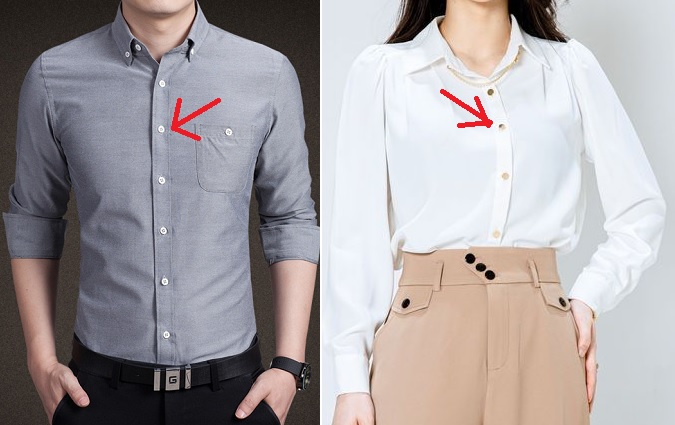
1. A Small Detail With a Surprisingly Long History
Buttons may seem like ordinary objects today, but they were not always the inexpensive, practical fasteners we know.
Decorative buttons appeared thousands of years ago. Some early examples, discovered at archaeological sites in the Indus Valley, date to approximately 2000 BCE. These objects were often used as ornaments rather than functional fasteners.
For centuries, clothing was commonly secured with ties, pins, brooches, belts, or other devices. Buttons eventually became increasingly useful as garment construction evolved, particularly when buttonholes allowed clothing to close securely.
By the Middle Ages, functional buttons were becoming more common in parts of Europe. Their use expanded over subsequent centuries, especially as tailoring techniques improved and fitted garments became fashionable.
Buttons offered practical advantages. They allowed sleeves to be tightened, coats to fit more closely, and garments to be opened without completely removing them.
However, the development of buttons did not immediately produce the standardized left-versus-right arrangement found in modern clothing.
For much of history, clothing varied according to region, occupation, wealth, and prevailing fashion. Garments were often made individually, and their construction depended on the preferences of the tailor and wearer.
The familiar convention gradually became associated with men's and women's clothing as European fashion developed more distinct styles for each sex.
This distinction became particularly noticeable in the clothing traditions of the eighteenth and nineteenth centuries, when wealthy men's coats and women's elaborate dresses were designed around different silhouettes and dressing practices.
The key point is that the convention was not created when buttons were invented. It emerged later, within particular clothing traditions.
And because the practice became embedded in tailoring and fashion, it continued long after the original circumstances that may have encouraged it had disappeared.
2. The Most Famous Explanation: Wealthy Women Had Servants to Dress Them
One of the most widely repeated explanations for the difference involves wealthy women and their servants.
Historically, affluent women in parts of Europe often wore elaborate garments that were difficult to put on without assistance. Dresses could involve multiple layers, tight bodices, corsets, petticoats, complicated fastenings, and other accessories.
Getting dressed could be a lengthy process.
Women from wealthy households sometimes relied on maids or personal attendants to help them dress, fasten garments, arrange their hair, and prepare for public appearances.
According to a popular theory, women's clothing developed with buttons on the left side because many dressers were right-handed. When standing in front of the woman, a right-handed attendant could find it easier to fasten buttons arranged on the wearer's left.
Men, by contrast, were more likely to dress themselves, so buttons on the right side were supposedly more convenient for a right-handed man.
It is an appealing explanation because it seems to fit the social conditions of the time.
It also provides a simple reason for a convention that otherwise appears arbitrary.
However, there is an important limitation: the theory is plausible, but it has not been conclusively established as the original reason for the convention.
There is no single piece of historical evidence demonstrating that clothing makers collectively decided to place women's buttons on the left specifically to accommodate servants.