
There are a handful of cases where bodies were burned in the Bible—but none of them set a moral precedent for cremation:
-
Achan and his family were stoned and then burned as part of God's judgment on Israel (Joshua 7:25). This was punishment, not normal burial practice.
-
The men of Jabesh-Gilead burned the mutilated bodies of Saul and his sons before burying the bones (1 Samuel 31:12-13). This was likely a practical measure to prevent further desecration by enemies, followed by proper burial.
-
Certain kings of Judah were burned with spices in their funerals—a mark of honor, not disgrace (2 Chronicles 16:14, 21:19).
These examples show that burning wasn't universally forbidden. Context matters.
The New Testament and Jesus' Burial
The New Testament offers no teaching on cremation. What it offers is the model of Jesus' burial: His body was wrapped in linen and placed in a tomb. This became the pattern Christians followed for centuries.
Paul uses burial as a metaphor for our union with Christ in death and resurrection:
"We were therefore buried with him through baptism into death in order that, just as Christ was raised from the dead through the glory of the Father, we too may live a new life." (Romans 6:4)
For Paul, burial symbolized something profound—a seed planted in the ground that will one day spring to life.
Why the Church Traditionally Preferred Burial
Given the biblical silence on cremation, why did the church oppose it for so long?
1. The Body as Sacred
Christianity inherited from Judaism a high view of the body. Unlike some Greek philosophies that saw the body as a prison for the soul, Christians believed the body was created by God, inhabited by the Spirit, and destined for resurrection.
As Paul wrote:
"Do you not know that your bodies are temples of the Holy Spirit, who is in you, whom you have received from God?" (1 Corinthians 6:19)
If the body was a temple in life, it deserved respect in death.
2. Distinction from Pagan Practices
Early Christians lived in a Roman world where cremation was common—but it was associated with pagan beliefs about the afterlife. By choosing burial, Christians made a counter-cultural statement about their hope in bodily resurrection.
3. Following Christ's Example
Jesus was buried. For centuries, that was enough. Christians sought to imitate their Lord even in death.
4. The Hope of Resurrection
Burial wasn't just about honoring the body. It was a tangible expression of hope. The body placed in the ground was like a seed waiting for spring—a powerful image of resurrection.
So Is Cremation a Sin?
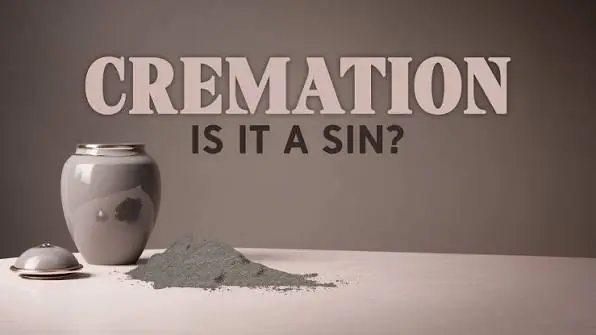
Most Christian theologians today would answer: no, cremation itself is not a sin.
The key distinction lies in why someone chooses cremation.
When Cremation Is Not a Sin
-
Practical reasons: Cost, lack of burial space, environmental concerns, or the wishes of the deceased
-
Cultural context: In some cultures, cremation is the norm and carries no anti-Christian symbolism
-
Simplicity and humility: A desire for a modest, unpretentious farewell
The Catholic Church, which historically opposed cremation, changed its teaching in 1963 and now permits it as long as it's not chosen for reasons contrary to Christian faith . The Orthodox Church remains more restrictive, but many Protestant denominations leave the decision to individual conscience .
When Cremation Might Be Problematic
-
Denial of resurrection: If cremation is chosen because someone believes the body is worthless and will never be raised
-
Anti-Christian statement: If chosen specifically to reject Christian teaching about the body
-
Disrespectful handling: Scattering ashes in undignified ways or keeping them in inappropriate places
The Church of England captures this well: "The Christian faith affirms the resurrection of the body and the life of the world to come. The manner of burial should express this faith. Cremation is not contrary to the Christian faith, but the ashes should be buried or interred in a cemetery or other appropriate place, not scattered or kept at home."
What Matters More Than the Method
Here's what every Christian tradition agrees on: how we treat the dead reflects what we believe about life, death, and resurrection.
Whether buried or cremated, the body deserves:
-
Dignity – As a creation of God
-
Respect – As the temple of the Holy Spirit
-
Hope – As a seed awaiting resurrection
The early church father Augustine wisely noted that God is powerful enough to raise any body, no matter how it perished—by fire, water, wild animals, or decay . For God, resurrection isn't a problem of logistics. It's a promise of power.
"And the sea gave up the dead that were in it, and death and Hades gave up the dead that were in them." (Revelation 20:13)
If God can raise bodies consumed by the sea or eaten by beasts, He can certainly raise bodies reduced to ash.
Practical Considerations for Families

If you're facing this decision for yourself or a loved one, here are some thoughtful questions to consider:
For Those Planning Ahead
-
Discuss your wishes with family so they're not guessing in grief
-
Consider a memorial service where the body or ashes are present, allowing for ritual and closure
-
Choose dignified placement for ashes—a columbarium, cemetery plot, or church garden—rather than scattering in undignified locations
-
Remember that your choice doesn't determine your salvation – Christ's work, not your burial method, secures your future
For Those Choosing for a Loved One
-
Honor their wishes if known, even if different from your preference
-
Don't let guilt drive the decision – God's grace covers this choice
-
Focus on worship, not worry – A funeral is for the living and for God's glory, not a test of orthodoxy
A Final Word
The Bible doesn't forbid cremation. It doesn't command a single method of burial. What it does is give us a vision of the body as sacred, destined for resurrection, and worthy of honor in death as in life.
For centuries, Christians expressed that honor through burial. Today, many express the same honor through cremation. The method may change, but the hope remains the same:
"For as in Adam all die, so in Christ all will be made alive." (1 Corinthians 15:22)
Whether buried in the earth or scattered as ash, we rest in that promise. And that promise is stronger than any fire.