At first glance, this looks like an incredibly simple question. Five sisters are together in a room, and four of them are already busy doing something. One is reading a book, another is cooking, the third is playing chess, and the fourth is doing laundry.
But there is one important detail that makes this little puzzle much more interesting than it initially appears.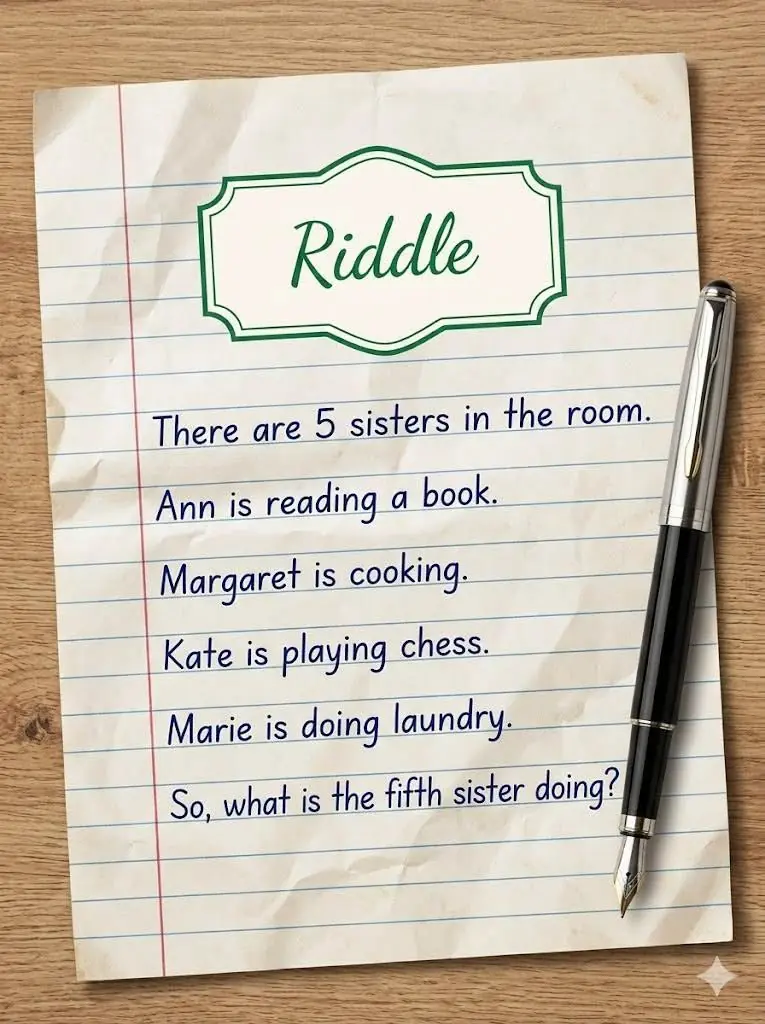
What is the fifth sister doing?
It sounds like an easy question, doesn't it? Yet many people overlook the most important clue hidden in the description. They begin imagining another activity, trying to come up with something that would make sense for the fifth sister to do.
Perhaps she is watching television. Maybe she is listening to music, cleaning the room, talking on the phone, or simply relaxing.
But what if the answer is already hiding in the information we have been given?
Let's take a closer look.
The Riddle That Makes You Think Twice
Imagine a room where five sisters are spending time together.
Each sister has her own activity, and everything seems perfectly ordinary.
Ann is sitting comfortably with a book in her hands. She is quietly reading, concentrating on the words and following the story.
Margaret is in the kitchen, preparing food. Perhaps she is making dinner for the family, cutting vegetables, stirring a pot, or preparing something delicious.
Kate is playing chess. She is looking carefully at the chessboard, thinking about her next move, and trying to develop a winning strategy.
Marie is doing laundry. She may be sorting clothes, washing garments, or folding freshly cleaned items.
Four sisters, four different activities.
But there are five sisters in the room.
That leaves one sister whose activity has not been directly mentioned.
So, what is she doing?
Before reading further, take a moment to think about the information provided. Do not rush to invent another activity. Sometimes, the simplest clues are the easiest to overlook.
The Hidden Clue Is in Kate's Activity
The most important sentence in the entire riddle is:
"Kate is playing chess."
Why is this detail so important?
Because chess is generally a two-player game.
Unlike reading a book, preparing food, or doing laundry, playing a traditional game of chess requires another person to participate.
A chessboard has two opposing sides. Each player controls sixteen pieces and takes turns making moves. One player controls the white pieces, while the other controls the black pieces.
The objective is to place the opponent's king in checkmate.
This means that if Kate is actively playing a normal game of chess, someone else must be playing against her.
And who could that person be?
The fifth sister!
She has not been given a separate activity because she is already involved in one of the activities mentioned in the riddle.
The fifth sister is playing chess with Kate.
That is the hidden answer.
Why So Many People Miss the Answer
This riddle is interesting because it takes advantage of a common thinking habit.
When people read a list of activities, they naturally assume that every person must be doing something completely different.
Ann reads.
Margaret cooks.
Kate plays chess.
Marie does laundry.
Therefore, the fifth sister must be doing something else.
This assumption feels logical, but it is not necessarily correct.
The riddle never says that all five sisters must be doing five different activities. It only tells us that there are five sisters in the room and describes what four of them are doing.
That distinction changes everything.
The missing person does not need a completely new activity. She can simply be participating in an activity that has already been mentioned.
This is a classic example of how assumptions can influence our reasoning.
Instead of carefully examining the details, our minds sometimes fill in missing information automatically.
We create possibilities that were never required by the question.
The trick is to stop, reconsider the wording, and look for an activity that logically involves more than one person.
Understanding the Logic Behind the Puzzle
Let's break the riddle down step by step.
First: Identify the people.
There are five sisters in the room:
-
Ann
-
Margaret
-
Kate
-
Marie
-
The unnamed fifth sister
Second: Identify their activities.
-
Ann is reading a book.
-
Margaret is cooking.
-
Kate is playing chess.
-
Marie is doing laundry.
Third: Examine the activities.
Reading can be done alone.
Cooking can be done alone.
Laundry can be done alone.
However, a traditional chess game normally requires two players.
Fourth: Connect the missing person to the activity.
Since Kate is playing chess, the most natural interpretation is that the fifth sister is her opponent.
Therefore, the fifth sister is playing chess with Kate.
The answer is simple once the hidden connection becomes clear.
A Small Riddle With a Bigger Lesson About Critical Thinking
Although this puzzle is designed to entertain, it also illustrates an important principle of critical thinking: the difference between what a question actually states and what we assume it means.