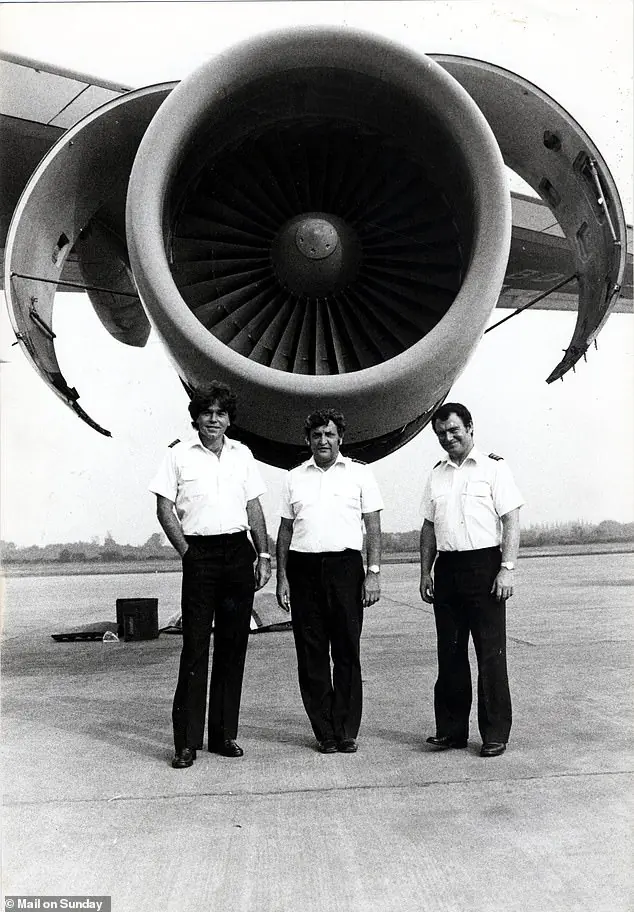
The lives of those 263 people — 248 passengers and 15 crew — would depend entirely on the skill and experience of Captain Moody, whose death in his sleep last month at the age of 84, reminds us of the events of that awful night. He had taken over the controls of BA Flight 009 for the Kuala Lumpur to
There, 57-year-old Betty Tootell and her mum Phyl had taken their seats in Economy at the back of the City Of , they were returning there following a trip to London.
Surely one of the most remarkable examples of a stiff upper lip in British aviation history (stock image)
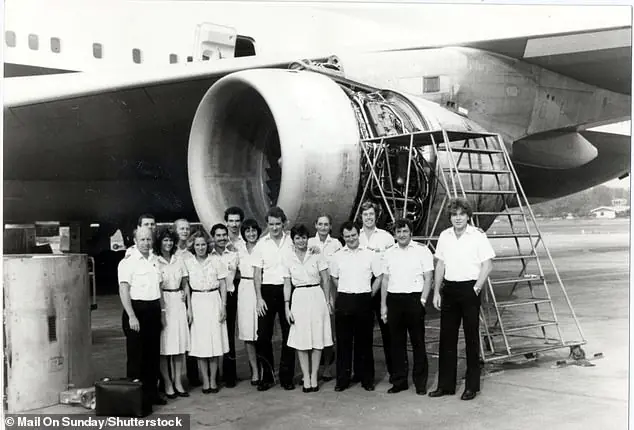
Most of the passengers had realised this was no regular flight. Pictured, the crew on the BA flight, Stephen Johns Roger Mcnichol Geoff Bell Graham Skinner Araf Chohan (hidden) Lorraine Stewart Clare Wickett Bernard Martin Susan Glennie Nicholas Gray Fiona Wright Sarah De Lane Lea (hidden) Barry Townley-freeman Richard Abrey Eric Moody And Roger Greaves
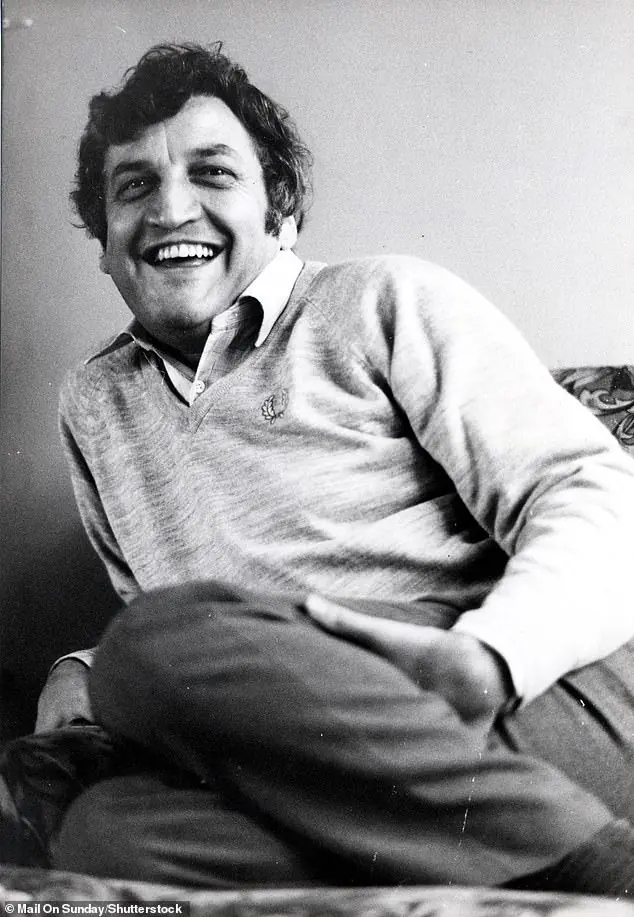
42-year-old Captain Moody (pictured) and his crew had no idea why their engines had failed
A few rows ahead of them was Charles Capewell, who was travelling with his two young sons, Chas, ten, and Stephen, seven. In a few hours, the family expected to be reunited with the boys' mother back at the family home in Perth. They were in good hands.
Captain Moody, who'd had his first taste of flying when he took gliding lessons at the age of 16, was one of the first pilots trained on the 747s.
An hour and a half into the flight and after finishing his meal, he took a lavatory break only to be summoned urgently back to the cockpit by first officer Roger Greaves and flight engineer Barry Townley-Freeman.
With the plane cruising at 37,000ft, they had been confronted with pinpricks of light bombarding the windscreen like tracer bullets.
At first they thought it might be St Elmo's Fire — a 'sparking' phenomenon caused by ionised air sometimes seen when planes fly through thunder-clouds — but the radar showed a clear sky.
Equally perplexing, given the radar reading, was that the plane appeared to be flying through banks of clouds. None of this made any sense.
TRENDING
Very quickly the strange visual effects on the windscreen turned into sheets of brilliant white light which extended to the wings, lending them an eerie glow. It was just the beginning of the nightmare.
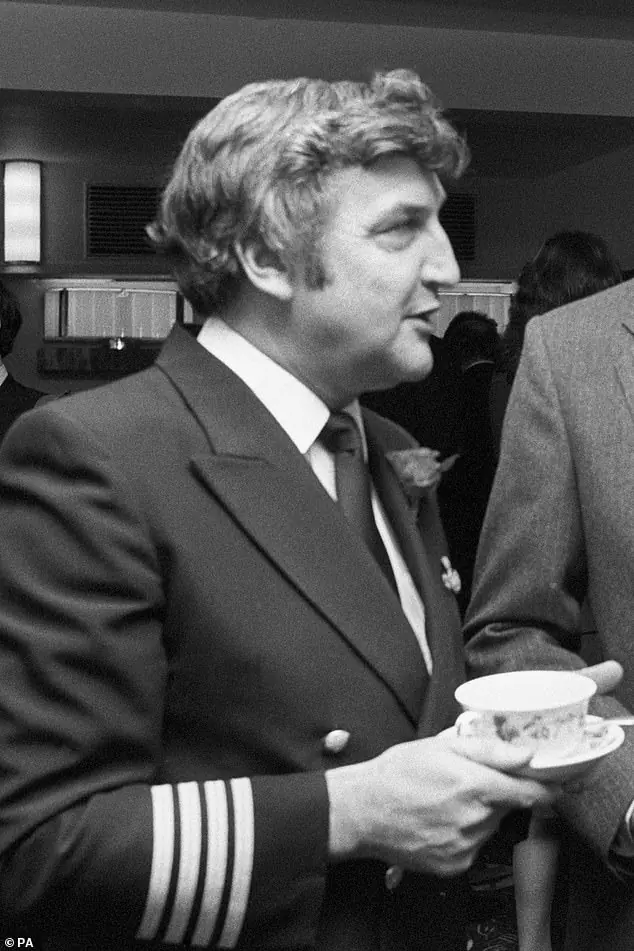
The lives of those 263 people — 248 passengers and 15 crew — would depend entirely on the skill and experience of Captain Moody
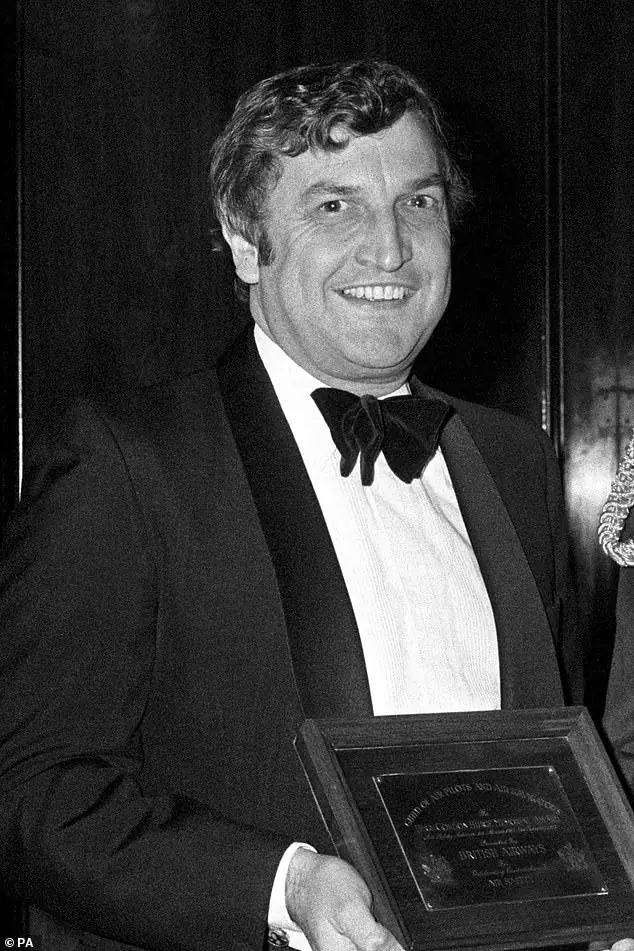
Captain Moody would have to land the plane manually, despite being unable to see through their front windows
At the back of the cabin, Betty Tootell had her reading of Jane Austen's Mansfield Park interrupted by what felt like a jolt of turbulence.
'I glanced over to the left wing and it was covered in a brilliant white shimmering light,' she said later in a TV documentary about the incident.
'I carried on reading but I found that I kept reading the same paragraph over and over again and not taking in a word of it. I just didn't know what was happening.'
To her alarm, Betty then saw smoke curling in through the ceiling vents as an acrid smell crept through the cabin.
In that era when passengers were allowed to light up on planes, the flight attendants mistook this for cigarette smoke but chief steward Graham Skinner realised that something was seriously wrong.
After checking the toilets in vain for smouldering cigarettes, Skinner's team began stowing away loose items in a bustle of efficiency, hoping to reassure passengers that they were on top of the situation.
'I didn't want them to get as upset as I felt,' recalled Skinner. 'I was saying: 'Nothing to worry about. It's just a little hiccup,' but it got really hot and the acrid smoke was at the back of your throat.'
Most of the passengers had now realised this was no regular flight.
Telling his young sons to close the blind on their porthole, Charles Capewell tried to affect an air of calm. 'As young as they were, they knew we were in bad, bad trouble and they looked at me as if to say: 'Well, what do we do now, Dad?'
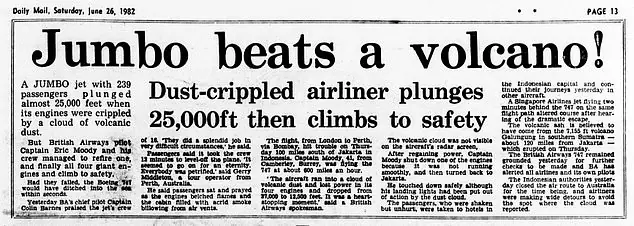
Betty then saw smoke curling in through the ceiling vents as an acrid smell crept through the cabin. Pictured, a Daily Mail report from 1982
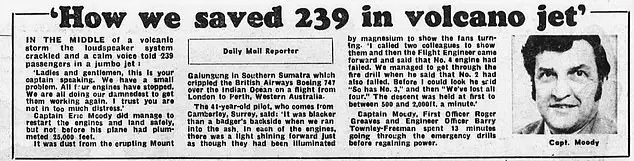
Engineers at Rolls-Royce later discovered that it had flown through a cloud of ash blasted into the air by the Mount Galunggung volcano