If you've ever stood on an escalator, you've probably noticed the strange rows of stiff brushes running along both sides of the steps.
At first glance, they look like they might be there to clean people's shoes.
After all, they're positioned exactly where a shoe might touch the side of the escalator, and their bristles appear to brush against anything that gets too close.
But that's not their main purpose.
Those brushes are actually part of an escalator safety system designed to encourage passengers to keep their feet, clothing, bags, and other objects away from the narrow gap between the moving steps and the stationary side panel.
They are often referred to as escalator skirt brushes, skirt guards, or skirt deflectors.
And their purpose is surprisingly clever.
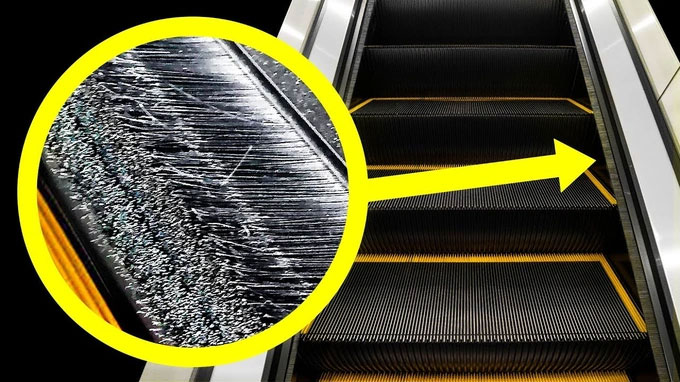
What Are Those Brushes Actually Doing?
An escalator has two very different surfaces moving alongside each other.
The steps move continuously.
The large panels on either side—the skirt panels—remain stationary.
That creates a potential hazard.
Where a moving step meets a stationary surface, there has to be a carefully controlled clearance. If a shoe, piece of clothing, shopping bag, or another object gets into that area, it can potentially become trapped.
The brushes provide a simple physical and psychological barrier.
Instead of allowing your foot to rest directly against the skirt panel, the bristles touch your shoe first.
That sensation gives you a subtle warning:
You're getting too close to the edge.
Most people instinctively move their foot away.
That's exactly what the designers want.
The Brushes Are Designed to Keep You Away From the Gap
Imagine standing on an escalator and moving your shoe toward the side.
Without the brush, your shoe could slide directly against the smooth skirt panel.
You might not pay much attention to how close you are to the edge.
The brush changes that.
As your shoe approaches the side, the bristles begin touching it.
The contact is noticeable.
Your brain interprets the sensation as a signal that your foot is too close to something.
You naturally move your foot inward, toward the center of the step.
That simple interaction can help keep footwear, clothing, and other belongings away from the potentially hazardous interface between the moving steps and stationary skirt.
The brush therefore works partly through physical deflection and partly through behavioral prompting.
Why Is the Side of an Escalator Potentially Dangerous?
To understand why the brushes matter, you first need to understand how an escalator is constructed.
The steps aren't simply moving up or down like a staircase.
They are connected into a continuous loop.
As the steps travel upward, they eventually disappear into the upper landing, travel underneath the escalator, and return to the bottom.
Along both sides are stationary panels.
These panels help enclose the moving mechanism and provide the side boundary of the escalator.
The steps and side panels must operate extremely close to one another while remaining separate.
That means the interface between them requires careful engineering.
Anything that gets into an inappropriate position can potentially create an entrapment hazard.
This is why passengers are repeatedly advised to keep their feet away from the sides.
The Brushes Don't Actually Stop the Escalator
One common misconception is that the brushes somehow detect a person's foot and automatically stop the escalator.
That's generally not what they are designed to do.
They are primarily a passive safety device.
There are no complicated electronics hidden inside every bristle.
Instead, the brushes create a physical boundary that encourages passengers to stay away from the side.
Think of them as a simple intervention that changes passenger behavior.
Rather than waiting for someone to place their shoe dangerously close to the gap, the brush makes that behavior uncomfortable before the shoe reaches the most hazardous area.
It's a remarkably simple solution.
They Are Sometimes Called "Skirt Brushes"
If you search for technical information about escalators, you may encounter several terms.
One common term is:
Skirt brush.
The "skirt" refers to the large stationary side panel alongside the escalator steps.
The brush is mounted along this skirt.
You may also see terms such as:
-
Skirt guard
-
Skirt deflector
-
Escalator side brush
-
Safety brush
-
Skirt panel brush