Few things can ruin the excitement of eating fresh berries faster than seeing something tiny and unexpected moving around in the water.
You place a handful of berries into a bowl, add water and salt, and wait a few minutes. Then, as you look more closely, you notice small white, thread-like or worm-like objects floating or moving in the water.
At first, it can be alarming.
Are they worms? Insect larvae? Something that was already inside the fruit? Does it mean the berries were contaminated? And most importantly, are the berries still safe to eat?
The answer isn't always as dramatic as social media videos make it seem.
Small organisms can sometimes be associated with fresh produce, particularly fruit that has been grown outdoors. Berries can occasionally harbor tiny insect larvae or other organisms that are difficult to see because of their size and because they may be located inside crevices, beneath the fruit surface, or around damaged areas.
However, a white object appearing in salt water isn't enough to identify exactly what it is.
Let's look at what may be happening and what you should actually do.
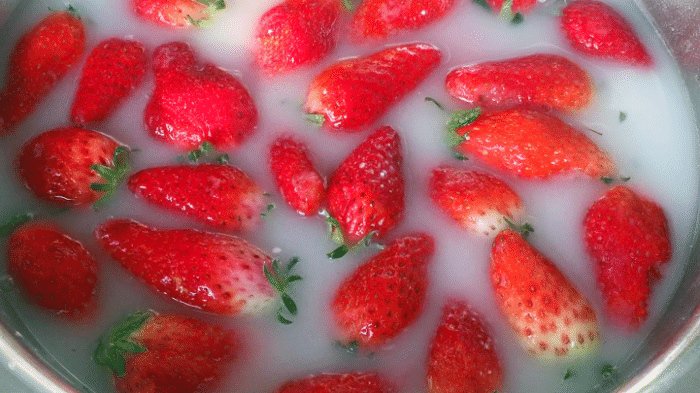
Why Would Anything Come Out of Berries?
Fresh berries grow outdoors, where they are exposed to insects, birds, soil, rain, wind, and other environmental factors.
Unlike processed foods, fresh fruit isn't produced in a completely sterile environment.
Certain insects lay eggs on or near fruit. Under suitable conditions, those eggs can hatch into very small larvae.
Depending on the type of fruit and insect, larvae may be extremely small and difficult to see when they're still inside or on the surface of the fruit.
This is one possible explanation when people notice tiny worm-like organisms after soaking berries.
But it's important to avoid assuming that every white object in a bowl of water is an insect larva.
It could also be:
-
A piece of fruit tissue
-
A plant fragment
-
A fiber
-
Residue from the fruit
-
An insect or larva
-
Another harmless organic particle
Appearance alone isn't enough for a reliable identification.
Why Does Salt Water Make Them Easier to Notice?
Salt-water soaking has become popular online as a way of revealing hidden organisms in fruit.
The basic idea is simple: placing fruit in water changes the environment around the fruit, and small organisms or loose debris may become more visible.
Salt also changes the concentration of dissolved substances in the water.
However, there's a lot of misinformation surrounding this practice.
A salt-water soak is not a scientifically guaranteed method for removing every insect, larva, microorganism, or contaminant from fruit.
If something appears after soaking, that doesn't automatically mean the salt "pulled worms out" of the berries.
It simply means something that wasn't obvious before became visible in the water.
Are These Actually "Worms"?
This is where things get interesting.
Many tiny organisms people call "worms" online are actually insect larvae.
Insects have several stages of development, and some larvae are small, pale, and elongated.
Certain fruit-associated insects can lay eggs on produce, and their larvae may feed on plant material.
Depending on the species, the larvae may be white, cream-colored, translucent, or pale yellow.
Without a clear photograph, magnification, or laboratory identification, however, it's impossible to say exactly which organism is present.
So if you see tiny moving white objects in your berry water, it's better to describe them as "worm-like organisms" or "possible larvae" rather than immediately declaring that they are a specific parasite.
Does This Mean the Entire Package Is Bad?
Not necessarily.
Fresh produce can occasionally contain individual damaged or infested pieces without every piece in the package being affected.
That's why inspection matters.
Look carefully at the berries and discard any that are:
-
Moldy
-
Rotten
-
Leaking
-
Severely damaged
-
Unusually soft
-
Developing an unpleasant odor
-
Obviously infested
If only a few berries appear questionable, removing them may be appropriate.
If a large proportion of the container appears damaged, moldy, or infested, discarding the entire package is the more cautious choice.
Should You Eat Berries After Finding Larvae?
If you've discovered visible larvae or other organisms in fresh berries, the safest approach is to discard visibly affected fruit rather than trying to salvage it.
For the remaining berries, wash them thoroughly under clean, running water before eating.
Do not rely on salt water as a substitute for normal produce washing.
And don't use soap, bleach, detergent, or household cleaning products on fruit.
These substances can leave harmful residues and aren't intended for washing food.
How Should Berries Actually Be Washed?
One of the simplest methods is also one of the most practical.
Step 1: Inspect the berries
Before washing, look for mold, damage, insects, or rotten fruit.
Step 2: Remove damaged berries
Discard berries that are visibly spoiled or contaminated.
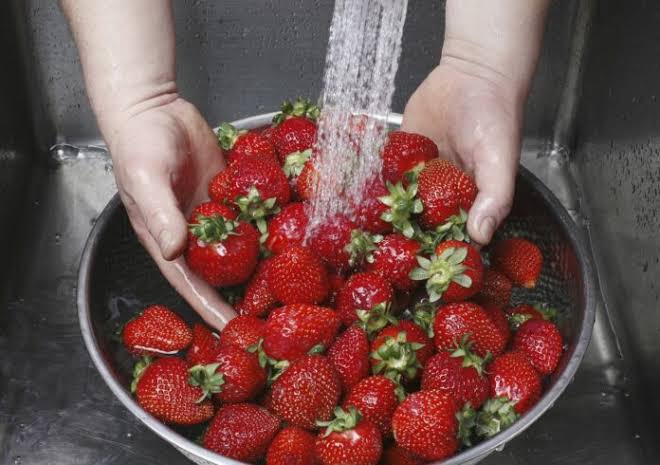
Step 3: Rinse under running water
Place the berries under clean, cool running water.
Gently move them around with your hands.
Step 4: Drain thoroughly
Allow excess water to drain away.
Step 5: Eat or store appropriately
For many berries, washing immediately before eating can help prevent excess moisture from encouraging spoilage during storage.
Always follow any specific storage instructions for the fruit you're buying.
Why You Shouldn't Wash Berries With Soap
This is worth emphasizing because some people become so concerned after seeing online videos that they start using household cleaners on fruit.
Don't do it.
Soap and detergents are formulated for cleaning surfaces, not for consumption.
Even if you rinse the berries afterward, residues may remain.
Clean running water is the standard simple approach for washing fresh produce.
What About Vinegar Soaks?
You'll also find recommendations online for soaking berries in vinegar and water.
Vinegar can help remove some surface contaminants, but it shouldn't be treated as a magic sterilizing solution.
It also won't guarantee that hidden larvae or other organisms have been eliminated.
If you're concerned about fresh produce, good food-handling practices are more important than relying on a particular viral cleaning trick.
Can You See Insects on Berries With the Naked Eye?
Sometimes.
But many organisms associated with fruit are extremely small.
A berry may look completely normal while containing microscopic or tiny biological material that isn't visible without close inspection.
That's one reason washing fresh produce is recommended even when it looks perfectly clean.
The purpose isn't necessarily to remove something dramatic.
It's simply a sensible food-safety habit.
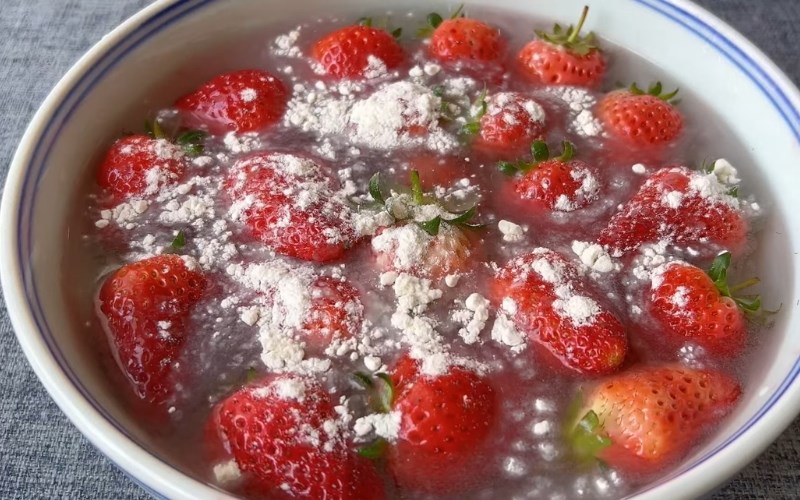
Does Salt Water Kill Everything?
No.
This is one of the biggest misconceptions surrounding viral berry-cleaning videos.
Salt water isn't a universal disinfectant.
It doesn't reliably eliminate all bacteria, viruses, parasites, or insect larvae.
Its effectiveness depends on the organism, salt concentration, exposure time, temperature, and many other factors.
So if you're soaking berries in salt water because you believe it makes them completely sterile, that's not a reliable assumption.
Clean running water and proper food handling remain important.
Why Fresh Berries Can Be More Delicate Than Other Fruits
Berries have a unique structure.
They're soft.
They're often eaten raw.
Many have small crevices or uneven surfaces.
And their delicate skin can be easily damaged.
That means they require somewhat more careful handling than hard-skinned fruits such as oranges or apples.
Once berries become damaged, microorganisms can also multiply more easily.
This is why refrigeration and proper storage are important.
What About Mold?
Mold is a separate issue from tiny larvae.
If one berry has visible mold, don't simply assume that rinsing it makes the problem disappear.
Soft fruits can have mold growth extending beyond what you can see.
When several berries in a package are moldy or spoiled, the safest option is generally to discard the affected fruit and, if contamination is extensive, consider discarding the package.
Never eat berries that smell fermented, rotten, or otherwise unusual.
Can Eating a Small Larva Make You Sick?
Accidentally consuming a tiny insect larva is generally not the same thing as being infected with a dangerous parasite.
This distinction is important because online posts sometimes use the word "parasite" to describe almost anything worm-like.
Many larvae found in produce are simply immature insects associated with plants.
That said, food can carry pathogens regardless of whether you see insects.
This is why proper produce washing and food handling remain important.
If you've accidentally eaten a berry that contained a tiny insect larva, don't panic.
For most healthy people, an isolated accidental ingestion is unlikely to result in a serious problem.
However, if you develop significant or persistent symptoms such as severe vomiting, diarrhea, difficulty breathing, or signs of an allergic reaction, seek medical advice.
What If the Berries Smell Fine and Look Fine?
That's a good sign, but it doesn't eliminate the need to wash them.
Fresh produce can carry microorganisms that don't change its appearance or smell.
That's why food-safety recommendations don't depend entirely on whether something looks clean.
The best habit is simple:
Inspect → discard damaged produce → rinse thoroughly → eat promptly or store properly.
Should You Throw Away the Entire Container?
There's no universal answer.
Consider the extent of the problem.
If you see one questionable berry
Remove and discard it, then inspect the remaining fruit carefully.
If several berries contain visible larvae or show damage
You may prefer to discard the package rather than trying to sort through it.
If there is widespread mold or obvious infestation
Discarding the entire container is the more cautious option.
If you're unsure
When in doubt about the safety or quality of perishable food, throwing it away is often the simplest choice.
A container of berries isn't worth risking your health over.
Why You Should Be Careful With Viral Food Videos
Social media has made unusual food discoveries incredibly shareable.
A video showing dozens of tiny white objects moving in a bowl of water can be shocking.
But viral content often leaves out important context.
A creator may identify an organism without scientific confirmation.
They may claim that every berry contains "worms."
They may suggest salt water is necessary to remove parasites.
Or they may imply that eating the fruit without soaking it will inevitably make you sick.
These claims can be exaggerated.
One person's observation isn't automatically a scientific conclusion.
The Difference Between an Insect Larva and a Human Parasite
This distinction is especially important.
A fruit-associated insect larva lives as part of an insect's life cycle.
A human parasite is an organism adapted to live in or on a human host.
They are not interchangeable terms.
Seeing a tiny larva associated with fruit does not automatically mean you have been exposed to a human parasite.
This is one reason it's better to identify what you're actually looking at before drawing conclusions.
How to Reduce the Chance of Finding Something Unpleasant
You can't eliminate every natural organism from fresh produce.
But you can reduce your risk of eating damaged or contaminated fruit by following a few simple habits.
Buy fresh-looking berries
Choose packages without obvious mold, crushed fruit, or leaking juice.
Check the bottom of the container
Problems often hide beneath the top layer.
Refrigerate appropriately
Keep berries refrigerated when appropriate and follow storage guidance.
Don't leave damaged fruit mixed with healthy fruit
One spoiled berry can encourage deterioration around it.
Wash before eating
Rinse under clean running water.
Don't store berries while excessively wet
Extra moisture can encourage mold growth.
What If You're Pregnant or Immunocompromised?
Food safety deserves extra attention during pregnancy and for people with weakened immune systems.
Certain foodborne infections can have more serious consequences in these groups.
If you're pregnant, immunocompromised, elderly, or caring for a young child, follow food-safety recommendations particularly carefully.
If you're uncertain about whether a particular food is safe, ask a healthcare professional.
The Bigger Lesson About Fresh Produce
Seeing something unexpected in your berries can be unpleasant, but it also reveals something important about fresh food.
Fruit comes from living plants.
It grows outdoors.
It interacts with insects and the environment.
It isn't manufactured in a sterile laboratory.
That doesn't make fresh produce unsafe.
It simply means that washing, inspection, refrigeration, and proper handling matter.
The occasional discovery of an insect or larva doesn't mean that fruit is inherently dangerous.
So, Should You Be Worried?
If you see tiny white, worm-like objects after soaking berries, don't panic.
They could potentially be insect larvae, but you can't reliably identify them from appearance alone.
The sensible response is to inspect the fruit carefully, discard visibly affected or spoiled berries, rinse the remaining fruit thoroughly under clean running water, and avoid using household cleaners or relying on salt water as a substitute for food-safety practices.
If the entire package appears heavily infested, moldy, or spoiled, throwing it away is the safest and simplest option.
And if you accidentally ate one before noticing anything unusual, there's generally no reason to panic.
Final Thoughts
Fresh berries are nutritious and can be an excellent part of a healthy diet. Their delicate nature, however, means they can occasionally harbor insects, larvae, microorganisms, or other environmental debris.
A salt-water soak may reveal something you hadn't noticed before, but what you see isn't automatically dangerous, and it doesn't automatically mean you've discovered a human parasite.
The best approach is much less dramatic than many viral videos suggest:
Inspect your fruit.
Remove anything visibly spoiled or suspicious.
Rinse berries thoroughly under clean running water.
Avoid soap, bleach, and other household cleaners.
Store fruit properly and eat it while fresh.
And remember that food safety is about consistent habits rather than one viral cleaning trick.
Sometimes the tiny white thing floating in your berry water is genuinely surprising.
But surprise doesn't have to become panic.
Take a closer look, use sensible food-safety practices, and when the quality of the entire package looks questionable, it's perfectly reasonable to let the berries go.