Imagine bringing home a fresh container of strawberries, blueberries, raspberries, or blackberries. The fruit looks beautiful, smells sweet, and seems perfectly safe to eat. You rinse it under running water, place it in a bowl, and prepare to enjoy a healthy snack.
Then someone suggests trying a salt-water soak.
You fill a bowl with water, add a little salt, and gently submerge the berries. At first, nothing seems unusual. The fruit floats or settles in the water, and everything looks just as it did before.
But after several minutes, you notice something moving.
Tiny, pale, worm-like creatures appear in the water. Some seem to emerge from the fruit itself, while others drift around the bowl. Suddenly, the berries that looked so fresh a few moments earlier seem much less appetizing.
The first question that comes to mind is obvious: Have I been eating insects without realizing it?
It is an understandable reaction. Most people expect fresh fruit to be clean, especially when it comes from a grocery store or a trusted market. Discovering tiny larvae in a bowl of berries can therefore feel disturbing.
However, the discovery does not automatically mean that the fruit was rotten, dangerously contaminated, or unsafe in every respect.
Some small insects naturally develop on or inside certain fruits. Their eggs or larvae may be difficult to see because they are tiny, pale, and sometimes hidden among the fruit's seeds or soft tissues.
Strawberries, raspberries, and blackberries can occasionally contain larvae of fruit-associated insects. One insect that has received particular attention is the spotted-wing drosophila, a small fruit fly whose larvae can develop inside ripening berries.
These larvae may be white or translucent and only a few millimeters long. Because they are so small, they can remain unnoticed until the fruit is examined closely or soaked.
Still, appearance alone cannot establish exactly what you found.
A pale, moving object could be an insect larva, but an observer would need a closer examination to identify the species reliably. Different fruits attract different insects, and not every white speck in soaking water is an animal.
The salt-water method has become popular because people believe it can reveal hidden larvae. Salt water may encourage some small organisms to move out of damaged or infested fruit, making them easier to notice.
But it is not a scientifically reliable test for every pest, and it does not prove that all berries contain larvae.
The important point is to understand what the discovery means, how to handle the fruit afterward, and how to reduce the chance of encountering unwanted insects in the future.
Before throwing away every berry in your refrigerator, there are several facts worth knowing.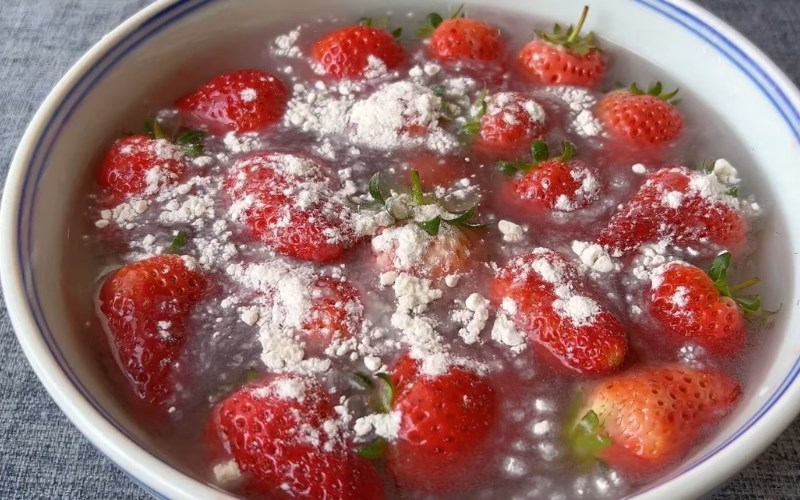
Chapter 2: Why Tiny White Larvae Can Appear in Berries
To understand why larvae sometimes appear in fruit, it helps to look at how certain insects reproduce.
Many fruit-associated insects lay eggs on or inside developing fruit. When the eggs hatch, the larvae feed on the fruit's tissues, where they may remain hidden until they mature or the fruit begins to deteriorate.
Unlike larger caterpillars or beetles, these larvae can be extremely small. Their pale bodies may blend into the soft flesh of a berry, making them difficult to notice during ordinary handling.
One example is the spotted-wing drosophila, scientifically known as Drosophila suzukii.
This small fruit fly is different from many common fruit flies because the female has a specialized egg-laying structure that allows her to place eggs inside ripening, relatively intact fruit.
The larvae can develop in several kinds of soft-skinned fruit, including strawberries, raspberries, blueberries, and blackberries, although susceptibility varies with the fruit and growing conditions.
After the eggs hatch, the larvae feed inside the fruit. In some cases, the damage is initially difficult to see from the outside.
A berry may still look reasonably attractive even though tiny larvae are present beneath its surface.
Other insects can also infest fruit before it reaches the consumer. The exact possibilities depend on the crop, the region where it was grown, seasonal conditions, and how the fruit was handled.
This is why it is not possible to identify a particular insect simply because a small white larva appears in salt water.
The fruit's appearance may offer clues. Softening, leaking juice, damaged skin, mold, or unusual discoloration can indicate deterioration or insect damage. However, the absence of those signs does not guarantee that the fruit is free of insects.
It is also important to distinguish insects from mold and other particles.
Mold may appear as fuzzy white growth, especially on damaged or overripe berries. Plant fibers, seeds, and fragments of fruit tissue can also become detached during soaking.
Unlike a living larva, these particles will not move independently, although water currents can make them appear to move.
If you see something that seems to wriggle, take a closer look without touching it directly. A clear container, good lighting, and a magnifying glass may help establish whether it is actually a small organism.
Even then, identifying the exact species may require an expert.
The presence of larvae can be unpleasant, but it is a known possibility in fresh agricultural produce. Fruit grows outdoors, where insects are part of the surrounding environment.