Chapter 1: What Are Those Small Bumps Appearing in Your Armpit?
Most people rarely pay attention to the skin beneath their arms unless something unusual happens.
One day, while showering or changing clothes, you might notice several tiny bumps along an armpit fold. At first, they may look like small pieces of loose skin. Some may be the same color as your skin, while others appear slightly darker.
You might also notice that the surrounding skin has become thicker, rougher, or more deeply folded.
These changes can cause concern, especially when several bumps appear together.
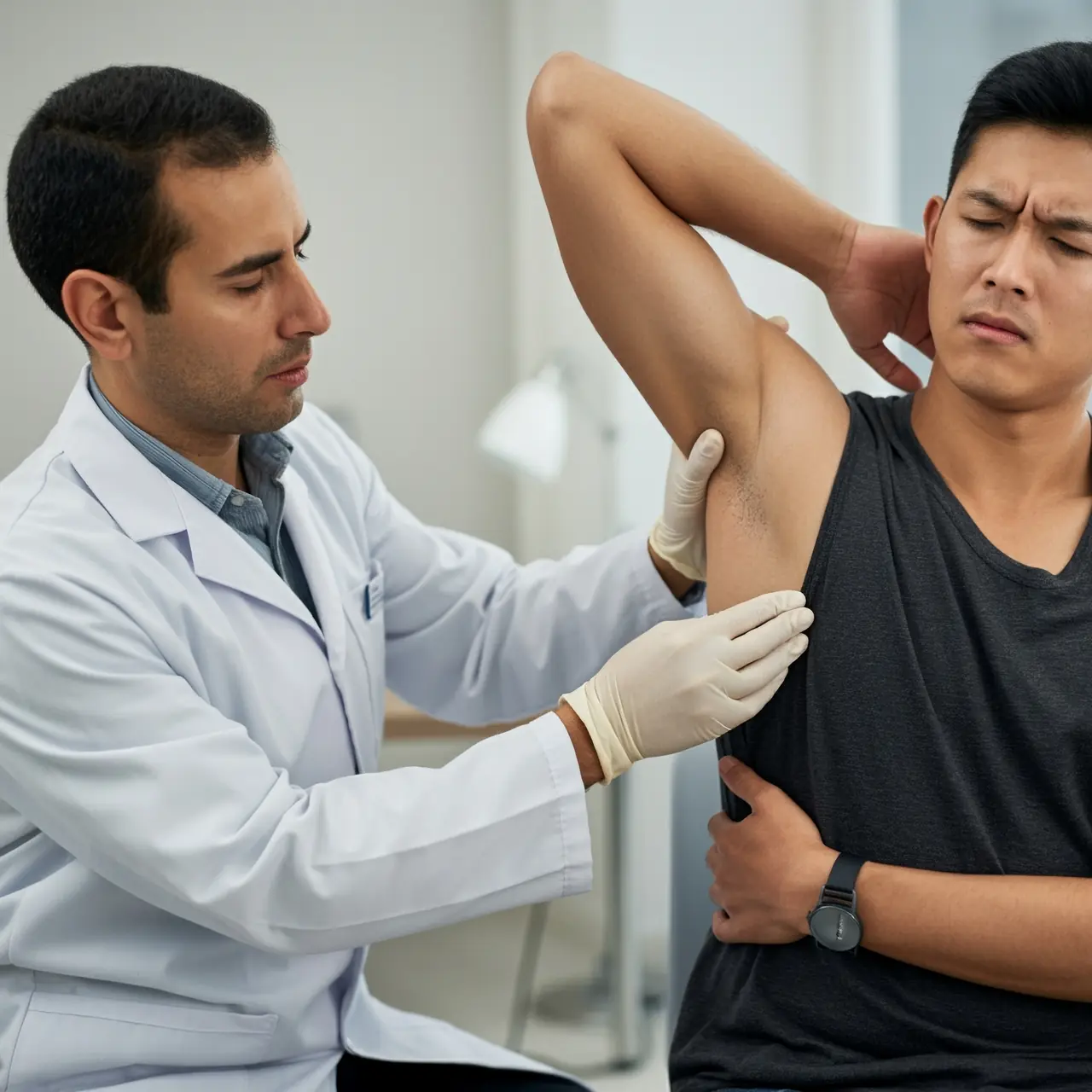
The photograph accompanying this article shows numerous small, raised growths concentrated around an armpit crease, alongside visible skin thickening and darker coloration.
There are several possible explanations for this appearance. One possibility is the presence of skin tags, while the thickened and darker skin may resemble a condition known as acanthosis nigricans.
However, photographs cannot confirm either diagnosis.
Understanding these conditions is a useful first step toward knowing when a skin change is harmless and when it deserves medical attention.
1. Skin Tags: Small Growths That Commonly Develop in Skin Folds
Skin tags, medically known as acrochordons, are small, soft growths that commonly appear in areas where skin rubs against skin or clothing.
The armpits are among their most frequent locations.
They can also develop around the neck, beneath the breasts, on the eyelids, and in the groin.
A typical skin tag may have the following characteristics:
-
Soft texture.
-
Flesh-colored or slightly darker appearance.
-
Smooth or wrinkled surface.
-
Small size.
-
A narrow attachment to the surrounding skin.
-
Little or no pain.
Some people develop only one or two skin tags, while others may have many.
They are generally benign and do not usually require treatment.
According to the American Academy of Dermatology, skin tags frequently develop in areas exposed to repeated friction, including the underarms and neck.
American Academy of Dermatology+1
2. Why Do Skin Tags Appear?
The exact reason why some people develop more skin tags than others is not always clear.
However, several factors are associated with their development.
Friction: Skin rubbing against skin can contribute to the formation of these small growths.
Age: Skin tags become increasingly common as people grow older.
Body weight: People with more skin folds may experience greater friction, increasing the likelihood of developing skin tags.
Pregnancy: Hormonal changes during pregnancy may contribute to their development.
Diabetes and metabolic conditions: Skin tags are more frequently observed in people with insulin resistance and certain metabolic conditions.
Having skin tags does not mean that someone necessarily has diabetes.
Nevertheless, numerous new skin tags, especially when accompanied by other skin changes, may be a reason to discuss metabolic health with a doctor.
3. Acanthosis Nigricans: When the Skin Becomes Darker and Thicker
Another possible explanation for the appearance shown in the photograph is acanthosis nigricans.
This is a skin condition characterized by areas that become darker, thicker, and sometimes velvety.
It most commonly affects skin folds, particularly:
-
The armpits.
-
The back of the neck.
-
The groin.
-
Areas beneath the breasts.
-
Certain folds around the body.
Unlike ordinary skin tags, acanthosis nigricans generally produces broader patches of altered skin rather than isolated hanging growths.
The affected area may gradually become more noticeable.
Some people also develop small skin tags within or around these darker patches.
The condition is not contagious, and the skin changes themselves are usually not harmful.
However, they can sometimes be an external sign of an underlying medical issue.
The NHS explains that acanthosis nigricans may be associated with obesity, type 2 diabetes, hormonal conditions, and certain medications.
NHS+1
4. Why These Two Conditions Can Appear Together
Skin tags and acanthosis nigricans are different conditions, but they can occur in the same person.
For example, someone with insulin resistance may develop darker, thicker skin in the armpits while also experiencing multiple skin tags.
This relationship is one reason doctors sometimes pay attention to unusual skin changes when evaluating metabolic health.
Insulin is a hormone that helps the body regulate blood glucose.
When the body's cells become less responsive to insulin, the pancreas may produce more of the hormone to compensate.
This condition is known as insulin resistance.
It is associated with an increased risk of developing type 2 diabetes.
However, skin tags and darker armpit skin cannot diagnose insulin resistance by themselves.
Blood tests and a broader medical assessment are needed.
5. Is Every Armpit Bump Dangerous?
Absolutely not.
Many armpit growths are harmless.
A typical skin tag is not considered a cancerous growth, and most people who develop several skin tags do not have a serious underlying disease.
Other harmless possibilities include certain benign moles, small cysts, and localized skin growths.
Nevertheless, an unfamiliar growth should be examined if it changes rapidly, bleeds, becomes painful, or develops an unusual appearance.
It is particularly important not to assume that every raised lesion is a skin tag.
Warts, moles, cysts, and other skin abnormalities can sometimes look similar.
A dermatologist can distinguish between them through a clinical examination and, when necessary, additional testing.
The most important message: Small bumps beneath the arms are common, but changes involving both the texture and color of the skin deserve attention, especially when they are new or increasing.
Chapter 2: Acanthosis Nigricans – The Skin Condition That May Be Connected to Insulin Resistance
One of the most important conditions to understand when discussing dark, thickened skin beneath the arms is acanthosis nigricans.
Many people initially mistake this condition for ordinary pigmentation caused by shaving, sweating, deodorant, or friction.
However, acanthosis nigricans is different from simple skin discoloration.
It involves changes in the skin's thickness and texture, often creating a darker, velvety appearance.
Although the condition is usually harmless in itself, it can sometimes provide clues about what is happening inside the body.
1. What Does Acanthosis Nigricans Look Like?
Acanthosis nigricans typically develops gradually.
At first, someone may notice that the skin beneath the arms looks slightly darker than the surrounding area.
Over time, the affected region may become more noticeable.
Common characteristics include:
-
Brown, grayish, or darkened patches.
-
Thickened skin.
-
A soft or velvety surface.
-
More visible skin folds.
-
Small skin tags in the affected area.
-
Occasional itching or an unusual odor.
The condition can also affect the neck, groin, elbows, knees, and other areas where skin folds occur.
One important distinction is that acanthosis nigricans generally affects a broader area rather than producing only individual small bumps.
A dermatologist can usually recognize its characteristic appearance during an examination.
2. The Connection Between Insulin Resistance and Skin Changes
One of the most common medical associations of acanthosis nigricans is insulin resistance.
To understand this relationship, it helps to know how insulin works.
After eating carbohydrates, the digestive system breaks them down into glucose.
Glucose enters the bloodstream and provides energy to the body's cells.
Insulin, a hormone produced by the pancreas, helps cells take up glucose from the blood.
However, in people with insulin resistance, cells respond less effectively to insulin.
The pancreas may compensate by producing additional amounts of the hormone.
This can lead to higher circulating insulin levels.
In some individuals, elevated insulin levels are associated with changes in skin-cell growth and the development of acanthosis nigricans.
This is why doctors may investigate blood glucose regulation when someone develops characteristic dark, thickened patches.