Have you ever looked down at your hands, arms, legs, or feet and noticed that your veins seem much more prominent than they used to be?
Perhaps the veins across the backs of your hands appear blue and raised. Maybe you can suddenly see a network of greenish lines beneath your skin, or the veins in your legs have become more noticeable after standing for a long time.
For some people, the change is gradual. For others, it seems to happen almost overnight.
Naturally, questions follow.
Is it normal to have visible veins? Could it be a sign of aging, dehydration, poor circulation, or an underlying medical condition?
The answer depends on several factors, and one important point should be understood from the beginning: visible veins are not automatically a sign of illness. In many cases, they are a normal feature of the body's anatomy.
Veins are blood vessels that carry blood back toward the heart. Unlike arteries, which carry blood away from the heart under relatively high pressure, veins operate at lower pressure and often contain valves that help blood move in the correct direction.
Many veins lie close to the surface of the skin. These are known as superficial veins, and they can become visible depending on the thickness of the skin, the amount of tissue beneath it, blood vessel size, and individual anatomy.
Some people naturally have more noticeable veins than others.
A person with thin or fair skin, for example, may see veins more clearly than someone whose veins lie deeper beneath thicker skin or more subcutaneous tissue.
Body composition also plays a role. People with relatively little fat beneath the skin may have more prominent veins, particularly on their hands, forearms, and legs.
Temperature can make a difference as well. When the body becomes warm, superficial blood vessels may widen to help release heat. This can make veins appear more noticeable temporarily.
Exercise can produce a similar effect. During physical activity, blood flow increases to working muscles, and veins may become more prominent. After the body cools down and circulation returns to its resting state, the appearance may change again.
Age is another factor. As people grow older, the skin gradually becomes thinner and loses some of its elasticity. The layer of fat beneath the skin may also decrease in certain areas, allowing underlying veins to show more clearly.
These changes can be entirely normal.
However, the appearance of veins can sometimes provide clues about circulation or other health concerns, particularly when the change is new or accompanied by pain, swelling, skin discoloration, or other symptoms.
The key is to look beyond the veins themselves.
Where are they located? Have they always been visible? Are they flat or raised? Do they appear on both sides of the body, or is one limb noticeably different from the other?
These details can help determine whether the appearance is likely to reflect normal anatomy or whether medical evaluation may be appropriate.
In the following chapters, we will explore the most common reasons veins become visible, the signs that deserve attention, and the practical steps you can take to support healthy circulation.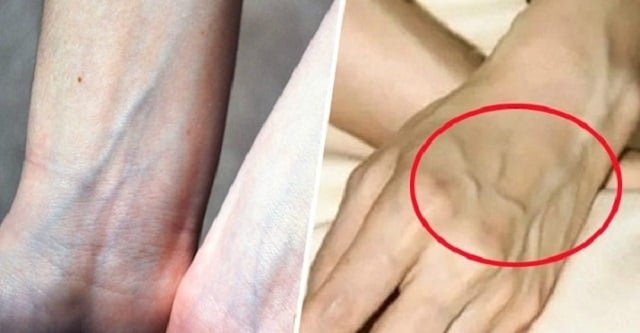
Chapter 2: Aging and Thinner Skin May Make Veins More Noticeable
One of the most common reasons veins become more visible is the natural aging process.
As the body ages, the skin undergoes gradual structural changes. Collagen and elastin, proteins that help maintain skin strength and elasticity, decline over time. The skin may become thinner, less firm, and more fragile.
The layer of fat beneath the skin can also change with age.
Because superficial veins sit relatively close to the skin's surface, these changes can make them easier to see, particularly on the hands, wrists, forearms, and feet.
You may notice that the veins on your hands look more prominent than they did ten or twenty years ago. The skin may appear thinner, and tendons, joints, and other underlying structures may also become more noticeable.
This does not necessarily mean that your circulation is deteriorating.
In many cases, the change simply reflects the way skin and underlying tissues evolve over time.
Sun exposure can contribute to skin aging, particularly on areas such as the hands and forearms that are frequently exposed outdoors. Over many years, ultraviolet radiation can damage the skin's supporting structures and make it appear thinner or more uneven.
Protecting exposed skin from excessive sunlight can help reduce additional skin damage, although it cannot reverse every change associated with aging.
Genetics also influence how prominently veins appear.
Some families naturally have thinner skin, less subcutaneous fat in certain areas, or vein patterns that are more visible. If your parents or other relatives have prominent hand veins, you may notice a similar pattern as you grow older.
There is no single appearance that defines healthy aging.
Some older adults have highly visible veins, while others do not. The difference can reflect genetics, body composition, skin characteristics, physical activity, and other individual factors.
It is also important to distinguish ordinary changes from sudden changes.
If the veins on both hands have gradually become more noticeable over several years without pain or swelling, the explanation may be relatively straightforward.
If one arm suddenly develops prominent veins accompanied by swelling, warmth, pain, or a change in skin color, the situation deserves more attention.
Similarly, a newly developed, painful, hard vein should not automatically be attributed to aging.
The most useful approach is to compare the current appearance with what is normal for your body.