For most people, shoes are among the simplest objects they use every day. They provide comfort, protect the feet, and make it possible to walk across different surfaces. But what if a pair of shoes could do something more?
That question is at the heart of the InnoMake Smart Shoe, an assistive-technology concept designed to help people detect obstacles while walking. By combining conventional footwear with sensors, electronics, wireless connectivity, and multiple warning systems, the technology turns an ordinary pair of shoes into an additional source of environmental information.
The concept is particularly relevant for people with visual impairments, for whom detecting obstacles ahead can sometimes be challenging. Rather than replacing established mobility tools, smart footwear is intended to provide another layer of information that can help the wearer recognize potential obstacles before reaching them.
It is a fascinating example of how technology can become integrated into everyday objects in ways that are subtle, practical, and potentially meaningful.

From Ordinary Footwear to Assistive Technology
Technology has already become deeply integrated into everyday life.
Smartphones can recognize faces and translate languages. Smartwatches can monitor activity and provide notifications. Cars can detect nearby vehicles and warn drivers about potential collisions.
The InnoMake project applies a similar philosophy to something much more basic: walking.
The idea is relatively straightforward.
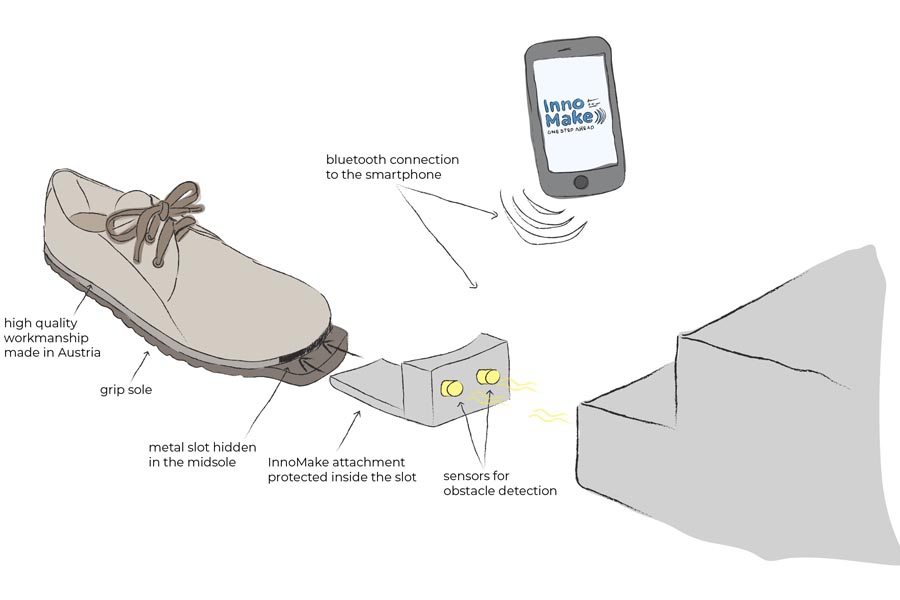
Sensors positioned toward the front of the footwear can scan the area ahead. When an obstacle is detected, the system processes the information and communicates a warning to the wearer.
Instead of requiring the user to constantly operate a separate electronic device, the technology travels naturally with the person.
Every step becomes part of the system.
Developed in Austria
The InnoMake Smart Shoe was developed by Austrian company Tec-Innovation, working in collaboration with Graz University of Technology.
The project was created with an important goal in mind: developing footwear that could help people with visual impairments identify obstacles in their walking path.
This is an example of assistive technology designed around a very practical problem.
When someone cannot rely fully on visual information, navigating unfamiliar environments can require additional sensory cues.
Traditional mobility aids remain extremely important, but researchers and engineers continue exploring ways technology can provide supplementary information.
InnoMake represents one approach to that challenge.
Ultrasonic Sensors Scan the Path Ahead
One of the most interesting components of the smart shoe is its ultrasonic sensing system.
Ultrasonic sensors work by emitting high-frequency sound waves and analyzing the returning signal. This can provide information about whether an object is located within a particular area in front of the sensor.
According to the system's specifications, the sensors can detect obstacles at distances of up to approximately four meters, depending on conditions.
That range is significant because it gives the wearer more time to react.
Instead of discovering an obstacle only when they are immediately next to it, the wearer can receive an alert while there is still some distance available to change direction or slow down.
What Kind of Obstacles Can Be Detected?
The technology isn't limited to one specific type of object.
Depending on the environment and the characteristics of the obstacle, the sensors can potentially detect objects such as:
-
Furniture
-
Bins
-
Steps or barriers
-
People
-
Other objects positioned along the walking path
The system is essentially looking for objects that occupy the area being monitored.
However, like any sensor-based technology, its effectiveness can depend on environmental conditions, object characteristics, positioning, and other technical factors.
It should therefore be understood as an assistive tool, rather than a device capable of recognizing every possible hazard.
The Information Is Processed Before the Warning Reaches the User
Detecting an object is only the first part of the process.
The shoe's electronic system must interpret the sensor information and determine when an alert should be provided.
This creates a basic chain:
Sense → Process → Warn.
The sensors gather information about the space ahead.
An electronic processing unit evaluates that information.
The system then provides feedback to the wearer.
That feedback can take different forms, allowing the user to receive information without necessarily needing to look at a screen.
Vibration Turns the Shoe Into a Physical Warning System
One of the simplest and most intuitive forms of feedback is vibration.
When an obstacle is detected, the footwear can provide a physical signal that the wearer can feel.
This approach has an obvious advantage.
The user doesn't necessarily need to look at a phone or listen for a spoken message to know that something has been detected.
The warning is delivered directly through the footwear.
For someone with visual impairment, this type of tactile information can potentially become another useful environmental cue.
The concept is similar to other wearable technologies that communicate information through touch rather than vision.
Audio Feedback Provides Another Layer of Information
The InnoMake system can also connect with a smartphone to provide acoustic feedback.
This gives users another method of receiving warnings.
Some people may find sounds easier to interpret than vibrations, while others may prefer tactile signals depending on the environment.
Having multiple feedback options is useful because accessibility technology works best when it can accommodate different users and situations.
A warning that is easy to notice in a quiet indoor environment might be less effective in a noisy street, for example.
Giving users alternatives can make the system more adaptable.
Bone-Conduction Headphones Help Keep the Ears Open
Another interesting aspect of the system is its compatibility with bone-conduction headphones.
Traditional headphones generally deliver sound through the ear canal and may reduce awareness of surrounding sounds, depending on their design and volume.
Bone-conduction technology works differently. It transmits vibrations through the bones of the skull, allowing the ears to remain more open to environmental sounds.
That distinction can matter when someone is walking outdoors.
A person may need to hear:
-
Traffic
-
Bicycle bells
-
Voices
-
Sirens
-
Warning signals
-
Other environmental sounds
For an assistive device intended to support navigation, maintaining awareness of the surrounding environment is especially important.
The technology therefore aims to provide additional information without requiring the wearer to become completely isolated from the sounds around them.
LED Lights Add Another Practical Feature
The smart shoes also incorporate LED lighting.
While the central purpose of the system is obstacle detection, lighting can provide additional visibility in darker environments.
This may be useful when walking in low-light conditions or around areas where being more visible is beneficial.
The LEDs therefore demonstrate another feature of the project: the footwear isn't limited to a single technological function.
Instead, several small technologies are combined into one wearable platform.
The Electronic Unit Can Be Detached
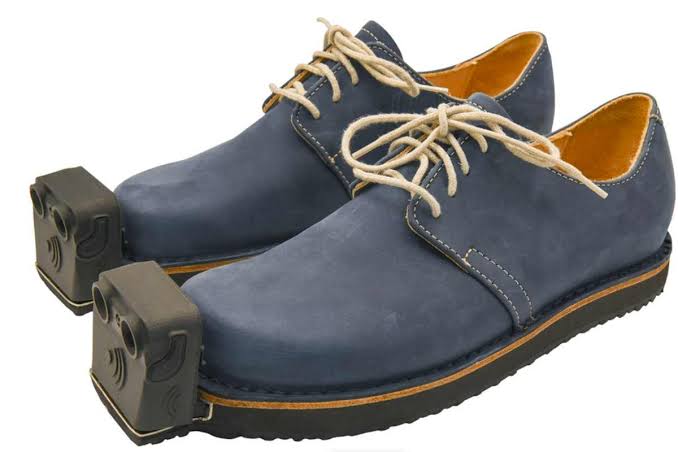
A particularly practical part of the design is the detachable electronics module.
Rather than permanently embedding every electronic component into the shoe, the system can be separated from the footwear.
This offers several potential advantages.
The user can manage the electronic components independently, while the shoes themselves remain conventional pieces of footwear.
It can also make maintenance, charging, or transferring the technology more convenient.
For wearable technology, practical considerations such as these can be just as important as the sensors themselves.
Designed to Look More Like Normal Footwear
Assistive technology doesn't necessarily have to look like medical equipment.
The InnoMake shoes were designed with everyday use in mind and use conventional footwear materials such as leather.
Their appearance is intended to remain relatively similar to normal shoes rather than making the technology itself the visual focus.
This can be an important consideration.
A device may be technologically impressive, but if it is uncomfortable, difficult to wear, or inconvenient to incorporate into everyday life, people may be less likely to use it consistently.
Comfort and practicality therefore matter just as much as technical capability.
Battery Life Makes Everyday Use More Practical
Another important consideration for wearable electronics is battery life.
According to the specifications described for the InnoMake system, the battery can last up to approximately one week on a charge, with a full recharge taking around three hours.
That means the device doesn't necessarily need to be connected to a charger every night.
Longer battery life can make wearable technology less burdensome because users can incorporate it into their routine without constantly thinking about charging.
Of course, actual battery performance can vary depending on usage and operating conditions.
The Goal Isn't to Replace a Cane or Guide Dog
It's important to understand the role of technology like this.
A smart shoe should not automatically be viewed as a replacement for established mobility tools such as a white cane or guide dog.
Instead, it can potentially function as an additional source of information.
A white cane, for example, provides direct physical feedback about surfaces and obstacles within its reach. A trained guide dog provides a completely different type of mobility assistance.
Smart footwear approaches the problem from another direction by using electronic sensing to provide advance warnings.
Different tools can therefore serve different purposes.
Why Detecting Obstacles Earlier Matters
Imagine walking toward an unfamiliar environment and discovering an obstacle only when you're already very close to it.
Your available reaction time is limited.
Now imagine receiving a warning several meters earlier.
You may have more time to:
Slow down.
Stop.
Change direction.
Move around the obstacle.
Prepare for what lies ahead.
This is one of the fundamental ideas behind obstacle-detection technology.
The objective isn't necessarily to tell the user exactly what to do.
Instead, it can provide additional information early enough for the person to make their own decision.
Smart Footwear Can Turn Walking Into an Interactive Experience
Traditional shoes are passive.
They don't perceive their surroundings or respond to changes in the environment.
Smart shoes introduce another possibility.
The footwear can sense, process, and communicate.
That means the relationship between a person and their shoes changes.
Instead of simply carrying the person from one place to another, the shoes become part of a larger wearable system that interacts with the environment.
This is an example of the broader concept of ambient or wearable computing, where technology becomes integrated into objects people already use rather than existing only as a separate gadget.
Why Wearable Assistive Technology Matters
Accessibility technology is often most effective when it fits naturally into everyday life.
A device that requires complicated controls or constant attention may become frustrating.
A system integrated into something a person already wears can potentially reduce that burden.
Shoes are particularly interesting because they are always involved in movement.
They are positioned close to the ground, move with the body, and naturally point in the direction the person is traveling.
That makes footwear an intriguing platform for technologies related to mobility and environmental awareness.
The Technology Also Highlights the Importance of Human Judgment
Despite its capabilities, sensor technology cannot eliminate the need for awareness and judgment.
Real-world environments are unpredictable.
Objects can move.
Surfaces can change.
People can suddenly step into a walking path.
Weather and environmental conditions can affect sensors.
Not every potential hazard will necessarily be detected.
For that reason, smart footwear should be viewed as an additional aid, not an infallible navigation system.
The human wearer remains an essential part of the process.
A Glimpse Into the Future of Assistive Devices
The InnoMake concept points toward a broader trend in technology.
Smart features are increasingly being incorporated into objects that previously had no electronic functions.
We already have:
-
Smart glasses
-
Smart watches
-
Connected clothing
-
Health-monitoring wearables
-
Sensor-equipped vehicles
-
Smart home appliances
Smart footwear fits naturally into this evolution.
Instead of carrying technology in a pocket, users may increasingly wear technology that interacts with the environment around them.
Could Future Shoes Become Even Smarter?
The possibilities are intriguing.
Future generations of smart footwear could potentially combine multiple types of sensors and technologies.
For example, advanced systems might eventually incorporate improvements in:
-
Object recognition
-
Terrain detection
-
Navigation
-
Location tracking
-
Fall detection
-
Personalized feedback
-
Smartphone integration
Artificial intelligence and computer vision could also play increasingly important roles in wearable accessibility technology.
But technological advancement should always be balanced with reliability, privacy, comfort, affordability, and ease of use.
A feature is only truly useful if people can trust it and comfortably incorporate it into their daily lives.
The Most Interesting Part May Be the Simplicity of the Idea
At its core, the concept isn't complicated.
A person is walking.
Something is in front of them.
A sensor detects it.
The system sends a warning.
The person has more information and can decide how to respond.
That simple sequence illustrates why assistive technology can be so powerful.
It doesn't necessarily need to transform the entire experience.
Sometimes, providing one additional piece of useful information at exactly the right moment can make a meaningful difference.
More Than Just a Pair of Shoes
The InnoMake Smart Shoe demonstrates how an ordinary object can be redesigned around a specific human need.
With ultrasonic sensors, vibration feedback, audio connectivity, bone-conduction compatibility, LED lighting, and a detachable electronic unit, the footwear combines several technologies into a compact wearable system.
Its primary focus is supporting people with visual impairments by providing additional awareness of obstacles ahead.
The concept also represents something larger.
It shows how the future of assistive technology may involve devices that don't necessarily look like traditional technology at all.
The next generation of helpful tools could be built into the things people already use every day.
A Small Innovation With a Bigger Idea Behind It
The most fascinating thing about smart footwear isn't simply that a shoe can detect an object.
It's the idea that technology can become almost invisible while still providing useful information.
A person doesn't necessarily need to carry another device in their hand.
They don't have to constantly stare at a screen.
They can simply walk.
Meanwhile, the sensors work quietly in the background, monitoring the path and providing alerts when appropriate.
For people who benefit from additional mobility support, that could represent a meaningful layer of assistance.
And for the wider world of wearable technology, it offers a glimpse of where innovation may be heading.
The smartphone may have started the era of technology we carry everywhere. Smart footwear suggests a future in which technology becomes something we wear—and perhaps something that quietly helps guide every step along the way.