There are few things more disappointing than cutting open a watermelon on a hot day only to discover that it is pale, dry, bland, or underripe.
From the outside, watermelons can look surprisingly similar. One may be incredibly sweet and juicy, while another sitting right next to it may taste watery or lack flavor.
So how can you tell which watermelon is worth taking home?
Fortunately, you don't have to cut open every melon at the store. While no external trick can guarantee sweetness with 100% accuracy, several visual and physical clues can help you make a better choice.
The key is to look at the combination of several signs, rather than relying on a single trick.
Here is what to look for the next time you're shopping for watermelon.
1. Look for a Large, Creamy-Yellow Field Spot
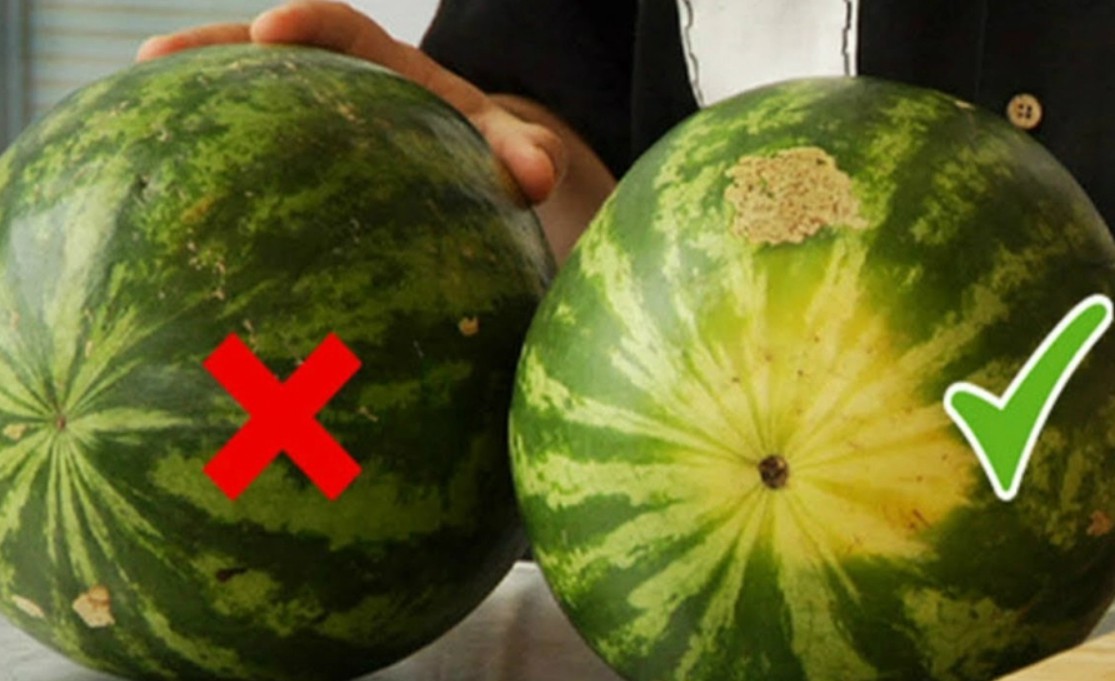
One of the most useful clues is the field spot.
This is the area where the watermelon rested against the ground while it was growing. Because that part of the fruit doesn't receive sunlight, it develops a different color from the rest of the rind.
A ripe watermelon often has a field spot that is:
-
Creamy yellow
-
Yellow-orange
-
Clearly visible
-
Relatively large
A very pale white or greenish field spot may indicate that the watermelon was harvested before it had fully matured.
This doesn't mean every watermelon with a white spot will be bad. Different varieties and growing conditions can produce different appearances.
But when comparing several similar melons, a well-developed creamy-yellow field spot can be a useful clue.
Why does the field spot matter?
Watermelons don't continue ripening in the same way some fruits do after harvest.
They generally need to develop much of their sweetness and desirable characteristics while still attached to the plant.
The field spot provides a visual clue about how long the fruit may have remained in contact with the ground during development.
2. Choose a Watermelon That Feels Heavy for Its Size
One of the simplest tests is also one of the most practical:
Pick it up.
A watermelon that feels surprisingly heavy for its size may contain a good amount of water, which is exactly what you want from a juicy watermelon.
Watermelons are mostly water, so a heavy fruit can be a useful indication of good hydration and density.
Instead of choosing the biggest watermelon automatically, compare fruits of similar size.
If two watermelons appear roughly the same size, pick them up one after another.
The one that feels heavier may be worth considering.
Of course, weight alone doesn't guarantee sweetness. A watermelon can be heavy and still lack flavor.
That's why this test works best when combined with other signs.
3. Look for a Strong, Well-Defined Pattern on the Rind
A healthy watermelon should generally have a firm, relatively symmetrical appearance.
Depending on the variety, the rind may have a distinctive pattern of:
-
Dark green areas
-
Lighter green stripes
-
Contrasting bands
-
A relatively matte surface
Color and pattern vary considerably among watermelon varieties, so you shouldn't reject a melon simply because it doesn't look like the classic striped watermelon.
However, when comparing similar varieties, a well-developed rind pattern can provide useful information about maturity.
The rind should also appear reasonably healthy rather than showing extensive bruising, cuts, or soft areas.
4. Don't Automatically Choose the Shiniest Watermelon
This is a common mistake.
A shiny watermelon may look attractive, but shine alone isn't a reliable indicator of sweetness.
In some cases, a mature watermelon may have a somewhat dull or matte appearance rather than an extremely glossy surface.
Again, this depends on the variety and growing conditions.
Instead of asking, “Which watermelon looks the prettiest?” look at the entire fruit.
A good watermelon should generally appear:
-
Firm
-
Intact
-
Free from major soft spots
-
Reasonably symmetrical
-
Appropriate in color for its variety
Appearance is most useful when several clues point in the same direction.
5. Check the Shape
A watermelon doesn't need to be perfectly round to be delicious.
Different varieties naturally have different shapes, including:
-
Round
-
Oval
-
Oblong
-
Long and cylindrical
What can be useful is looking for a fruit with a fairly uniform shape.
Large irregular bumps, pronounced indentations, or unusual deformities may sometimes reflect inconsistent growing conditions.
They don't automatically mean the watermelon is bad, but if you're choosing between otherwise similar fruits, a well-developed, symmetrical melon can be a reasonable choice.
6. Check the Stem if It's Visible
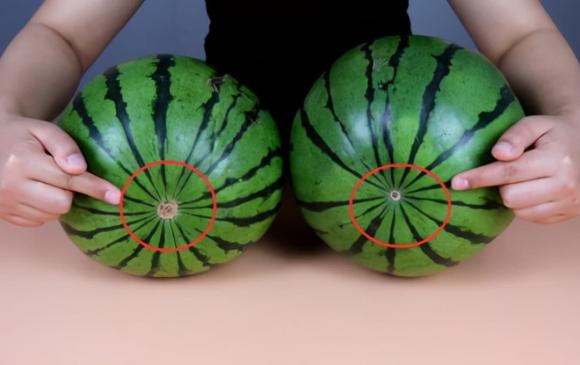
If the stem is still attached, take a look at it.
A stem that is brownish and dry can indicate that the watermelon had reached maturity when harvested.
A very green stem may indicate a more recently harvested fruit, although this isn't a definitive ripeness test.
It's important not to treat stem color as a guarantee.
Watermelons don't continue ripening dramatically after harvest in the way bananas or peaches do.
Therefore, the stem is just one clue among several.
7. What About the Famous “Hollow Sound” Test?
You've probably heard the advice to knock on a watermelon.
The idea is that a ripe, juicy watermelon should make a deep, hollow sound, while an underripe or overripe melon may sound different.
There is some logic behind the tradition because the internal structure and water content of the fruit can influence the sound.
However, this method isn't precise enough to guarantee sweetness.
Two watermelons can sound similar while tasting noticeably different.
The problem is that the sound depends on multiple factors, including:
-
Fruit size
-
Variety
-
Internal structure
-
Rind thickness
-
Maturity
-
Water content
So feel free to tap the watermelon—but don't make your decision based solely on the sound.
Use it as an additional clue.
8. Look at the Yellow Spot, Not Just the Overall Color
When people shop for watermelon, they often focus on the green rind.
But the ground spot may tell you more.
A watermelon that has a creamy or yellow-orange spot where it rested on the ground can be a more promising choice than one with a very white or barely visible spot.
If you're comparing multiple melons, look at the size and color of this area.
A larger, well-developed yellow field spot is often preferred by experienced watermelon buyers.
9. A Dry, Brownish Tendril Can Be Another Clue
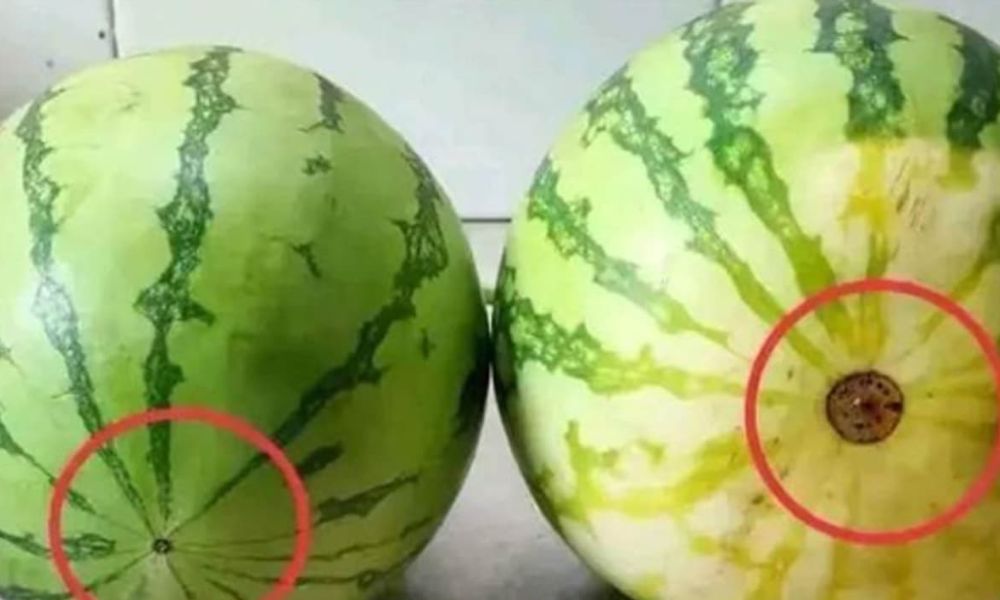
Some watermelons have a small curly tendril near the stem.
If you can see it, a dried or brown tendril can sometimes indicate that the fruit was allowed to mature on the vine.
A green tendril may indicate that the plant was still actively growing when the fruit was harvested.
However, this isn't always visible or reliable, especially with commercially harvested watermelons.
Treat it as a bonus clue rather than a rule.
10. Don't Choose a Watermelon With Major Soft Spots
This is less about sweetness and more about avoiding a poor-quality fruit.
Before buying, inspect the rind for:
-
Deep bruises
-
Cracks
-
Soft or sunken areas
-
Mold
-
Leaking juice
-
Damaged sections
A few superficial scratches may not matter.
But large soft areas can indicate physical damage or deterioration.
If the rind feels unusually soft when you press it, especially around a damaged area, choose another watermelon.
A good watermelon should generally feel firm and solid.
11. What About Thin Rinds?
A common goal is finding a watermelon with a thin rind because it means more edible flesh.
But this is where shoppers need to be careful.
You generally cannot reliably determine rind thickness simply by looking at the outside.
Different watermelon varieties naturally have different rind characteristics.
Some have thick protective rinds, while others have thinner ones.
The most important thing is not necessarily finding the thinnest rind.
Instead, focus on selecting a watermelon that is:
-
Mature
-
Heavy for its size
-
Firm
-
Free of significant damage
-
Well developed in appearance
If you are specifically buying a variety known for thin rind, then the variety itself is a more useful clue than trying to judge rind thickness from the outside.
12. Bigger Doesn't Always Mean Sweeter
It can be tempting to assume that the largest watermelon must be the best one.
Not necessarily.
A giant watermelon can be juicy but relatively bland, while a smaller fruit can have excellent flavor.
Instead of choosing based purely on size, compare:
Weight relative to size.
A watermelon that feels dense and heavy for its dimensions may be a more promising choice.
But again, size and weight don't directly measure sugar concentration.
They're simply useful shopping clues.
13. The Time of Harvest Matters
One of the reasons choosing watermelon can be difficult is that the fruit doesn't behave like climacteric fruits such as bananas.
Once harvested, watermelon generally doesn't continue to increase its sugar content substantially.
That means harvesting at an appropriate stage of maturity is extremely important.
A watermelon picked too early may never develop the sweetness you hoped for.
This is why external signs associated with maturity can be useful when selecting a whole melon.
It also explains why buying from a reputable grower or retailer can make a difference.
14. What If the Watermelon Is Already Cut?
Buying a pre-cut watermelon gives you a major advantage:
You can actually see the flesh.
Look for flesh that appears:
-
Richly colored for its variety
-
Firm
-
Moist
-
Relatively uniform
-
Free from excessive mushiness
Avoid pieces that appear dried out around the edges or have significant discoloration.
You should also pay attention to food safety.
Pre-cut fruit is more vulnerable to contamination than an intact watermelon because cutting introduces surfaces where microorganisms can potentially grow.
Keep cut watermelon refrigerated and follow food-safety recommendations for storage.
15. Seeds Can Tell You Less Than You Think
Traditional watermelons may contain black seeds, while modern seedless varieties contain small, soft, underdeveloped seed structures.
Seed color isn't a reliable indicator of sweetness.
Likewise, the presence or absence of seeds doesn't automatically tell you whether the watermelon is ripe.
Focus instead on maturity, condition, weight, and the overall quality of the fruit.
16. Don't Assume More Red Means More Sugar
A bright red interior can certainly look appealing.
But color and sweetness aren't exactly the same thing.
Different varieties naturally produce different flesh colors, and pigmentation depends on plant genetics and maturity.
A watermelon can have beautiful red flesh without being exceptionally sweet.
Conversely, a watermelon with slightly different coloration can still have excellent flavor.
The best approach is to consider flesh color together with texture and other quality indicators.
17. How to Store Your Watermelon After Buying It
Choosing a good watermelon is only half the process.
Proper storage can help preserve quality.
Whole watermelon
An intact watermelon can generally be stored at room temperature for a limited period if kept in a cool, dry place.
Refrigeration can help keep it cold and refreshing, particularly once it has been cut.
Cut watermelon
Once cut, watermelon should be refrigerated promptly.
Store pieces in a clean, covered container or wrap them appropriately.
Avoid leaving cut watermelon sitting at room temperature for extended periods.
And before cutting, wash the outside of the watermelon under running water and scrub the surface if needed.
Even though you don't eat the rind, cutting through an unwashed surface can transfer microorganisms from the outside to the flesh.
Common Watermelon-Picking Myths
Myth 1: A hollow sound guarantees a sweet watermelon.
Reality: Tapping can provide a clue about the fruit's internal characteristics, but it isn't a reliable sweetness test by itself.
Myth 2: The biggest watermelon is always the best.
Reality: Size doesn't guarantee sweetness or juiciness.
Myth 3: A shiny rind means the watermelon is fresh and sweet.
Reality: Surface appearance varies with variety and maturity. A glossy rind isn't a reliable sweetness indicator.
Myth 4: You can always see whether a watermelon has a thin rind.
Reality: Rind thickness varies by variety and isn't reliably determined from the outside.
Myth 5: A watermelon with a yellow field spot is guaranteed to be sweet.
Reality: A developed field spot can be a useful maturity clue, but no single external feature guarantees flavor.
The Best Strategy: Combine Several Signs
If you want the best chance of bringing home a sweet watermelon, don't rely on one trick.
Instead, look for several positive signs at the same time.
Your watermelon checklist:
✔ Heavy for its size
Suggests good water content and density.
✔ Creamy-yellow field spot
Can indicate that the fruit developed on the ground for an appropriate period.
✔ Firm rind
Avoid large soft or sunken areas.
✔ Healthy appearance
Look for minimal bruising, cracks, or signs of deterioration.
✔ Reasonably symmetrical shape
A uniform shape can be a useful quality clue.
✔ Dry stem or tendril when visible
May provide an additional maturity clue.
✔ Appropriate size for the variety
Don't assume bigger automatically means better.
✔ Pleasant, fresh appearance
The whole fruit should look and feel healthy.
The more of these characteristics a watermelon has, the more promising it may be—but remember that none provides a 100% guarantee.
One More Tip: Buy From a Good Source
Growing conditions, variety, harvest timing, and handling can all affect watermelon quality.
That means where you buy the fruit can matter almost as much as how you choose it.
A reputable produce market, grocery store, farmers' market, or local grower with good turnover may provide better-quality fruit than produce that has been sitting for an extended period under poor storage conditions.
When watermelons are in season locally, you may also have more options to choose from.
The Bottom Line
Finding a sweet, juicy watermelon doesn't require a complicated trick.
Start by looking for a watermelon that feels heavy for its size, has a well-developed creamy-yellow field spot, feels firm, and shows no major bruising or soft areas.
A dry stem or tendril and a well-developed appearance can provide additional clues.
You can also tap the watermelon if you like, but don't treat the famous “hollow sound” test as a guarantee of sweetness.
And don't worry too much about finding a watermelon with the absolute thinnest rind. Rind thickness varies naturally between varieties and is difficult to judge reliably from the outside.
The most effective approach is simple:
Don't look for one magical sign. Look for several good signs together.
With a little practice, you'll become much better at judging which watermelon is worth taking home—and your chances of cutting into a sweet, refreshing, juicy melon will be considerably better.