Martha Reiskind, a molecular ecologist at North Carolina State University, said that with modern genetic sequencing technology and a scientific understanding of evolution, making short-term predictions is “a piece of cake,” Live Science reported. For example, we can predict that if humans suddenly went extinct tomorrow, climate change would continue to push many species toward drought-resilience to survive. Cold-climate species would also continue to struggle, but sadly, with global warming, polar bears and penguins are unlikely to thrive for millennia after humans are gone.
Convergent Evolution
The biggest problem with the concept of convergent evolution is that it’s not a problem, according to geologist Dougal Dixon, a geologist, science writer and author of a fantasy book about animals of the future. It is an evolutionary process in which two unrelated organisms eventually develop similar characteristics to adapt to a particular environment or fill a particular ecological niche.
According to research from the University of Manchester, to fulfill the same ecological role as humans, another species would need to develop a similar capacity to manipulate objects. In other words, they would need hands with opposable, flexible thumbs.
Other primates, such as chimpanzees and bonobos - our closest living relatives - also have opposable thumbs that they use to create tools in the wild. So if humans were to become extinct, these primates would likely replace us. It would probably take hundreds of thousands or even millions of years of evolution for other apes to develop the ability to create and use sophisticated tools like humans.
But any disaster powerful enough to wipe out humans is likely to wipe out primates as well. This situation brings up another potential tool-using candidate to fill the human void: birds.
When the dinosaurs went extinct 66 million years ago, mammals stepped up to fill many of the ecological niches that were left vacant. If humans were gone, birds could take over our role as the smartest and most dexterous land animals.
Birds are incredibly intelligent, according to a study published in the journal Science in 2020. Crows, for example, are on par with chimpanzees. And some birds can use their dexterous feet and beaks to bend a wire into a hook to grab food, according to a 2002 study. Meanwhile, trained African grey parrots can learn up to 100 words and do simple math, understanding the concept of zero.
Birds can also gather in large flocks, even building large communal nests like the Philetairus socialus.
But there are many other groups of animals that are extremely adept at manipulating objects with their limbs.
Other Potential Candidates
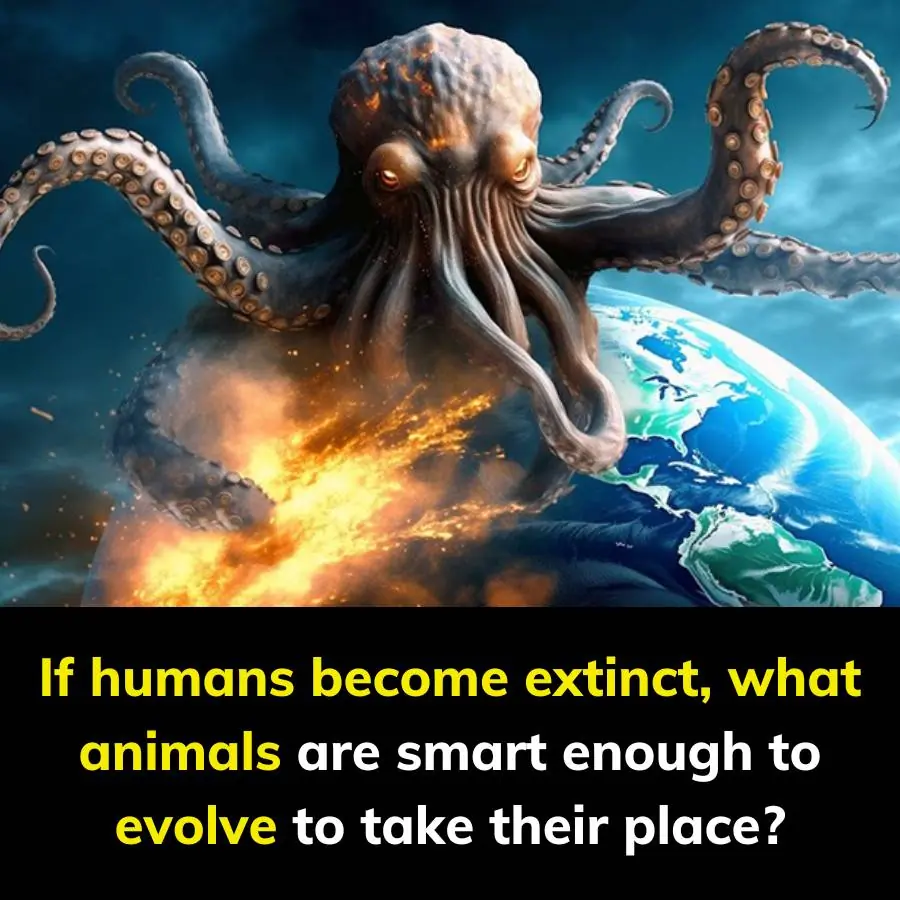
“The intelligence that governs your behavior is a result of your environment,” says Jennifer Mather, a researcher on cephalopod intelligence at the University of Lethbridge in Alberta, Canada. In this respect, octopuses are perhaps the most intelligent non-human animals on Earth. They can learn to distinguish between real and virtual objects and can even arrange their surroundings by removing unwanted algae from their nests and barricading their entrances with shells, according to a study in the journal Communicative and Integrative Biology. They have even been known to live in communities.
However, octopuses or any other cephalopod would have a hard time adapting to life on land, so they are unlikely to replace humans.
Mather turned to social insects, like ants and termites.
Insects are incredibly adaptable to a wide variety of environments. They’ve been on Earth for about 480 million years. During that time, they’ve evolved to fill almost every possible niche, from flying to burrowing and swimming, to even building complex city-like structures. The organization of ant and termite colonies is probably more similar to that of human civilization than any other non-human species on Earth.
Ants are known to cultivate fungi, according to a 2017 study published in the journal Proceedings of the Royal Society B. They can also communicate between colony members, according to another 2021 study. If humans were to go extinct, it’s possible that these insect colonies could dominate the world, assuming they survive climate change.
Of course, all of this is speculation. It’s virtually impossible to predict how evolution will actually play out over geological timescales. There are many factors at play, including random mutations, sudden extinction events, and population bottlenecks, in which one species pulls itself back from the brink but loses much of its genetic diversity.
And it’s even harder to predict whether another species will develop human-level intelligence or build cities. Mather thinks that could happen under evolutionary selection pressure over millions of years.
Dixon is less optimistic, saying: “I don’t think nature makes the same mistake twice.”