Do You Sleep Like This? Your Position May Reveal Something About You
Have you ever wondered why you always fall asleep in almost exactly the same position? Perhaps you curl tightly onto your side, stretch your arms and legs across the bed, lie flat on your back like a soldier, or hug your pillow as if it were the most comfortable place in the world. You may even wake up in a completely different position from the one you remember choosing.
For years, popular articles and personality quizzes have suggested that the way we sleep reveals hidden parts of who we are. Some claim that people who curl up tightly are sensitive and protective of their emotions. Others say that people who stretch out across the mattress are confident, independent or even a little lazy. A person who hugs a pillow, meanwhile, is sometimes described as affectionate, while someone who sleeps face-down is said to have a strong personality.
It is an appealing idea. After all, sleep is one of the few moments when we stop consciously managing our expressions, conversations and behavior. Could the position we naturally adopt at night reveal something we rarely show during the day?
The truth is more interesting than a simple personality test. There are traditional theories that attach character traits to different sleeping positions, and researchers have explored whether any connection exists. But scientific evidence does not support using a sleeping posture to decide whether someone is lazy, confident, shy, emotional or trustworthy.
What sleep position can reveal more reliably is how your body responds to comfort, pressure, breathing and physical support. The position you prefer may be influenced by your shoulders, hips, back, mattress, age and even certain health conditions. And because most people move during the night, the position in which they fall asleep may not be the position in which they spend most of their sleep.
So before deciding what your favorite sleeping posture says about your personality, it is worth looking at all eight positions in the illustration—and understanding what science can, and cannot, tell us about them.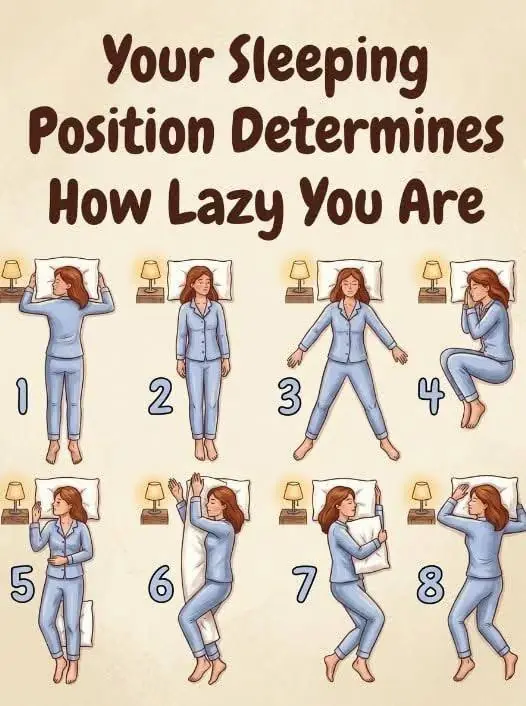
1. The Fetal Position: Curling Up Into a Comfortable Ball
The first sleeping position in the illustration is one of the most familiar: lying on the side with the knees drawn toward the chest and the arms resting close to the body. It is commonly called the fetal position because it resembles the curled posture of a baby before birth.
People who sleep this way are sometimes described in popular personality theories as sensitive, cautious or protective of their emotions. Some versions suggest that they may appear confident during the day but prefer comfort and reassurance when they are resting. Others associate the position with people who value close relationships and familiar surroundings.
These descriptions can sound surprisingly personal, especially when someone recognizes their own habits in them. But they should be understood as folklore and entertainment, not psychological conclusions. There is no reliable scientific test that can determine a person's emotional sensitivity or confidence from the way their knees are positioned at night.
There are more practical reasons why someone may curl up. Bending the knees can feel comfortable for the hips and lower back. The position may reduce the sensation of pressure in certain areas, particularly when the mattress and pillow provide suitable support. Some people naturally adopt it because it resembles a posture they used as children.
The fetal position also has several variations. One person may curl tightly, bringing the knees almost to the chest. Another may bend the legs only slightly while keeping the spine relatively straight. Someone else may hug a pillow, while another keeps both arms close to the face.
These differences matter because the label alone does not describe the full posture. A tightly curled position may feel restrictive for some people, especially if it causes stiffness in the hips or knees. A gentler version may be more comfortable.
For people who sleep on their sides, a useful goal is to keep the head, neck and spine in a reasonably neutral line. A pillow should support the space between the shoulder and the head without forcing the neck upward or allowing it to drop too far. A small pillow between the knees may help some sleepers keep their hips more comfortable.
The Mayo Clinic recommends drawing the knees slightly toward the chest and placing a pillow between the legs for people who sleep on their sides and experience back discomfort. This can help support the alignment of the spine, pelvis and hips.
So if you recognize yourself in the first drawing, the most meaningful question is not whether you are secretly shy or emotional. It is whether the position allows you to wake up feeling rested rather than stiff.
2. The Straight Position: Sleeping With Your Arms Close to Your Body
The second illustration shows a person lying relatively straight, with the legs close together and the arms resting near the sides. This resembles what popular sleep-position guides often call the soldier position, especially when the sleeper lies flat on the back with the arms close to the body.
In personality folklore, the soldier position is associated with people who are disciplined, quiet, organized and serious about their responsibilities. Some descriptions suggest that these sleepers prefer order and may hold themselves to high standards.
It is easy to see why the comparison became popular. The posture resembles a person standing at attention, which naturally brings to mind ideas of discipline and control. But that resemblance is not evidence that the sleeper is more organized or more responsible than someone who sleeps in a different position.
A person may sleep straight because it feels comfortable, because the mattress supports the body evenly or because they simply developed the habit over time. Another person may choose the same posture because turning onto their side causes discomfort.