There is something strangely fascinating about a can of SPAM.
It is small. It is rectangular. It has a simple blue-and-yellow label that has remained recognizable for generations. And inside that can is a block of processed meat that has become one of the most recognizable canned foods in the world.
For some people, SPAM is nostalgic comfort food. For others, it is an emergency pantry staple. Some people fry it until the edges become crisp and golden, while others add it to rice, noodles, sandwiches, breakfast dishes, or even sushi.
But despite its global popularity, one question keeps coming up:
What exactly is SPAM, and what ingredients are actually used to make it?
The answer is surprisingly straightforward.
SPAM is a canned, cooked pork product made primarily from pork and ham, along with water, salt, potato starch, sugar, and sodium nitrite in the classic formulation.
That may sound simple, but the story behind those ingredients—and the process used to turn them into the familiar rectangular loaf—is much more interesting.
The Story Begins With a Can
Before looking at the ingredients, it helps to understand what SPAM actually is.
SPAM is not a particular type of animal or a mysterious meat. It is a brand of canned cooked pork, originally created by Hormel Foods in the United States.
The product was introduced in 1937, during a period when canned foods were becoming increasingly important in American kitchens.
At the time, refrigeration was not as widespread or convenient as it is today. Fresh meat could be expensive, difficult to store, and prone to spoilage.
Canning offered a solution.
Food could be cooked, sealed inside a container, and protected from contamination. Properly processed canned foods could then remain shelf-stable for long periods without requiring refrigeration.
SPAM was designed to take advantage of that technology.
Instead of selling fresh pork that needed to be consumed quickly, the manufacturer created a compact, ready-to-eat meat product that could be stored for months or longer under appropriate conditions.
And the timing turned out to be important.
SPAM would eventually become much more than a convenient American canned meat.
It would become a global cultural phenomenon.
So, What Is Actually Inside a Can of SPAM?
The classic SPAM formulation is surprisingly short.
The primary ingredients are:
-
Pork
-
Ham
-
Water
-
Salt
-
Potato starch
-
Sugar
-
Sodium nitrite
The exact formulation and ingredient labeling can vary depending on the specific SPAM product and the market where it is sold.
But the basic idea remains consistent:
Take pork and ham, combine them with seasoning and functional ingredients, form the mixture into a loaf, seal it inside a can, and cook it under controlled conditions.
There is no need for an enormous list of exotic ingredients.
In fact, the simplicity of the ingredient list is part of what makes SPAM so interesting.
The unusual part is not necessarily what goes into the can.
It is what happens to those ingredients before the can reaches your kitchen.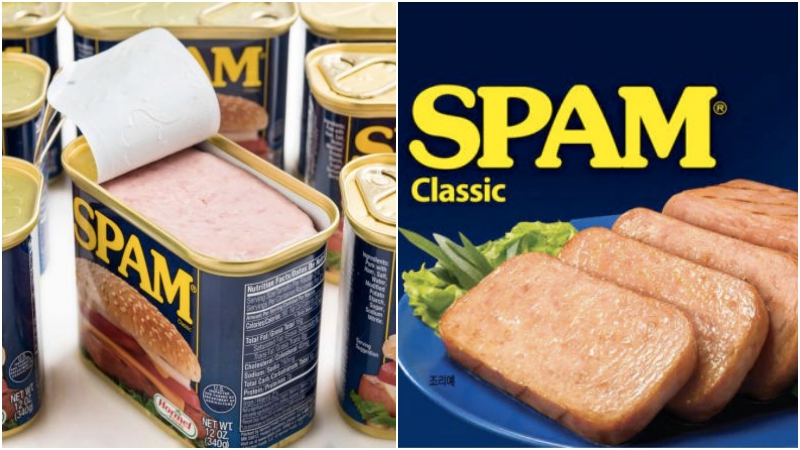
1. Pork: The Main Ingredient
At the heart of SPAM is pork.
Pork provides most of the meat, flavor, fat, and protein that give the product its characteristic texture.
Unlike a steak or a pork chop, however, the pork used in SPAM is processed before it becomes the final loaf.
The meat is cut and prepared before being combined with the other ingredients.
This allows the manufacturer to create a consistent mixture.
Every can needs to have approximately the same texture, flavor, moisture level, and appearance.
That consistency is one of the defining characteristics of processed foods.
When you cook a pork chop at home, its texture can vary depending on the cut, thickness, temperature, and cooking time.
With a manufactured product such as SPAM, the goal is very different.
The manufacturer wants the same basic experience every time you open a can.
2. Ham: Adding Flavor and Character
The second major meat ingredient is ham.
Ham is itself pork, of course, but its inclusion is important because it contributes to the distinctive flavor profile associated with SPAM.
The combination of pork and ham creates a richer meat flavor than using a single meat component alone.
It also contributes to the product's characteristic dense texture.
When the mixture is processed correctly, the meat becomes cohesive rather than falling apart like ordinary cooked ground pork.
That is why a slice of SPAM can hold its shape so well.
You can cut it into thin pieces.
You can fry it.
You can cube it.
You can grill it.
You can even cut it into small strips and mix it into rice or noodles.
The product behaves more like a firm meat loaf than loose ground meat.
3. Water: More Important Than It Sounds
Water might seem like an unimportant ingredient.
But in processed meat production, water plays an important role.
It helps create the desired consistency and contributes to the final texture of the product.
During processing, meat proteins interact with water and other components.
The goal is to create a stable mixture that can be formed into the familiar rectangular shape.
Water also affects how the product behaves during cooking.
Too little moisture could produce a dry or overly dense product.
Too much could negatively affect texture and stability.
So even a basic ingredient like water needs to be carefully controlled.
4. Salt: Flavor and Preservation
Salt is one of the most recognizable ingredients in processed meat.
It provides flavor, but its role goes beyond taste.
Salt can also influence the behavior of meat proteins during processing and contribute to the preservation characteristics of the product.
This is particularly important for a shelf-stable canned meat.
Historically, salt has been one of humanity's oldest methods of preserving meat.
Long before refrigerators and modern canning technology, people used salt to slow spoilage and extend the usable life of meat.
Modern processed foods use much more sophisticated preservation and processing systems, but salt remains an important part of the equation.
And if you've ever tasted SPAM straight from the can, you probably already know one thing:
It is salty.