Sometimes the most interesting household ideas come from combining two ingredients that people already have at home. Lemon and charcoal may seem like an unusual pair, but both have been used for different purposes for generations. Lemons are commonly associated with cleaning, freshening, cooking, and removing certain stains, while charcoal has become widely known for its ability to absorb odors and its use in filtration and other practical applications. When these two ingredients are brought together, they create an interesting mixture that has attracted attention among people looking for simple, inexpensive household solutions.
The idea is easy to understand. Lemon contains citric acid, which can help loosen certain mineral deposits and contribute to the removal of some types of residue. It also has a fresh scent that many people associate with cleanliness. Charcoal, particularly activated charcoal, has a porous structure that allows it to adsorb certain substances onto its surface. This is one reason activated charcoal is used in specialized filtration and odor-control applications.
However, combining lemon and charcoal does not automatically create a powerful cleaning product. The effectiveness of the mixture depends on the type of charcoal, the surface being treated, the concentration of lemon juice, and the specific problem someone is trying to solve. Understanding these differences is important before trying the mixture around the home.
Rather than treating the combination as a miracle solution, it is more useful to think of it as an interesting household experiment involving two ingredients with different properties. With the right expectations and a little caution, exploring their potential uses can help people better understand inexpensive home-care methods and the science behind everyday cleaning.
Chapter 2: Why Lemon Has Been Used in Household Cleaning
Lemon has been used in kitchens and households for a long time, partly because it is easy to obtain and has a recognizable fresh aroma. The juice contains citric acid, a naturally occurring organic acid that can help dissolve some mineral deposits and loosen certain types of residue. This makes lemon useful in some situations involving hard-water marks, mineral buildup, and other deposits that respond to acidic substances.
The acidity of lemon juice is one of its most important characteristics. Certain alkaline mineral deposits can react with acids, making them easier to remove from surfaces. For example, small amounts of mineral residue around some kitchen fixtures may respond to acidic cleaners, although commercially formulated cleaning products are often more predictable and effective.
Lemon juice also contains water and various natural compounds that contribute to its smell and flavor. The citrus aroma can make a cleaning task feel more pleasant, especially when compared with some products that have strong chemical odors. This is one reason lemon is frequently associated with homemade cleaning recipes.
Nevertheless, lemon juice is not suitable for every surface. Its acidity can damage materials such as marble, limestone, travertine, and other acid-sensitive stone. It may also affect certain metals, finishes, coatings, and delicate materials. A substance that works well on one surface may cause discoloration or damage on another.
The fact that lemon is natural does not mean it is harmless in every situation. Its usefulness comes from its chemical properties, and those same properties can create problems when it is used incorrectly.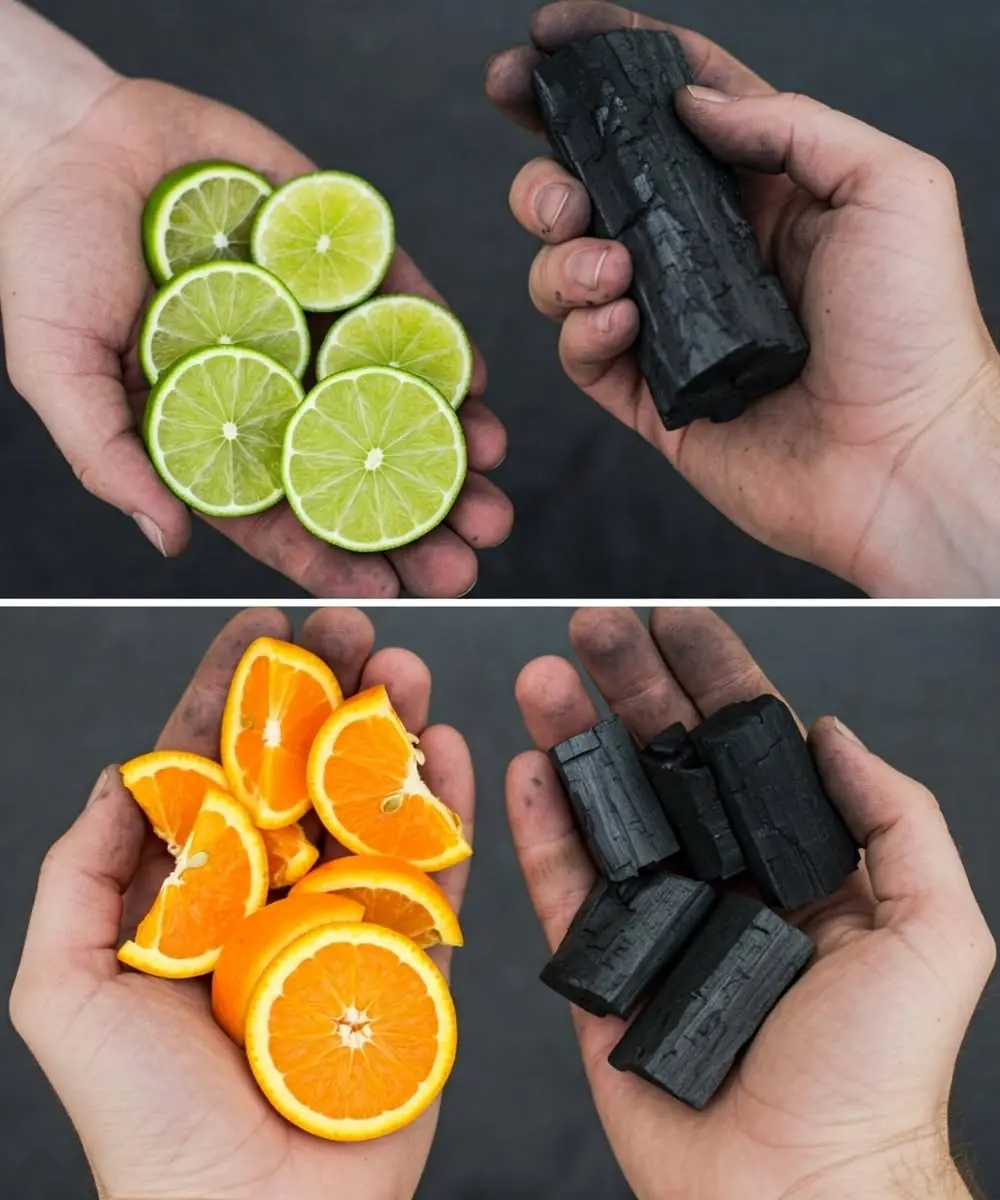
Chapter 3: What Makes Charcoal Different From Ordinary Black Powder?
Charcoal is produced by heating organic material, usually wood or other plant matter, under conditions that limit oxygen. The process leaves behind a carbon-rich material that can have a porous structure. The properties of charcoal vary considerably depending on how it is produced and what material is used.
Ordinary charcoal is commonly used for cooking and heating. Activated charcoal, on the other hand, undergoes additional processing designed to create a much larger internal surface area and increase its ability to adsorb certain substances. Adsorption is different from absorption. Absorption generally involves a substance entering another material, while adsorption involves molecules attaching to the surface of a material.
The extensive surface area of activated charcoal is responsible for many of its specialized uses. It can adsorb certain molecules under appropriate conditions, which is why it is used in some filters and odor-control products. However, its ability to adsorb substances depends on many factors, including the type of substance, the charcoal's properties, moisture, temperature, and the surrounding environment.
Not all charcoal has the same properties. A piece of barbecue charcoal cannot automatically be treated as equivalent to activated charcoal used in filtration. Some commercial charcoal products may also contain additives, binders, ignition chemicals, or other ingredients that make them unsuitable for household experiments.