Water breaks into droplets, changes direction around rocks, creates foam, and reflects surrounding light. A camera freezes one moment in that movement, producing a still image that may look different from what a person remembers seeing with their eyes.
The shutter speed plays a role. A fast shutter can freeze individual droplets and create sharply defined patterns. A slower shutter can blur moving water into a smooth, flowing texture.
Neither result is necessarily a faithful representation of how the scene appeared to the people standing there. Each is a photographic interpretation shaped by exposure settings.
If the friends used a phone camera, automatic processing may also have affected the final image. Modern phones can combine several exposures, adjust brightness, reduce noise, and sharpen details. These processes improve many photographs, but they can sometimes make distant or low-contrast shapes look unusual.
Reflections Can Create Objects That Seem to Be Somewhere Else
Water is reflective, and a natural pool may contain reflections of trees, cliffs, sky, and nearby objects.
Depending on the angle of the camera, reflections can overlap with the real background. A dark branch reflected in the water may appear to be part of the rocks. A bright patch of sky can merge with white spray. Ripples can distort the reflection of a stationary object.
A person looking at the photograph may interpret the combined pattern as a single object.
This is particularly likely when the image is small or compressed. The eye tries to organize the available details into recognizable forms, even when the original scene is more complicated.
The figure in the waterfall photograph may be a person, but reflections and overlapping visual elements are also possibilities that would need to be considered.
The Psychology Behind Seeing a Person in an Unclear Image
One of the most interesting parts of this story is that the mysterious shape does not need to be clearly visible to attract attention. In fact, its uncertainty may be exactly what makes it so compelling.
The human brain is highly skilled at recognizing patterns. This ability helps people identify faces, bodies, animals, and objects quickly, even when they are partly hidden or viewed from unusual angles.
But pattern recognition can sometimes lead to mistakes.
When a person sees an unclear shape, the brain may interpret it as something familiar. A dark patch can look like a face. A cluster of branches can resemble a person standing upright. A shadow beside a rock can appear to have shoulders and a head.
This tendency is commonly called pareidolia.
It does not mean that someone is foolish or careless. It is a normal feature of human perception. People are constantly trying to make sense of incomplete visual information.
Why the Red Circle Changes What Viewers See
The red circle in the shared photograph plays an important role.
Without the circle, many viewers might focus on the two women in the pool and the waterfall behind them. The small shape near the rocks could easily be overlooked.
Once the circle is added, however, the audience is told exactly where to look. The eye moves toward the highlighted area, and the viewer begins searching for a recognizable figure.
That instruction can influence perception.
Someone who is told that a person is standing behind the waterfall may begin to see a head, shoulders, and legs in a collection of pale and dark patches. Another viewer, given no explanation, might see only rocks and mist.
This does not prove that the figure is imaginary. It simply means the image should be examined without assuming the conclusion in advance.
A useful test would be to show the original photograph to several people without the red circle or the accompanying caption. Ask each person to describe what they see before revealing the suggested interpretation. If people identify completely different shapes, that would be a reason to remain cautious.
The Power of Expectation
Expectation can strongly influence how people interpret an ambiguous photograph.
Imagine seeing a picture of a forest after being told that someone was hiding among the trees. You may begin looking for a face or body. If you are told the same forest contains an unusual rock formation, you may interpret the very same shapes differently.
The information provided before viewing the image changes what the brain pays attention to.
This is why sensational captions can be so effective. A headline suggesting that a camera captured something frightening encourages viewers to approach the image with suspicion. Ordinary shadows may seem unusual, and small background details may take on a much greater significance.
The caption does not necessarily change the photograph, but it changes the experience of looking at it.
The waterfall image is a good example. The words surrounding it invite the audience to believe that the women were not alone. Once that idea is introduced, the pale shape becomes the center of attention.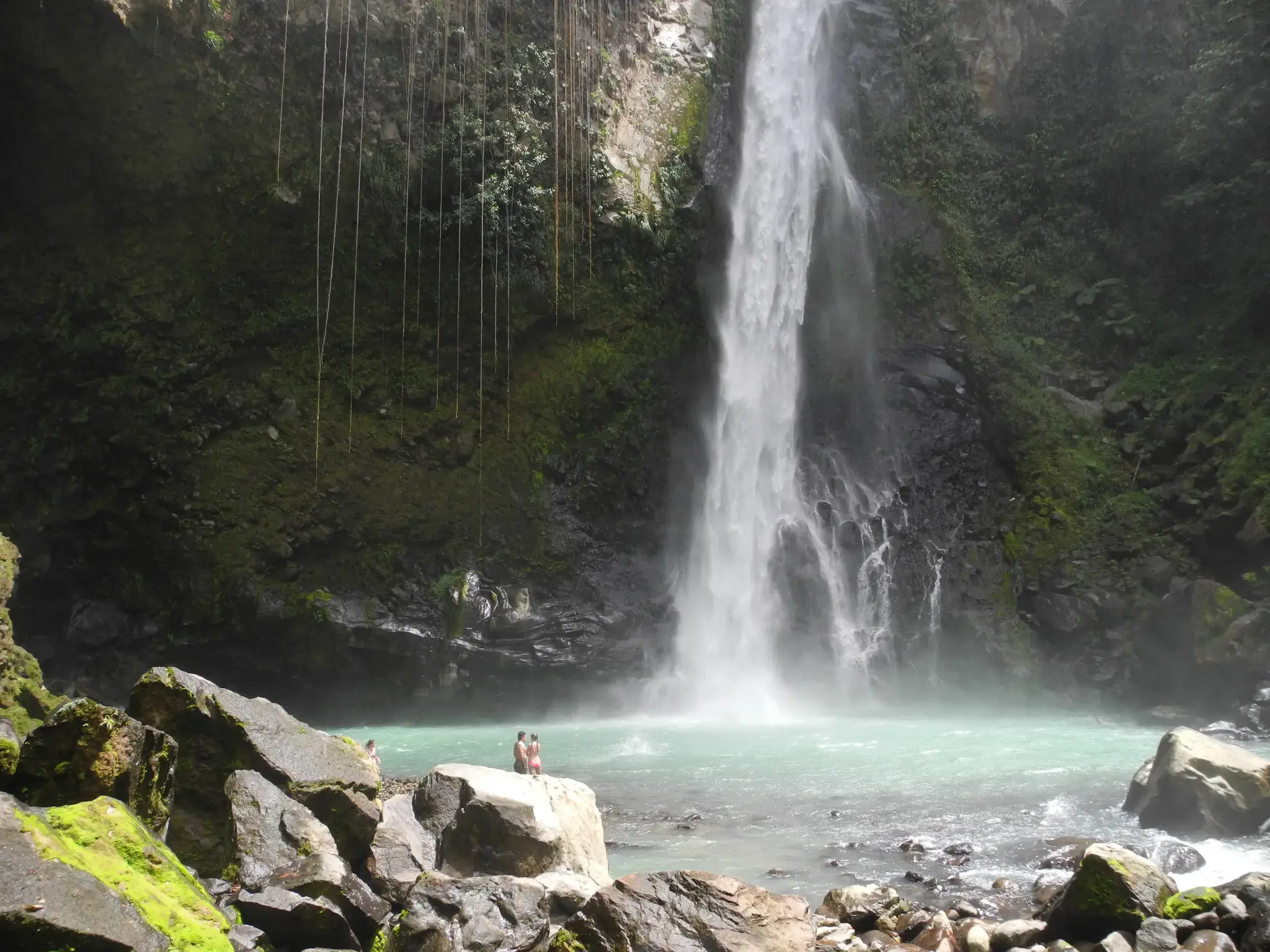
Why Different People May See Different Figures
An unclear shape does not always produce the same interpretation for every viewer.
One person may think it resembles a standing adult. Another may see a tree trunk or a rock formation. Someone else may believe it is a reflection of the waterfall.
These differences are useful because they reveal how much interpretation is involved.
A clearly photographed person usually has recognizable features and a consistent outline. In the supplied image, the shape is small and partly obscured. The available details are not sufficient to establish identity, clothing, posture, or even whether it is a person.
The more uncertain the visual information, the more room there is for different interpretations.
That is why the safest description is not "a person was standing behind the women." It is "a pale, human-like shape appears near the rocks in the photograph."
The wording may seem less dramatic, but it accurately reflects what can be seen.
Could the Figure Have Been Another Hiker?
The most straightforward explanation is also one that should not be dismissed: another person may have been near the waterfall.
A secluded location does not necessarily mean a completely inaccessible location. Hikers may use narrow trails, climb over rocks, or approach the pool from a direction that is not visible in the photograph.
A person could have been standing at the edge of the waterfall, taking pictures, resting, or watching the water. If the individual was partly hidden by mist, the swimmers may not have noticed them.
There are several reasons why a visitor might remain unnoticed.
First, the waterfall produces considerable noise. The sound of falling water can make ordinary conversation difficult to hear, particularly when someone is standing at a distance.
Second, the friends were in the pool and may have been facing the camera rather than looking continuously toward the surrounding rocks.
Third, the figure may have been small in the frame. People naturally pay more attention to nearby objects and faces than to distant background details.
Finally, the person may have been present for only a short time. A visitor could have crossed the rocks while the women were looking elsewhere.
None of this establishes that another hiker was actually there. It simply shows that a human explanation is possible.
Why the Apparent Change in Position Matters
The account says the shape appears in two different positions in photographs taken only seconds apart.
If the shape is a person, movement is one possible explanation. A visitor might have walked along a ledge or moved closer to the water.
However, the apparent change in position could also be caused by the camera.
A slight shift in viewpoint can alter the relative position of background objects. When the camera moves, nearby objects appear to shift more noticeably than distant ones. This is known as parallax.
Imagine taking two photographs of a tree with a mountain behind it. If you move sideways, the tree may appear to move across the mountain even though neither object has changed position. The mountain is much farther away, so its apparent movement is smaller.
The same effect can occur in a waterfall photograph. If the person taking the pictures changed position, a stationary rock, branch, or distant visitor could appear in a different place relative to the waterfall.