In a world filled with constant distractions and fast-paced living, finding moments to challenge our minds and spark curiosity can seem like a luxury.
Yet, puzzles and brain teasers offer more than just a break from the mundane—they provide a gateway to deeper intellectual exploration and personal growth.
These seemingly simple challenges have the power to expand our mental horizons, sharpen our problem-solving skills, and unlock new ways of thinking.
Riddles often rely on the solver’s ability to observe details that others might miss.
For example, a riddle might ask, “Who Can Escape?” requiring the solver to carefully examine the situation and notice subtle differences, such as the looseness of a character’s cuffs.
This focus on observation sharpens the mind and trains you to pay attention to the small details that can make all the difference.
A
B
C
ANSWER:
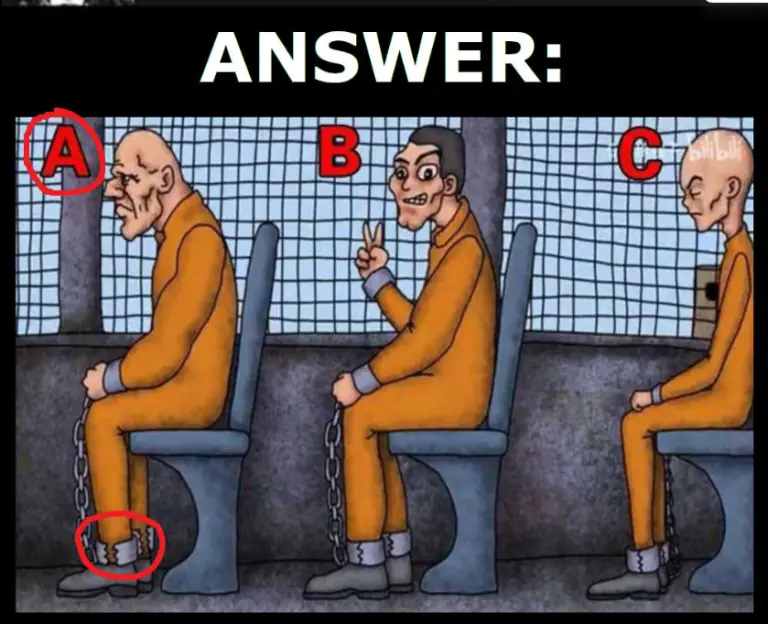
The Hidden Power of Puzzles: How Brain Teasers Strengthen Observation, Creativity, and Critical Thinking
In a world filled with constant distractions and fast-paced living, finding moments to challenge our minds and spark curiosity can seem like a luxury. Our days are often divided between work, family responsibilities, digital notifications, and an endless stream of information. We move quickly from one task to another, rarely allowing ourselves the time to pause and examine something carefully.
Yet, puzzles and brain teasers offer more than just a break from the mundane. They provide an opportunity to slow down, focus our attention, and explore different ways of thinking. A simple visual challenge can encourage us to question our first impressions, recognize overlooked details, and approach familiar situations from an entirely new perspective.
A puzzle may appear to be nothing more than a picture containing a few people, objects, or hidden clues. But solving it often requires a combination of observation, reasoning, patience, memory, and imagination.
Consider the riddle commonly presented under the title "Who Can Escape?" At first, the challenge may seem straightforward: examine several characters and decide which one has the greatest chance of escaping. The answer may depend on a small visual clue, such as the looseness of a character's cuffs or another detail that suggests greater freedom of movement.
The difficulty lies not necessarily in understanding the situation, but in noticing the detail that changes everything.
This is one of the most fascinating aspects of visual puzzles. They remind us that the information we need may already be directly in front of us. The challenge is learning how to see it.
1. The Difference Between Looking and Observing
Most people look at their surroundings constantly, but looking and observing are not quite the same thing.
Looking is often automatic. Our eyes receive information, and our brains quickly identify familiar objects, people, and situations. We recognize a chair, a window, or a person's expression without consciously examining every detail.
Observation requires something more deliberate.
When we observe carefully, we pay attention to relationships between objects, small differences in appearance, unusual positions, and details that might otherwise seem unimportant.
Imagine looking at an illustration containing three people standing near a locked door. One person has a key, another is holding a tool, and the third appears to have loose clothing around the wrists.
A quick glance might lead someone to choose the person holding the key. After all, keys are associated with opening doors.
However, if the question concerns escaping from restraints rather than opening a door, the person with the loose cuffs may be the more logical answer.
The puzzle changes when the solver stops focusing on the most obvious object and starts examining what the question actually requires.
This distinction is useful beyond puzzles. In everyday life, careful observation can help people notice changes in their surroundings, identify mistakes in documents, recognize patterns in data, and understand situations more accurately.
The important skill is not simply seeing more things. It is learning to identify which details are relevant.
2. Why the Brain Sometimes Misses Obvious Details
One reason visual puzzles can be surprisingly difficult is that the human brain does not process every detail equally.
The brain receives an enormous amount of sensory information. To function efficiently, it prioritizes certain signals and filters out others.
This process is useful because it allows us to recognize familiar environments without having to analyze every object individually.
However, it can also create blind spots.
When a person looks at a picture, the brain may immediately identify its main subject. If the illustration shows three people attempting to escape, attention may focus on their faces, positions, and apparent actions.
Small details around their clothing, hands, or feet may receive less attention.
This is sometimes related to inattentional blindness: the failure to notice an unexpected or unattended object because attention is focused elsewhere.
A classic demonstration involves asking people to count the number of times a ball is passed in a video. Some viewers become so focused on counting that they fail to notice an unusual event occurring in the background.
The lesson is not that people have poor eyesight. They may see the image clearly while failing to consciously register a particular detail.
Visual puzzles take advantage of this difference between seeing and noticing.
They encourage the viewer to move beyond the first interpretation and inspect the scene again.
3. The Importance of Reading the Question Carefully
A common mistake in brain teasers is beginning to solve the puzzle before fully understanding the question.
People often see an illustration and immediately start searching for clues. They may assume the challenge concerns strength, intelligence, speed, or access to an object.
But the wording may point toward something entirely different.
For example, the question "Who can escape?" is not necessarily asking who looks strongest or who appears closest to the exit.
It may be asking who has the greatest physical freedom, who has access to an overlooked route, or who is least restricted by the circumstances shown.
The same principle applies to many other riddles.
A question about who is safest may require identifying the source of danger rather than choosing the person who looks most protected.
A question about who is lying may depend on an inconsistency in the scene rather than someone's facial expression.
A question about which object does not belong may involve its function rather than its appearance.
Before examining the picture, it helps to identify exactly what information the question is requesting.
A useful three-step approach is:
-
Identify the central problem.
-
Determine what conditions must be satisfied.
-
Search for visual evidence that directly relates to those conditions.
This simple habit can prevent a great deal of unnecessary guessing.
4. How Visual Puzzles Encourage Flexible Thinking
Flexible thinking is the ability to consider more than one interpretation of a situation.
Many people naturally approach problems using familiar patterns. If a door is locked, they look for a key. If someone is trapped, they look for a way to break the lock. If a person appears stronger, they assume that person has a greater chance of success.