When the sun disappears and the neighborhood grows quiet, another world begins to make itself heard.
From somewhere beneath the grass, behind a flowerpot, or near the edge of a porch comes a familiar sound:
chirp… chirp… chirp…
Sometimes it is soft and distant. Sometimes it seems as though a cricket has chosen the exact spot outside your bedroom window to begin its nightly concert.
For thousands of years, people have listened to this sound and wondered about it. In different cultures, the cricket has been associated with good fortune, protection, prosperity, patience, and even messages from the unseen world.
But what is really happening when a cricket sings at night?
The scientific answer is fascinating and the cultural history surrounding the sound may be even more interesting.

The “Song” of a Cricket Is Actually a Form of Communication
Although we commonly call it singing, a cricket does not sing in the same way a bird does.
The sound is produced through a process called stridulation.
Male crickets have specialized structures on their wings. One wing has a roughened edge or file-like structure, while the other has a scraper-like structure. When the male moves his wings against each other, these structures rub together and create vibrations.
Those vibrations become the familiar cricket chirp.
The remarkable part is that the sound is not random.
It is a message.
For many cricket species, the primary purpose of the male's calling song is to attract females.
In other words, when you hear a cricket calling in the darkness, there is a good chance that somewhere nearby a male is essentially announcing:
“I am here.”
Why Do Crickets Prefer the Night?
One of the biggest mysteries for people unfamiliar with cricket behavior is why these insects seem so determined to make noise after sunset.
There are several biological reasons.
Darkness provides protection
Many cricket species are vulnerable to predators.
Calling loudly can attract attention—not only from potential mates but also from animals that eat crickets.
Nighttime can provide a different environment from daytime, with cooler temperatures and different patterns of predator activity.
For some species, nighttime therefore offers a useful window for communication.
Their surroundings become quieter
During the day, the environment is filled with competing sounds.
Birds call. People talk. Cars pass. Wind moves through trees. Other insects buzz.
At night, many of those sounds decrease.
A cricket's call can therefore travel through a quieter environment, making it easier for another cricket to detect.
Temperature affects their activity
Crickets are ectothermic animals, meaning their body temperature and activity are strongly influenced by their surroundings.
Warm evenings can make them particularly active.
This is one reason you may notice that cricket sounds become much louder during warm summer nights.
Why Does the Chirping Sometimes Become Louder?
If you've ever sat outside at night, you may have noticed something strange.
A cricket begins chirping.
Then another answers.
Then another.
Suddenly, what seemed like one tiny insect becomes an entire orchestra.
This happens because crickets are not necessarily calling in isolation.
Multiple males may be communicating within the same area.
Their calls can overlap, producing what sounds like a continuous nighttime chorus.
The apparent volume can also change because of temperature, weather, the number of crickets nearby, and where the insects are hiding.
A cricket sitting close to your house may sound dramatically louder than one several meters away.
Can You Tell the Temperature From Cricket Chirps?
There is a famous old saying that cricket chirps can be used to estimate the temperature.
Interestingly, there is some science behind the idea.
Cricket metabolism is influenced by temperature, and their calling activity generally becomes faster as the environment warms within a suitable range.
For certain cricket species, researchers have developed formulas relating chirp rates to temperature.
But there is an important qualification:
It is not a universal thermometer.
Different species behave differently, and humidity, age, reproductive condition, and environmental conditions can influence calling rates.
So if someone tells you that you can count cricket chirps and determine the exact outdoor temperature, treat it as a fascinating approximation rather than a precise scientific instrument.
Still, the basic observation is real:
warmer conditions can make many crickets chirp more rapidly.
Why Do Crickets Suddenly Stop?
This can be just as noticeable as the singing itself.
One moment you hear a loud chorus.
Then—silence.
There are several possible explanations.
A cricket may detect movement nearby and stop calling to avoid attracting attention.
It may be responding to vibrations.
A predator may have entered the area.
The male may simply have completed a calling sequence and paused before starting again.
Environmental conditions can also change their activity.
This is why walking toward a cricket can sometimes feel almost comical.
You hear it clearly.
You move closer.
Silence.
You wait.
Chirp.
You take another step.
Silence again.
The insect may be detecting your movement before you can locate it.
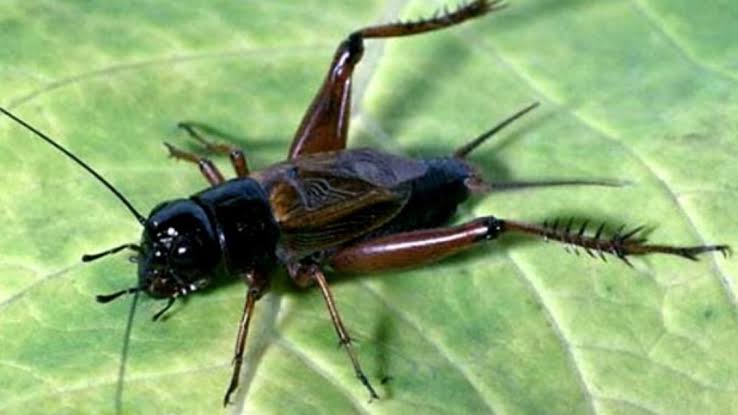
Why Is It So Difficult to Find a Chirping Cricket?
Crickets are surprisingly good at hiding.
A sound can make you think an insect is directly beside your feet when it is actually several meters away.
They may hide:
-
Beneath leaves
-
Under stones
-
In cracks
-
Around foundations
-
Beneath outdoor furniture
-
In dense vegetation
-
Around wood piles
-
Near garden structures
-
In small gaps around buildings
Their coloration can also help them blend into soil, grass, bark, and other natural surfaces.
So the cricket you hear from your bedroom may not be sitting directly outside the window.
It could be somewhere completely different.
The Ancient Symbolism of the Cricket
The scientific explanation tells us why crickets call.
But it doesn't explain why people have attached so much meaning to that sound.
For generations, the cricket has appeared in folklore, poetry, art, stories, and traditional beliefs.
In some cultures, crickets have been viewed as symbols of good luck and prosperity.
In others, their presence around a home has been associated with protection or positive energy.
These beliefs are cultural traditions, not scientific predictions. But they reveal something important about the relationship humans have had with these small insects.
People have always listened to nature and searched for meaning in what they heard.
Crickets and Good Fortune
One of the most enduring beliefs is that a cricket inside or near a home can symbolize good fortune.
This idea is particularly strong in some East Asian traditions, where crickets have historically been associated with positive qualities such as good luck, vitality, and prosperity.
The cricket's presence could be interpreted as a welcome sign rather than an unwanted pest.
This may seem surprising to people who immediately think of insects as something that should be removed from the house.
But cultural attitudes toward animals can vary dramatically.
An insect that one person sees as a nuisance may be regarded by another culture as a symbol of something positive.
Why Would a Cricket Become a Symbol of Prosperity?
There are several possible cultural explanations.
Crickets are seasonal insects, and their appearance is closely connected to changes in weather and the natural environment.
Their presence can signal that warm conditions have arrived and that the natural world is active.
Their persistent nighttime song may also have been associated with vitality and abundance.
In agricultural societies, people paid close attention to seasonal changes because farming depended heavily on environmental conditions.
A small creature appearing at a particular time of year could therefore become connected with the larger rhythms of life.
Over time, observations of nature could become traditions, stories, and symbolism.
The Cricket as a Symbol of Patience
There is another interesting interpretation of the cricket.
Its nighttime song is repetitive.
It may continue for long periods, repeating the same basic pattern again and again.
Because of this persistence, crickets have sometimes been associated in storytelling and symbolism with qualities such as patience, endurance, and persistence.
Of course, the cricket isn't consciously trying to teach humans a lesson.
Its behavior is driven by biology.
But humans have always used animals as metaphors.
A small insect repeatedly calling into the darkness can easily become an image of persistence.
What Does It Mean If a Cricket Enters Your House?
If you discover a cricket indoors, there is no scientific evidence that its presence predicts money, good luck, bad luck, or an upcoming event.
Usually, the explanation is much simpler.
The insect may have entered because it found:
warmth, shelter, food, moisture, or an accessible opening.
Outdoor lights can also attract insects, indirectly creating conditions where predators and other animals may appear nearby.
A cricket may slip through a gap beneath a door, a crack around a window, or another opening.
So if you suddenly hear one chirping inside your home, you probably don't need to interpret it as a mysterious message.
It is most likely just an insect that found its way indoors.
Why Does a Cricket Near Your Bedroom Sound So Loud?
This is partly an acoustic illusion.
Your home is relatively quiet at night.
When everything else becomes silent, even a very small sound can seem enormous.
Walls and hard surfaces can also reflect sound.
If a cricket is positioned near a wall, window, or enclosed space, its chirping may appear louder than it actually is.
This explains why a tiny insect can sometimes sound as though it is sitting directly beside your bed.
Your brain is simply paying much more attention to a sound that would be easy to ignore during the day.
Do Crickets Bring Good Luck or Bad Luck?
That depends entirely on the cultural tradition you're considering.
Scientifically, there is no evidence that crickets predict future events.
They do not cause financial success or misfortune simply by appearing in a house.
But folklore is different from science.
For some people, hearing a cricket at night evokes comfort, nostalgia, summer evenings, childhood memories, or a connection with nature.
For others, the same sound may be irritating.
Neither emotional reaction changes the insect's biology.
The meaning comes from the person and the culture—not from the cricket itself.
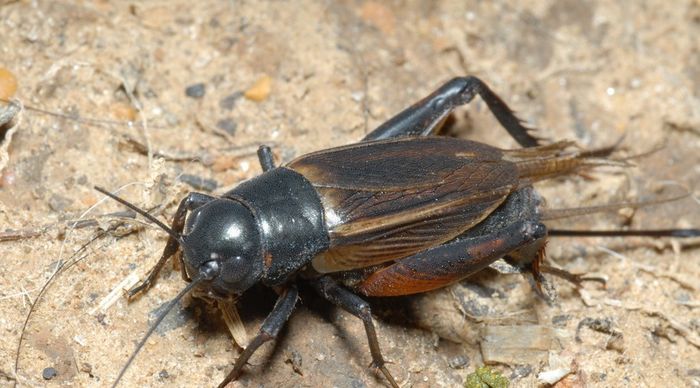
Why Their Nighttime Song Still Fascinates Us
There is something strangely powerful about hearing a cricket when everything else is quiet.
You cannot always see the insect.
You may not know exactly where it is.
Yet its presence is unmistakable.
A tiny creature hidden somewhere in the darkness announces itself with a sound that has probably been heard by humans for thousands of years.
Long before electricity, televisions, smartphones, or traffic filled our nights with artificial noise, people would have heard the same basic chorus.
That continuity is part of what makes the cricket fascinating.
The sound connects the modern world with something ancient and natural.
When Cricket Sounds Become a Problem
Although a single cricket is harmless to most households, a large number of crickets can become annoying.
If you repeatedly find crickets indoors, inspect areas where they might be entering.
Check:
-
Door seals
-
Window screens
-
Foundation gaps
-
Garage doors
-
Basement openings
-
Vents
-
Cracks around utility lines
Reducing unnecessary outdoor lighting near entrances can also help limit insect activity around doors and windows.
Keep food waste contained and reduce excessive moisture where possible.
If you have a significant insect infestation, professional pest-control advice may be appropriate.
The Sound Beneath the Silence
The next time you hear a cricket singing outside your window, you might hear more than just an annoying chirp.
Biologically, it is a sophisticated communication system.
A male cricket is using specialized structures on its wings to produce vibrations that can attract potential mates and communicate with other members of its species.
Ecologically, the sound is part of a larger nighttime community involving insects, predators, plants, temperature, weather, and habitat.
And culturally, the cricket has become something even more fascinating: a symbol.
For generations, people have associated its song with luck, prosperity, patience, seasonal change, and the mysterious connection between humans and the natural world.
There is no scientific evidence that a cricket's song predicts your future.
But perhaps it doesn't need to.
Sometimes, the mystery isn't in what the cricket is trying to tell us.
The mystery is simply that such a tiny creature can make itself heard so clearly in the darkness—and that humans have been listening to that song for countless generations.