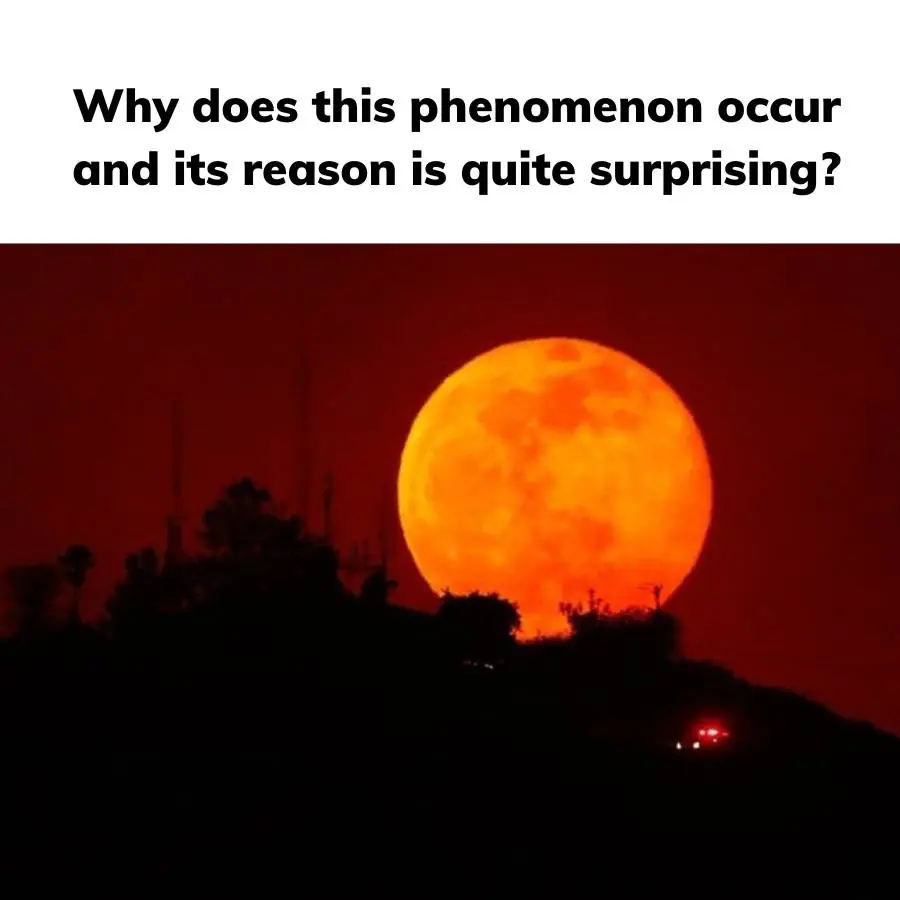
A total lunar eclipse occurs when the Sun, Earth and Moon are aligned with each other, with the Earth in the middle. Therefore, this phenomenon only occurs on full moon days. Unlike a solar eclipse, a lunar eclipse can be seen anywhere on Earth at night and can be easily observed with the naked eye.
2. When a lunar eclipse occurs, the moon turns red
Why is it that the size of the Earth can completely cover the Sun, but when a total lunar eclipse occurs, the Moon does not completely darken but turns from bright orange to bright red? According to scientists, this phenomenon occurs because sunlight has "swept" through the Earth's atmosphere and reflected onto the Moon. During that journey, the light will be filtered by the air and dust on Earth. Short-wavelength light will be filtered out, leaving only long-wavelength light to reach the Moon. In which, red light has the longest wavelength, so when a total lunar eclipse occurs, the Moon is red.
Some abnormalities on Earth can make the Moon redder. It could be a volcanic eruption that causes a large amount of dust to be "released" into the atmosphere. At this time, the Earth's atmosphere will "filter" the light more strongly, making the red color of the Moon more intense.
When a total lunar eclipse occurs, if the Moon is near the horizon, it will have a larger image. This is an illusion caused by the human eye "comparing" the size of the Moon with smaller objects such as buildings, bushes, and mountain ranges, making us feel that the Moon is larger than normal.