There are no obvious attempts to create perfectly matching outfits. Each woman appears to have selected clothing that reflects her own preferences.
This individuality was an important part of the fashion culture of the decade.
According to the Fashion History Timeline at the Fashion Institute of Technology, women's fashion during the 1970s included everything from early bohemian-inspired dresses to disco clothing and emerging sportswear. The decade was not defined by a single look but by the coexistence of multiple styles.
Another fascinating detail is the use of accessories.
The belts, necklaces and simple jewelry in the photograph demonstrate how small details could complete an otherwise uncomplicated outfit.
Wide belts were especially recognizable in seventies fashion. They could emphasize the waist, add structure to loose clothing or create a stronger contrast between a top and a pair of trousers.
Long necklaces also appeared frequently in casual and bohemian-inspired outfits.
Accessories did not always need to be expensive or luxurious. Sometimes, one necklace or a distinctive belt was enough to give an outfit its own character.
The hairstyles deserve equal attention.
Long, naturally flowing hair was a familiar feature of the period, particularly during the early and middle parts of the decade. Some women preferred straight hair, while others experimented with waves, curls, layers and more dramatic styles.
The four women in the photograph appear to have relatively natural hairstyles. Their hair is not excessively structured, and their overall appearance feels informal.
This is another reason the picture feels so authentic to viewers who associate the seventies with relaxed fashion.
However, it would be inaccurate to assume that every woman during the decade dressed this way.
Fashion differed significantly depending on geography, income, age, occupation and personal preference. A young woman living in a large city might have followed very different trends from someone living in a rural community.
The image represents one particular visual moment, not the entire experience of women during the decade.
Nevertheless, it captures something important about the changing relationship between clothing and personal identity.
Women were increasingly able to experiment with trousers, casual tops and different combinations without feeling restricted by older expectations.
Fashion became a way to express personality rather than simply follow established rules.
And perhaps that is why these outfits remain so recognizable today.
Chapter 3: Hairstyles, Confidence and the Changing Image of Women
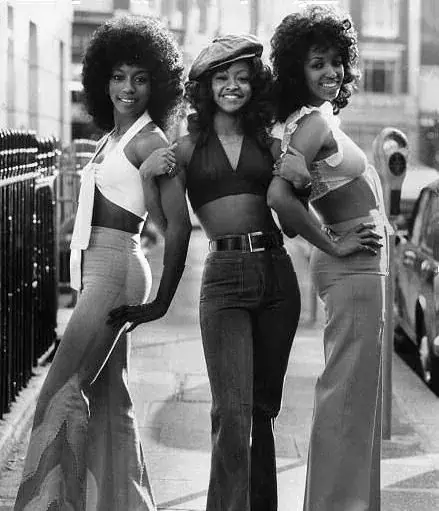
Fashion is only one part of what makes this photograph interesting. The hairstyles and body language of the women reveal another aspect of the period.
Look closely at their expressions.
None of them appears to be attempting an exaggerated fashion pose. Their shoulders are relaxed, their hands rest naturally and their expressions are relatively straightforward.
The woman on the left leans slightly toward the others. The two women in front stand close together, while the woman behind them is positioned just high enough to remain visible in the photograph.
It feels like a moment shared among friends rather than a carefully organized fashion presentation.
Their hairstyles also deserve attention because hair was an important part of women's personal style throughout the seventies.
During the early part of the decade, long, straight hair continued to carry the influence of the late 1960s. Natural textures, center parts and relaxed shapes were common among younger women.
As the decade progressed, layered cuts and feathered hairstyles became increasingly recognizable.
The influence of celebrities, musicians, television personalities and fashion magazines helped spread these looks.
One hairstyle could quickly become a recognizable symbol of a particular period.
However, not every woman followed the same trends. Some preferred long hair, others chose shorter cuts, and many simply maintained whatever hairstyle suited their everyday lives.
The women in this photograph appear to favor relatively natural, shoulder-length or longer styles.
Their hair is not identical, which makes the group look even more interesting.
One has a slightly straighter appearance, another has more visible volume, and the woman standing behind them has a different silhouette around her face.
These small variations remind us that personal style has always been about individual choices.
Beyond appearance, the 1970s were also an important period for women's changing social roles.
Across several countries, movements advocating women's equality gained visibility. Discussions about education, employment opportunities, political representation and personal independence became increasingly prominent.
In the United States, the Women's Strike for Equality took place in August 1970, bringing attention to demands for greater equality in public and private life.
These broader changes also influenced fashion.
For generations, expectations about how women should dress had been shaped by traditional ideas about femininity and social respectability.
During the seventies, trousers became increasingly accepted in situations where dresses and skirts had previously been considered more appropriate.
Women could wear jeans, pantsuits and casual separates in a wider range of everyday settings.
This transformation did not happen everywhere at the same speed, nor did every woman experience the same degree of freedom.
Still, clothing became one visible expression of broader cultural changes.
The fitted tops and trousers in the photograph can therefore be understood within a larger fashion history.
They are not necessarily political statements, and we should not assign personal beliefs to the women based on their clothing.
However, the overall style reflects an era in which casual dress had become increasingly normal and diverse.
Another detail worth noticing is the apparent absence of heavy styling.
There are no elaborate hairstyles that dominate the picture, no obvious professional makeup arrangement and no elaborate fashion accessories.
Instead, the women appear comfortable with a relatively uncomplicated look.