A $2 bill might look like an ordinary piece of money, but before you spend one, it may be worth taking a closer look.
Certain $2 bills can be worth significantly more than their face value to collectors. Depending on the age, series, condition, serial number, rarity, printing characteristics, and historical significance, an ordinary-looking $2 bill could potentially be worth several times its original value.
But there's an important detail many people misunderstand:
Not every $2 bill is valuable.
In fact, most modern circulated $2 bills are worth exactly $2.
The reason these notes attract so much attention is that they're relatively uncommon in everyday transactions. People don't see them as often as $1, $5, $10, or $20 bills, which can make them seem rare.
So how do you know whether your $2 bill is ordinary - or something a collector might want?
Here's what to check.
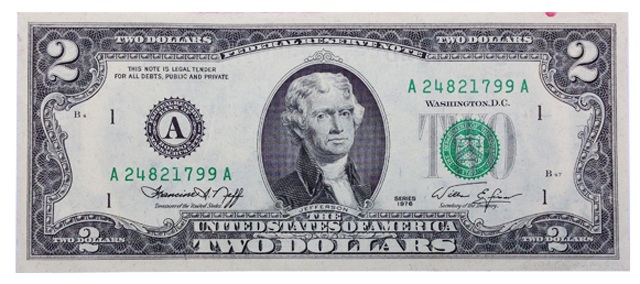
Why Are $2 Bills So Interesting?
The $2 denomination has a fascinating history in the United States.
The government has issued $2 notes in different forms for well over a century. Over time, the appearance of the notes changed, including the portraits, seals, colors, serial-number formats, and artwork on the reverse.
Some older notes have become collectible because relatively fewer examples remain in excellent condition.
Other $2 bills attract attention because of unusual serial numbers, replacement stars, printing varieties, or production errors.
And then there are the notes that simply survived decades in unusually good condition.
That's what makes collecting paper money interesting.
The denomination alone doesn't determine the value.
The details do.
1. Check the Year and Series
The first thing to look at is the series designation.
Older $2 bills can be considerably more interesting than ordinary modern examples.
You'll find different series from different periods, including:
-
1928
-
1953
-
1963
-
1976
-
Later modern series
The exact series matters because different issues were produced in different quantities and have different designs and collector demand.
One especially recognizable group is the Red Seal $2 bill.
These older notes have a red Treasury seal, making them immediately distinguishable from modern notes.
If you find one tucked inside an old book, drawer, envelope, or family collection, don't spend it before identifying the exact series.
2. Look for a Red Seal
The color of the Treasury seal can provide an important clue.
Older $2 notes from certain series feature a red Treasury seal.
These notes can be collectible, particularly when they are old, scarce, or in excellent condition.
But don't make the mistake of thinking:
"Red seal = hundreds of dollars."
That's not necessarily true.
The exact series, condition, rarity, and demand all matter.
A heavily worn example of a common issue may be worth only a modest premium, while a scarce example in exceptional condition can be much more interesting.
3. Check for a Star Next to the Serial Number
Here's one of the easiest things to look for.
Examine the serial number on your $2 bill.
Some notes have a star symbol instead of the usual letter suffix.
These are commonly called Star Notes.
Star Notes are replacement notes that were printed to replace notes that were removed from the production process because of an error or other problem.
Because replacement notes are produced separately, some varieties can be less common than ordinary notes.
That can make them interesting to collectors.
However:
A Star Note isn't automatically worth a fortune.
Some are common enough that their value remains close to face value, while scarcer examples can command a premium.
4. Your Serial Number Could Be the Most Interesting Part
Don't overlook the serial number.
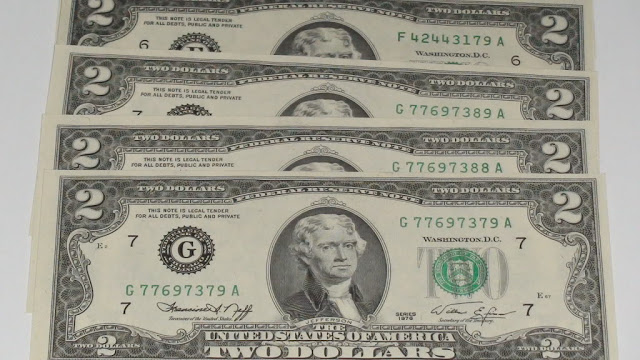
Collectors sometimes search for unusual or memorable number patterns.
For example, a $2 bill could become more interesting if it has a serial number with:
Repeating digits
Something like:
77777777
would immediately stand out.
Very low numbers
A serial number with many zeros can be desirable to some collectors.
Sequential numbers
A pattern such as:
12345678
can be particularly attractive.
Reverse sequences
A number that counts backward can also be unusual.
Palindromes
These are numbers that read the same forward and backward.
For example:
12344321
Repeated patterns
Numbers such as:
12121212
or
11221122
may attract collectors who specialize in fancy serial numbers.
But remember:
Interesting doesn't always mean expensive.
The market determines whether a particular serial number actually commands a premium.
5. Condition Can Dramatically Change the Value
Imagine finding two identical $2 bills.
One has been carried in a wallet for years.
It's folded, dirty, creased, and has rounded corners.
The other looks like it was printed yesterday.
It's crisp, clean, flat, and free of writing or tears.
Even though they're technically the same note, the second one may be much more desirable to collectors.
Condition is one of the most important factors in paper-money collecting.
Collectors may describe notes using grades such as:
-
Fine
-
Very Fine
-
Extremely Fine
-
About Uncirculated
-
Uncirculated
The better the condition, the greater the potential collector premium—especially for scarce or historically important notes.
6. Look for Printing Errors
Some of the most interesting collectible banknotes are those containing genuine production errors.
Currency printing involves numerous stages, and unusual mistakes can occasionally occur.
Examples of potentially collectible errors include:
-
Misaligned printing
-
Missing design elements
-
Incorrectly positioned elements
-
Cutting errors
-
Double impressions
-
Other abnormalities created during production
These can sometimes make a note considerably more interesting to collectors.
But there's a major catch.
Most strange-looking $2 bills aren't valuable printing errors.
Many unusual-looking notes have simply been damaged after leaving the printing facility.
7. Don't Confuse Damage With a Valuable Error
This is a common mistake among new collectors.
Suppose you find a $2 bill with:
-
A crooked edge
-
A strange crease
-
Faded ink
-
A stain
-
Writing
-
A torn corner
It might look unusual.
But that doesn't necessarily mean the printing process produced the defect.
A bill can become damaged after being handled by thousands of people.
Collectors generally distinguish between a genuine production error and ordinary damage caused after the note entered circulation.
If you think you've found a genuine error, professional evaluation can help.
8. Older $2 Bills Can Be Especially Interesting
If your $2 bill looks noticeably different from modern currency, pay attention.
Older $2 notes were produced in a variety of designs.
Some were larger than today's familiar notes, and some feature historical designs that are no longer seen in everyday currency.
Older paper money can have significant collector value depending on:
-
Date
-
Series
-
Rarity
-
Condition
-
Signatures
-
Seal
-
Serial number
-
Historical significance
Some older $2 notes can be worth substantially more than face value.
But again, old doesn't automatically mean rare.
A common old note in poor condition may be worth much less than a scarce variety in excellent condition.
9. What About the 1976 $2 Bill?
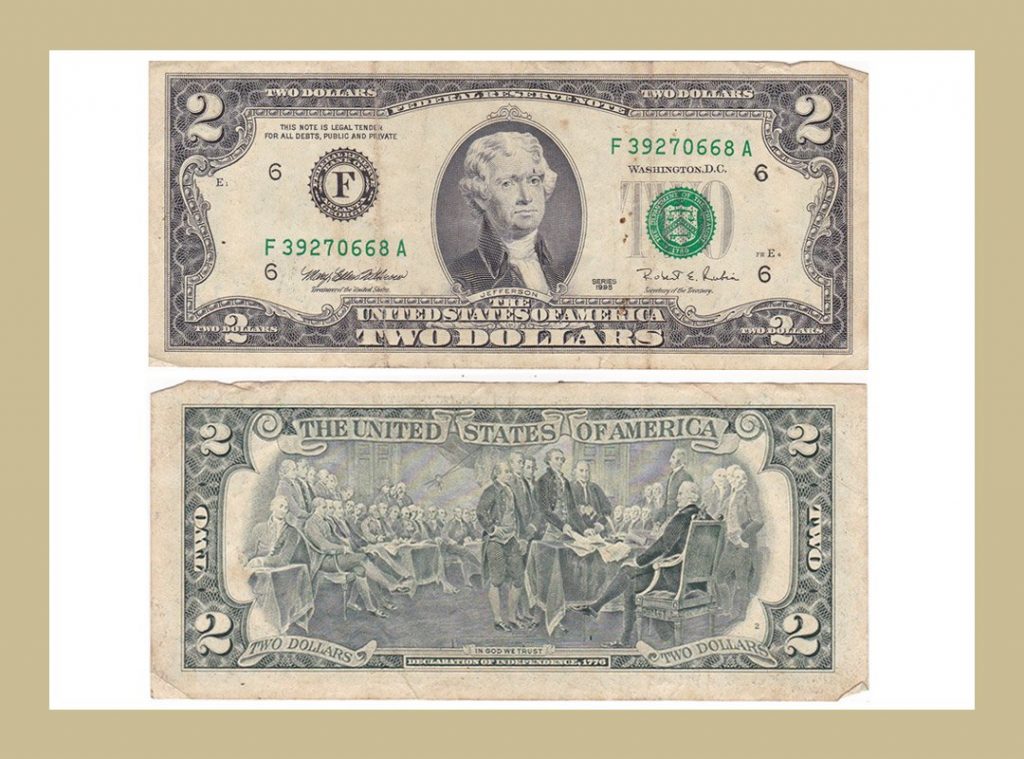
The 1976 $2 bill is one of the most recognizable modern examples.
It was introduced during the United States Bicentennial period and features a distinctive reverse design showing the presentation of the Declaration of Independence.
Because the bill was released as part of a major national anniversary, many people saved them.
That has created a common misconception:
"Every 1976 $2 bill is valuable."
That's generally not true.
Many ordinary 1976 $2 bills are still worth around their face value when circulated.
A crisp, uncirculated example may have additional collector interest, while unusual serial numbers, Star Notes, and certain varieties can potentially command higher prices.
So if you find a 1976 note, inspect it—but don't automatically assume it's worth hundreds.
10. Look at Both Sides of the Bill
Don't only look at the portrait.
Turn the bill over.
The reverse design can help identify the particular type of note you have.
Modern $2 bills feature a famous historical scene associated with the Declaration of Independence.
Older notes may have completely different designs.
When researching a collectible note, identifying the exact design is important because visually similar notes can have very different values.
11. Very Old Large-Size $2 Notes Are Worth Investigating
Here's where things can become particularly interesting.
Before 1928, many U.S. banknotes were physically larger than the currency we're accustomed to today.
These are often called Large Size Notes.
If you find an extremely old $2 note—especially one that looks noticeably larger than modern currency—don't assume it's ordinary.
Certain large-size $2 notes can be highly collectible.
Their value can vary enormously depending on the exact issue and condition.
If an old $2 bill appears to have been passed down through a family, it may be worth having professionally evaluated before selling or spending it.
12. Don't Clean an Old $2 Bill
If you think you've found something valuable, resist the temptation to make it look newer.
Don't:
-
Wash it
-
Iron it
-
Bleach it
-
Scrub it
-
Apply chemicals
-
Tape tears
-
Flatten it aggressively
Paper money is fragile.
Attempting to "restore" a note at home can permanently damage it and potentially reduce its collector value.
Sometimes a worn but completely original note is more desirable than one that has been altered.
13. Don't Fold It More Than Necessary
If you find a potentially valuable note, handle it carefully.
Repeated folding creates creases and weakens the paper.
If the note is already crisp, keeping it flat and protected can help preserve its condition.
A suitable currency holder can be useful for valuable examples.
The key principle is simple:
Preserve first. Investigate second.
14. How Much Could a $2 Bill Actually Be Worth?
This is where viral posts can become misleading.
You may see headlines claiming:
"$2 bills worth $500!"
or:
"Check your wallet—you could have a $2 bill worth $4,500!"
Those claims may be based on unusual examples, auction results, or specific rare varieties.
They should not be interpreted as meaning every $2 bill has that value.
A typical modern circulated $2 bill may be worth:
$2.
Some nicer examples may bring a modest premium.
Certain Star Notes may be worth more.
Some fancy serial numbers can attract collectors.
Certain older notes may be worth tens, hundreds, or potentially much more.
The exact value depends on the individual note.
15. The Six Things That Matter Most
If you want a quick checklist, remember these six factors:
1. Age
Older isn't automatically better, but certain older issues are highly collectible.
2. Rarity
How many examples exist?
3. Condition
A crisp note can be much more desirable than a heavily worn one.
4. Serial Number
Unusual patterns can attract collectors.
5. Errors or Varieties
Genuine production errors can be highly collectible.
6. Demand
Ultimately, collector interest determines the market.
16. A Simple Way to Inspect Your $2 Bill
Before doing anything else, take a few minutes to examine it.
Check the front
Look for:
-
Series year
-
Treasury seal
-
Serial number
-
Star symbol
-
Signatures
-
Unusual printing
Check the back
Look at the design and compare it with known issues.
Check the condition
Ask:
-
Is it crisp?
-
Has it been folded?
-
Are there stains?
-
Are the corners sharp?
-
Is there writing?
-
Are there tears?
Then research the exact note
Don't search simply for:
"How much is a $2 bill worth?"
Instead, identify the exact series and characteristics first.
The more specific the information, the more meaningful the comparison.
17. What If You Think You Found a Rare $2 Bill?
Don't rush to sell it to the first person who offers you money.
First, get more information.
You can compare the note with reputable currency references and, if it appears genuinely valuable, consider having it examined by a professional currency dealer or grading service.
This is particularly important for:
-
Very old notes
-
Suspected printing errors
-
Rare Star Notes
-
Extremely low serial numbers
-
Exceptional-condition notes
-
Notes claimed to be worth hundreds or thousands of dollars
A professional opinion can help distinguish a genuine collectible from an ordinary bill with an unusual appearance.
18. Why $2 Bills Make Great Collectibles
You don't have to be a serious numismatist to appreciate them.
The $2 bill is interesting precisely because it's different.
You can encounter one in circulation and immediately wonder:
"Where did this come from?"
The note connects everyday spending with American history.
Older examples can tell stories about different eras of currency design, while newer examples demonstrate how familiar designs have changed over time.
And unlike many collectibles, you may occasionally discover one without searching for it.
It could be sitting in:
-
An old wallet
-
A desk drawer
-
A family envelope
-
A cash register
-
An old book
-
A forgotten collection
That's part of the fun.
The Most Important Lesson
Finding a $2 bill should make you curious—not automatically convinced that you've struck gold.
Most $2 bills aren't worth hundreds.
But certain examples genuinely can be worth considerably more than face value.
The trick is knowing what makes a particular note different.
So the next time you receive one, don't immediately put it back in your wallet.
Take a moment.
Look at the year.
Check the seal.
Inspect the serial number.
Look for a star.
Examine the condition.
Then flip it over and study the design.
You might discover that it's simply an ordinary $2 bill.
And that's perfectly fine.
But if you happen to find an unusual older issue, a rare serial number, a genuine printing error, or an exceptionally well-preserved example, you may have something that collectors would be interested in.
The Bottom Line
Your $2 bill could be worth more than $2—but only if it has the right characteristics.
Don't rely on viral claims that every old or unusual-looking $2 bill is worth hundreds.
Instead, look for the details that actually matter:
Series + rarity + condition + serial number + Star Note status + genuine errors or varieties.
And if you find a particularly old or unusual note, don't clean it, alter it, or spend it before having it properly identified.
That little piece of paper in your wallet may be ordinary currency.
Or it could be a small piece of history hiding in plain sight.