Most people think of their nails as little more than a cosmetic feature. We trim them, paint them, clean them, and occasionally notice when they break.
But your nails can sometimes provide clues about what is happening beneath the surface.
Changes in color, texture, thickness, shape, or growth pattern can occur for many reasons. Some are completely harmless and may result from aging, minor injuries, nail products, or everyday habits. Others can be associated with nutritional deficiencies, infections, circulation problems, inflammatory conditions, or other health issues.
In rare cases, certain nail changes can even be associated with serious disease, including some forms of cancer.
That doesn't mean an unusual nail automatically means something dangerous. In fact, most nail changes have much more ordinary explanations.
The important lesson is to recognize persistent or unusual changes and understand when they deserve professional attention.
Here are four nail changes worth knowing about.
1. A Dark or New Vertical Line Under the Nail
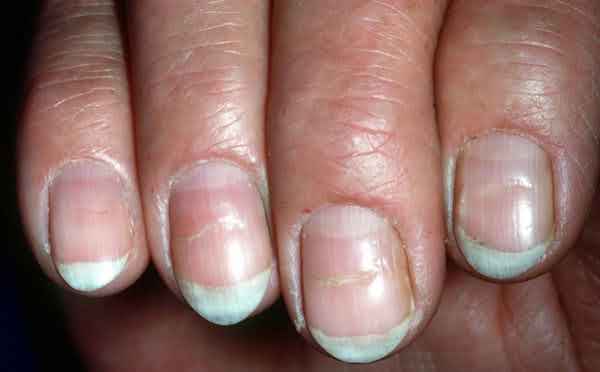
One of the nail changes that deserves particular attention is a new dark streak running vertically from the base of the nail toward the tip.
This type of pigmentation is known medically as longitudinal melanonychia.
It can look like a brown, black, or dark-colored stripe beneath the nail.
There are many possible causes.
For example, pigmentation can occur because of:
-
Normal variation in skin pigmentation
-
Previous trauma to the nail
-
Certain medications
-
Hormonal changes
-
Repeated pressure or injury
-
Benign growths involving pigment-producing cells
However, in some cases, a dark streak can be associated with subungual melanoma, a rare form of melanoma that develops beneath the nail.
That's why a new or changing dark streak shouldn't automatically be dismissed.
What makes a dark streak more concerning?
Doctors may pay closer attention when a streak:
-
Appears in only one nail
-
Becomes wider over time
-
Has irregular or uneven coloring
-
Has an irregular border
-
Changes noticeably
-
Extends onto the surrounding skin near the nail
-
Is associated with nail destruction or other unusual changes
The presence of one of these features doesn't prove melanoma.
But it can be a reason to have the nail examined by a dermatologist.
Don't panic over every dark line
It's important not to assume that every dark stripe is cancer.
Many harmless conditions can produce similar pigmentation.
The key is change over time.
If you've had the same narrow line for many years without any noticeable change, it may have a very different significance from a newly appearing, progressively widening streak.
2. A Nail That Suddenly Changes Shape or Becomes Unusually Thick
Another change to watch is a noticeable alteration in the shape or thickness of a nail.
Healthy nails are relatively smooth and grow in a predictable pattern. When a nail becomes dramatically thicker, distorted, brittle, or misshapen, there can be several explanations.
One of the most common is a fungal nail infection.
Fungal infections can cause nails to become:
-
Thick
-
Yellowish or whitish
-
Brittle
-
Crumbly
-
Distorted
-
Separated partially from the nail bed
Trauma can also change the appearance of a nail.
Repeated pressure from shoes, nail biting, picking, manicures, or an old injury may affect nail growth for months.
But persistent nail distortion can occasionally be associated with other medical conditions, including inflammatory skin disorders such as psoriasis.
In rare situations, a tumor affecting the nail unit can also cause changes in the nail's shape or growth.
Why persistent changes matter
Your fingernails grow slowly.
That means a problem affecting the nail matrix—the area responsible for producing the nail—can remain visible for quite some time.
A damaged nail doesn't necessarily return to normal overnight.
If you've injured a nail, for example, the abnormal portion may gradually grow out as new nail develops.
But if a nail continues to deteriorate without an obvious explanation, it is worth getting checked.
Particularly concerning changes include a nail that:
-
Continues to become distorted
-
Develops a persistent mass
-
Bleeds without an obvious injury
-
Becomes painful
-
Separates from the nail bed
-
Develops a persistent dark or unusual area
-
Changes progressively rather than improving
Again, these symptoms don't automatically indicate cancer.
They simply deserve an appropriate evaluation rather than being ignored indefinitely.
3. A Persistent Dark Spot, Discoloration, or Change That Doesn't Grow Out
Here's something many people overlook:
A nail injury can look surprisingly dramatic.
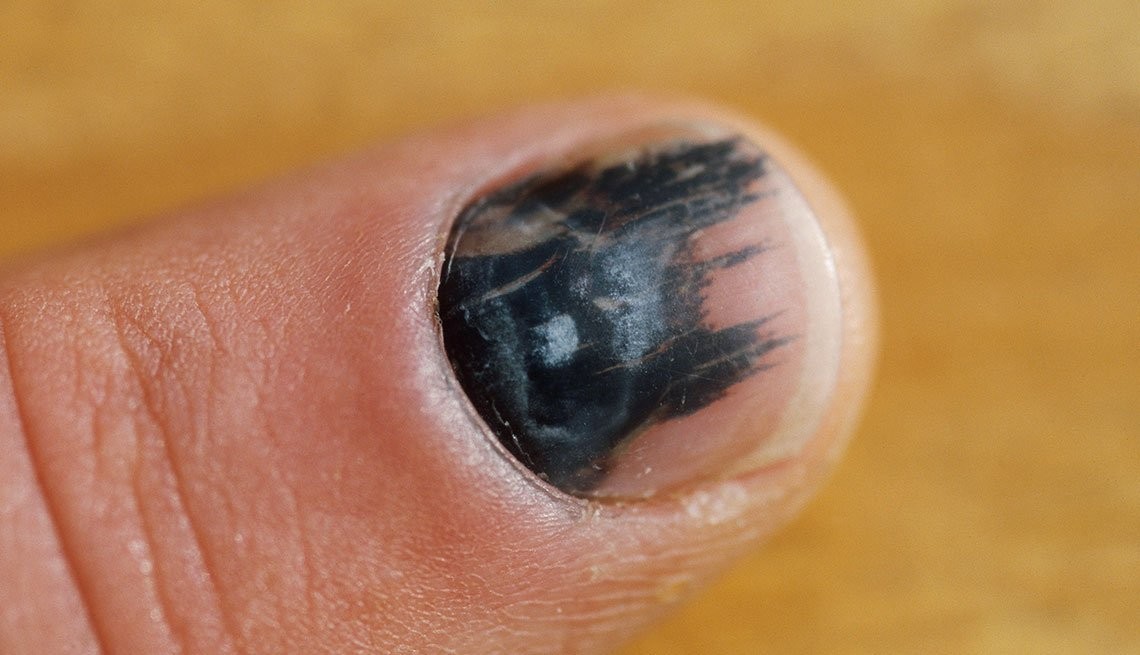
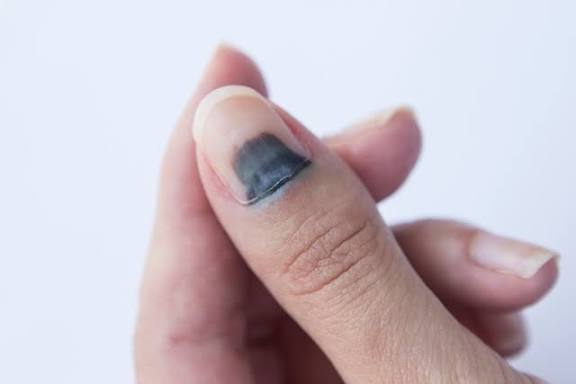
If you hit your finger or trap it in a door, blood can collect underneath the nail.
This creates a dark red, purple, brown, or almost black area called a subungual hematoma.
It can look alarming.
But there's an important clue.
As the nail grows, the discoloration caused by an injury should generally move toward the tip of the nail.
Over time, the damaged portion grows out.
That's very different from pigmentation that remains fixed near the base of the nail or progressively changes.
Watch what happens over time
Imagine noticing a dark spot underneath your thumbnail.
If you remember hitting your thumb a few days earlier, an injury is a reasonable possibility.
Over the following weeks, you may notice that the dark area slowly moves outward as the nail grows.
That's generally reassuring.
But if you don't remember injuring the nail and the discoloration persists, changes, expands, or develops unusual characteristics, it's worth having it evaluated.
This is especially important when the discoloration affects only one nail.
A dermatologist can examine the nail and, when necessary, use specialized magnification or other diagnostic methods to determine what is happening.
4. A New Dark Pigment That Spreads Onto the Skin Around the Nail
One particularly important feature to recognize is pigmentation that appears to extend beyond the nail itself and onto the surrounding skin.
This can sometimes occur with melanonychia and is known as Hutchinson sign when pigment extends onto the proximal or lateral nail folds.
It can have different causes, and not every case indicates melanoma.
However, when this finding occurs in the appropriate clinical context, it can be an important reason for further examination because melanoma of the nail unit can sometimes produce pigment that extends onto the surrounding skin.
This is one reason dermatologists don't look at the nail in isolation.
They also examine:
-
The skin surrounding the nail
-
The nail folds
-
The nail bed
-
The nail plate
-
The pattern and color of pigmentation
-
Whether the change is progressing
A photograph taken when you first notice the change can also be useful for comparing its appearance over time.
Why Nail Changes Can Be Easy to Miss
Nails change slowly.
That makes gradual abnormalities surprisingly easy to overlook.
A small streak may become slightly wider over several months.
A nail may gradually thicken.
A subtle color change may slowly become more obvious.
Because there is usually no immediate pain, people often assume nothing important is happening.
That's why paying occasional attention to your nails can be useful.
You don't need to constantly inspect them.
Simply noticing significant changes during routine grooming can help you recognize when something is different from your normal appearance.
Your Nails Can Change for Many Reasons Besides Cancer
This is perhaps the most important point of the entire article.
Nail changes are common, and cancer is not the most likely explanation for most of them.
A nail can change because of something as simple as:
Aging
Nails may become thinner, more brittle, or develop ridges as people get older.
Trauma
Repeated impacts or pressure can alter nail growth.
Nail cosmetics
Frequent manicures, artificial nails, aggressive filing, or chemical exposure can damage nails.
Fungal infections
These commonly cause thickened, discolored, brittle nails.
Skin conditions
Psoriasis, eczema, and other inflammatory disorders can affect the nails.
Nutritional issues
Certain nutritional deficiencies can contribute to changes in nail appearance, although nails alone cannot reliably diagnose a deficiency.
Medications
Some medications can cause changes in pigmentation or nail growth.
Systemic illness
Some medical conditions can affect nail growth, color, or texture.
So the goal isn't to look at your nails and diagnose yourself.
The goal is to recognize unexplained or persistent changes that deserve professional assessment.
What About White Spots on Your Nails?
White spots are extremely common.
Many people immediately associate them with calcium deficiency.
But that's often an oversimplification.
Small white spots on individual nails are frequently related to minor trauma affecting the nail as it develops.
They can appear after things like:
-
Bumping the nail
-
Picking at the cuticle
-
Aggressive manicuring
-
Minor damage to the nail matrix
As the nail grows, these spots usually move toward the tip and eventually disappear when the nail is trimmed.
So a few small white marks generally aren't a reason to assume something is seriously wrong.
What About Ridges in the Nails?
Nail ridges can also have many causes.
Vertical ridges running from the cuticle toward the tip are common, particularly with aging, and are often harmless.
However, a new horizontal groove or indentation across the nail can sometimes indicate that nail growth was temporarily interrupted.
These grooves are often called Beau's lines.
They can occur after:
-
Significant illness
-
Fever
-
Physical trauma
-
Severe stress on the body
-
Certain medical treatments
-
Other conditions that temporarily disrupt nail growth
The appearance of such a groove doesn't tell you exactly what caused it.
A healthcare professional needs the broader medical history to interpret it properly.
Can Nail Color Reveal Your Health?
Nail color can change for countless reasons.
Yellow nails, for example, can occur with fungal infections, staining from nail polish, smoking, or certain medical conditions.
Bluish nails can sometimes be associated with reduced oxygenation or circulation problems, although lighting, temperature, and other factors can affect appearance.
Pale nails may have numerous causes as well.
This is why using nail color as a stand-alone diagnostic test isn't reliable.
Instead, consider the entire picture.
Is the change new?
Is it getting worse?
Is it affecting one nail or many?
Are there other symptoms?
Did you recently injure the nail?
Are you taking a medication that could cause the change?
Those details matter.
When Should You See a Dermatologist?
A dermatologist can evaluate abnormalities of the skin, hair, and nails.
Consider arranging an evaluation if you notice a nail change that is:
-
New and unexplained
-
Persistent
-
Progressively changing
-
Associated with pain or bleeding
-
Associated with a lump or growth
-
Causing the nail to separate or become destroyed
-
Producing a new dark streak
-
Producing irregular pigmentation
-
Extending onto the surrounding skin
You don't have to wait until a nail becomes severely abnormal.
When it comes to unusual pigmentation or growths, early professional assessment can be valuable simply because it helps distinguish harmless conditions from those that need treatment.
A Simple Habit That Can Help
You don't need a complicated health routine to monitor your nails.
Once in a while, take a moment to look at them while washing your hands, trimming your nails, or applying moisturizer.
Pay attention to your normal baseline.
You might even take a clear photograph if you notice something unusual.
Then, if the feature changes, you'll have something to compare it with.
This is particularly useful for a pigmented streak or other slow-changing feature.
Don't Let the Internet Diagnose Your Nails
One dark line can generate hundreds of frightening search results.
A ridge can lead to a list of serious diseases.
A white spot can be blamed on a vitamin deficiency.
This is one of the problems with online health information: the same visible symptom can have dozens of possible explanations.
A photograph cannot always distinguish between them.
That's why the best approach is neither to panic nor to ignore the change.
Instead:
Notice it.
Observe whether it changes.
Consider possible everyday explanations.
And seek professional advice when the change is persistent, unusual, or concerning.
The Bottom Line
Your nails may occasionally provide clues about your health, but they are not a crystal ball.
Most nail abnormalities are caused by relatively common issues such as trauma, fungal infections, aging, medications, nail treatments, or skin conditions.
Still, certain changes deserve attention—especially a new or changing dark streak, persistent unexplained discoloration, significant nail distortion, or pigmentation that extends onto the surrounding skin.
These findings don't mean you have cancer.
They mean it's worth finding out what is causing the change.
Your nails grow slowly, making them an easy part of the body to overlook. But once you know what your normal nails look like, significant changes become easier to recognize.
And sometimes, the most important thing you can do isn't to search for the scariest explanation.
It's simply to notice that something has changed—and get the right person to take a closer look.