Why an Ambulance Can Become a Dangerous Place During a Crash
Ambulances are designed to transport patients and provide medical care. They are not immune to the physical forces involved in a collision.
In fact, the rear compartment can present special challenges.
A patient may be lying on a stretcher. Medical staff may be seated beside the patient or moving around to provide treatment. Equipment such as monitors, oxygen supplies, bags, and other medical devices may be secured in designated locations.
When the vehicle stops suddenly or rolls over, those inside can be exposed to rapid changes in direction and force.
Even equipment that is properly stored can become dangerous if it is damaged or displaced.
The patient may be unable to brace themselves. A newborn may require additional support and careful positioning. A medical professional may be focused on treatment rather than the road.
This is why ambulance safety involves more than the driver’s skill.
It also depends on vehicle design, restraint systems, crew procedures, patient positioning, equipment storage, and the ability to make safe decisions during transport.
The Albany crash demonstrated how quickly several risks can come together.
The Difficult Balance Between Patient Care and Road Safety
One of the most complicated issues raised by the incident is the balance between providing medical care and operating the ambulance safely.
Inside an ambulance, medical personnel may need to monitor a patient, assist with breathing, manage bleeding, or prepare for childbirth.
Those tasks can require attention and movement.
But the vehicle is also traveling through public traffic, where other drivers, pedestrians, and road conditions can create unexpected hazards.
The driver must remain focused on the road and make decisions that protect everyone involved.
The later interview with Holloway raised questions about what should happen when a delivery occurs during transport.
He said standard procedure calls for the crew to pull over and reassess the situation when a birth is in progress, so that the mother, newborn, and personnel can be secured.
He also said that, as a new employee, he relied on the more experienced provider beside him.
The county’s statement emphasized that EMS personnel are trained to manage labor and delivery while maintaining a safe environment for patients, staff, and other motorists.
It also explained that the actions taken can depend on the patient’s condition, the stage of labor, and the circumstances of the transport.
That is an important point. Emergency medical care often requires decisions based on changing conditions.
However, the crash shows why those decisions must be guided by clear protocols and a strong safety culture.
The Importance of Seat Belts Inside an Ambulance
Seat belts are one of the most basic protections in any vehicle, but their use inside an ambulance can become complicated when medical care is required.
A patient may need to be monitored continuously. A paramedic may need to reach the patient or operate equipment. During childbirth, the medical team may need to provide immediate assistance.
Still, the risks of being unrestrained during a collision are significant.
A person who is not secured can be thrown against the interior of the vehicle or into other occupants. In a rollover, the direction of movement can change repeatedly.
The later reporting on the Albany crash raised questions about the use of restraints and the procedures in effect at the time.
Holloway said he believed the crew should have stopped and secured everyone after the delivery.
The county said its personnel follow applicable safety requirements and protocols, and that decisions about restraints depend on the circumstances and patient needs.
These statements show the importance of reviewing safety procedures carefully.
The goal is not to prevent medical staff from providing necessary care. It is to create an environment where care can be delivered with the greatest possible protection for everyone inside the ambulance.
The Other Drivers Were Also Part of the Emergency
The crash did not involve only the ambulance and its occupants.
The pickup truck and Buick Encore were also struck during the collision.
Their drivers and passengers were suddenly confronted with a vehicle that had overturned in the middle of an intersection.
For the people inside those cars, the accident may have happened with little time to react.
The later account from one of the pickup truck occupants described the collision as happening too quickly for her to respond.
She was traveling with family members when the ambulance struck the truck.
The crash also damaged the third vehicle, whose driver was reportedly trapped or pinned by the wreckage.
This detail underscores an important aspect of emergency vehicle safety: the risks of an ambulance collision extend to everyone sharing the road.
An ambulance may be responding to a life-threatening emergency, but other road users still need to be protected.
The public relies on emergency vehicles to move quickly, yet that movement must be managed with appropriate caution.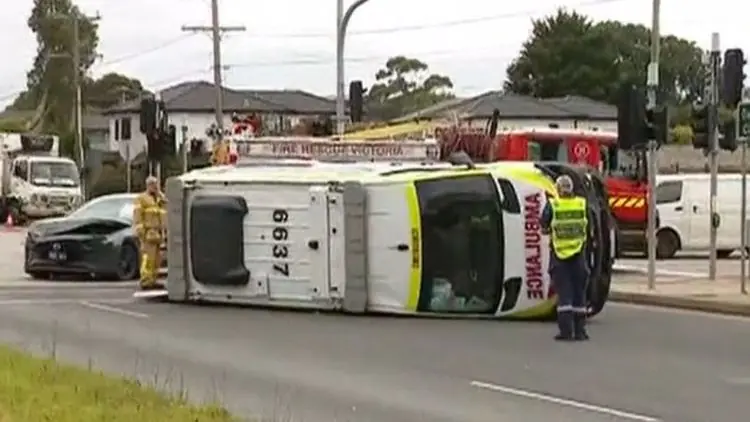
The Role of Traffic Signals and Intersections
Intersections are among the most complex places for emergency vehicles to navigate.
They bring together traffic moving in different directions, pedestrians, turning vehicles, and drivers who may not see or hear an approaching ambulance immediately.
Even when an emergency vehicle uses warning lights and a siren, other motorists may be distracted, confused, or unable to move out of the way safely.
The Albany crash occurred at the intersection of Pine Avenue and Monroe Street.
The Georgia State Patrol report described the ambulance approaching the intersection and colliding with the pickup truck.