A large earthquake that produces little vertical displacement of the seabed may generate a smaller tsunami than another earthquake with different fault characteristics.
Why the first wave may not be the largest
One dangerous misunderstanding is the belief that a tsunami arrives as one enormous wave.
In reality, a tsunami usually consists of a series of waves.
The first wave may be followed by several additional waves, sometimes separated by considerable periods.
Depending on local geography and ocean conditions, a later wave can be larger or more destructive than the first.
This means that people who survive the initial impact should not assume that the danger has passed.
Returning to the coastline too soon can expose them to additional waves, strong currents and floating debris.
The National Weather Service warns that tsunami waves can continue for hours and that the first wave is not necessarily the largest.
Tsunami Hazards
Why coastal geography makes a difference
Some coastlines are more vulnerable than others.
Narrow bays, coastal inlets and certain harbor shapes can concentrate incoming water.
Low-lying communities may be especially exposed because even relatively modest increases in water level can flood large areas.
The Sanriku coastline in northeastern Japan contains numerous deep coastal embayments.
Historical tsunami events have demonstrated how these geographical features can amplify wave heights and increase inland inundation.
The USGS has documented this vulnerability in its geological summary of the 2011 earthquake.
2011 Great Tohoku Earthquake, Japan
The hidden danger of powerful currents
A tsunami is not dangerous only because of the height of its waves.
Fast-moving water can exert tremendous force against buildings, vehicles, bridges and other infrastructure.
It can carry heavy objects over considerable distances.
A person caught in the current may be struck by timber, pieces of buildings, vehicles or other debris.
Even after the main flooding begins to recede, powerful currents can continue moving through streets and waterways.
This is why evacuation should always be directed toward designated high ground or safe inland areas rather than simply moving away from the visible shoreline.
Aerial view of tsunami destruction along Japan's coastline
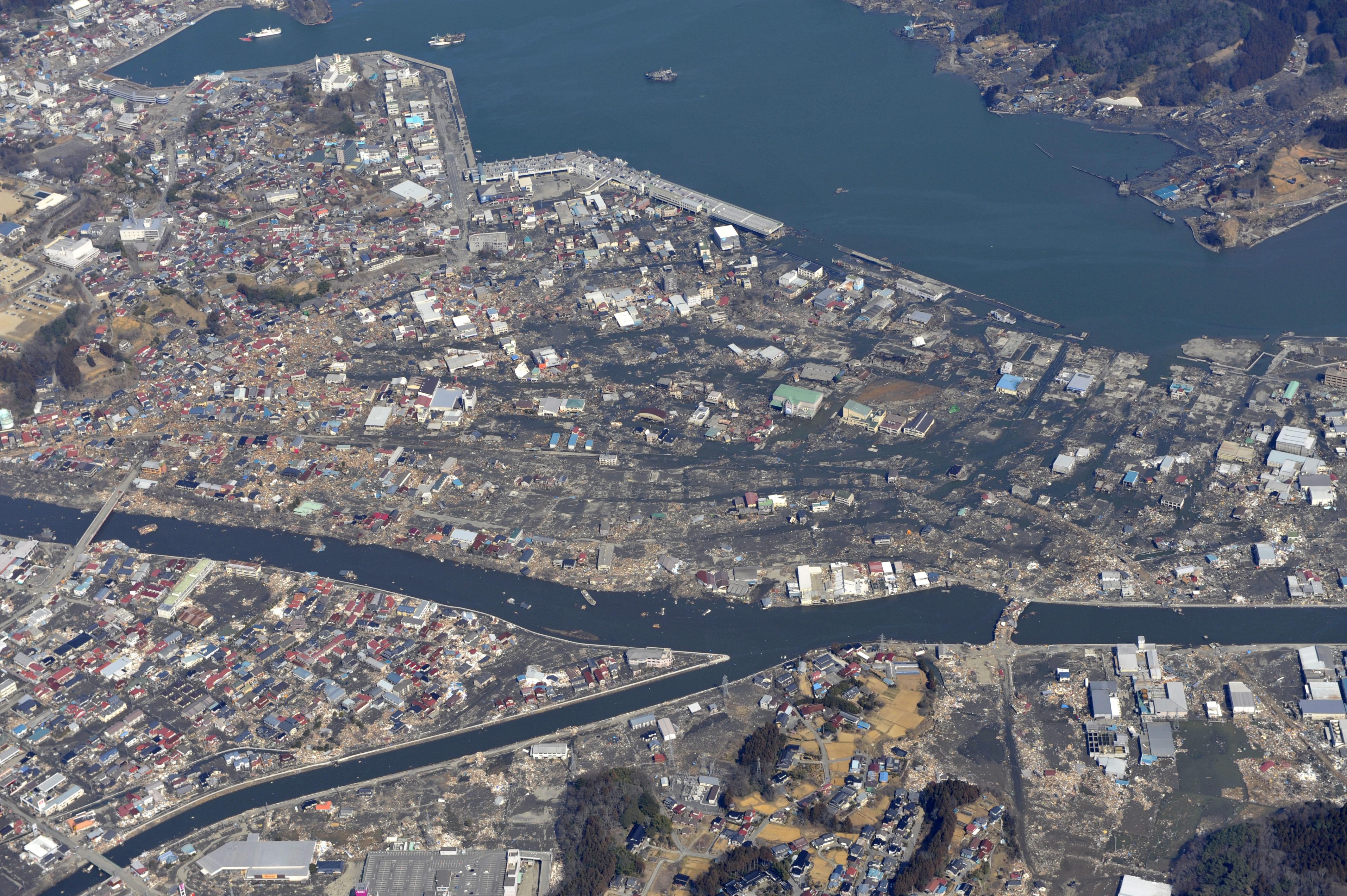
Image 2: Coastal destruction documented after the March 2011 Tōhoku disaster.
Why scientists cannot predict the exact moment of an earthquake
Scientists can identify areas where large earthquakes are more likely to occur.
They can study fault movements, historical seismic activity and patterns of accumulated stress.
However, they cannot currently predict the exact date, time and location of an individual major earthquake with sufficient reliability for public warnings.
This is why earthquake monitoring and tsunami-warning systems are so important.
Instead of waiting for scientists to predict an earthquake days in advance, modern warning systems monitor seismic activity and ocean conditions after an event begins.
Their purpose is to provide people with as much time as possible to move to safety.
A few minutes may seem insignificant, but during a tsunami emergency, those minutes can be extremely valuable.
Chapter 3: When Entire Coastal Communities Disappear Beneath the Water
The most devastating aspect of a major tsunami is not always the height of the waves.
It is the speed at which an entire community can be transformed.
A neighborhood that has existed for generations may be reduced to scattered foundations, broken timber and flooded streets. Places where families once gathered, children attended school and fishermen prepared their boats can become almost unrecognizable.
This was the reality faced by thousands of people along Japan's northeastern coastline in March 2011.
The terrifying arrival of the water
When the earthquake struck, residents across northeastern Japan felt powerful shaking.
Buildings moved violently, furniture fell and roads began to crack in some locations.
For many coastal communities, the earthquake itself was an unmistakable warning.
Tsunami alerts were issued, and residents began moving toward higher ground.
However, not everyone had enough time to escape.
The tsunami arrived rapidly in areas closest to the earthquake's source. According to NOAA, the first waves reached parts of the northeastern Honshu coastline within approximately 30 minutes, while some observations closer to the epicenter recorded arrival within about 15 minutes.
ncei.noaa.gov+1
As the water advanced, it did not behave like an ordinary wave breaking along a beach.
Instead, enormous volumes of water surged inland.
The advancing flood carried debris, vehicles, boats and sections of buildings.
In some locations, the water moved through residential streets with enough force to destroy structures that had stood for decades.
Cars became objects carried by the current
One of the most disturbing features of tsunami photographs is the sight of vehicles surrounded by floodwater.
Cars are designed to withstand ordinary road conditions, not powerful ocean currents.
When a tsunami enters a town, vehicles can be lifted, pushed sideways and carried into buildings or other obstacles.
Some are swept into fields, while others become trapped beneath collapsed structures.
Even large vehicles may lose stability when the water becomes deep enough.
The danger increases when debris is carried alongside the water.
A floating vehicle can become a dangerous obstacle for anyone attempting to escape on foot.
This is why evacuation routes should lead away from flood-prone streets and toward higher ground rather than toward roads that may become blocked.
Buildings cannot always withstand the force
Modern buildings are designed to meet specific structural requirements.
However, tsunami forces can be very different from the loads considered during ordinary construction.
Water pressure increases with depth, and moving water can push against walls, doors and foundations.
Floating debris can strike buildings repeatedly.
In some cases, the water can undermine foundations by removing soil around structural supports.
Buildings near the coast may therefore suffer severe damage even if they initially survive the earthquake.
The 2011 disaster demonstrated that earthquake-resistant construction alone does not guarantee protection against tsunami flooding.
Coastal communities need to consider both hazards when planning buildings and evacuation infrastructure.
The tragedy of the Fukushima region
The 2011 earthquake and tsunami also created a major nuclear emergency.
At the Fukushima Daiichi Nuclear Power Station, tsunami flooding disabled important electrical and cooling systems.
Without adequate cooling, several reactor units suffered severe damage.
The resulting nuclear accident became one of the most significant nuclear emergencies in modern history.
This demonstrated how a natural disaster can trigger a chain of secondary emergencies.
A single earthquake can affect transportation, electricity, water supplies, communications, hospitals and industrial facilities simultaneously.
The consequences can extend far beyond the immediate coastline.
The NOAA documents the connection between the earthquake, tsunami and the disabling of three nuclear reactors in the days following the disaster.