Imagine sitting quietly at home when you suddenly notice something moving near your front door.
You look closer and see a black cat standing at the entrance.
Its eyes reflect the light. Its dark fur almost blends into the shadows, and it seems completely comfortable in a place it has never visited before. Perhaps it takes a few cautious steps inside, looks around, and then settles near the doorway as if it belongs there.
For some people, this would be an ordinary encounter with a curious animal. For others, it might immediately raise an intriguing question:
Does a black cat entering your home mean good luck or bad luck?
For centuries, black cats have occupied a fascinating place in human imagination. They have been associated with witches, supernatural powers, protection, prosperity, mystery, and even unexpected good fortune.
In some cultures, seeing a black cat is considered a positive sign. In others, the same encounter has traditionally been interpreted as an omen of misfortune.
But where did these beliefs come from? Why have black cats been treated so differently throughout history? And what does it actually mean when one unexpectedly walks into your home?
The answers reveal a surprising mixture of folklore, cultural traditions, history, and ordinary animal behavior.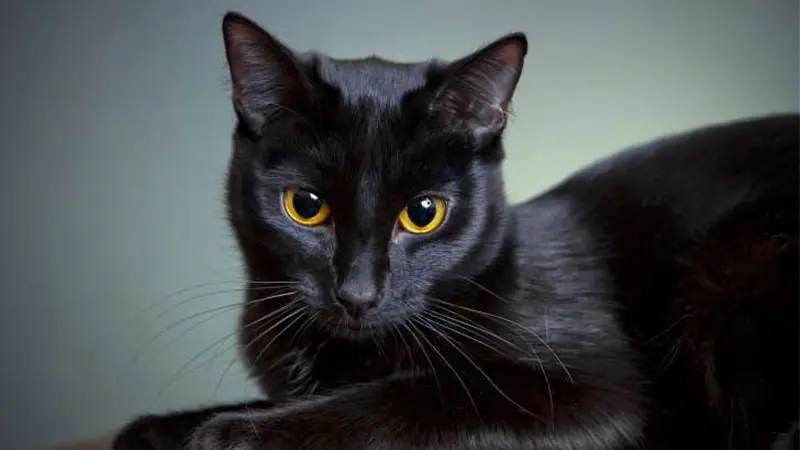
1. Why Are Black Cats Surrounded by So Much Mystery?
Cats have lived alongside humans for thousands of years.
Their independence, quiet movements, excellent night vision, and ability to appear almost silently have made them fascinating animals throughout history.
Unlike many domesticated animals, cats often move according to their own instincts. They may disappear for hours, observe people from a distance, and suddenly appear in places where nobody expected them.
Their behavior has sometimes encouraged people to associate them with mystery.
Black cats, in particular, have attracted attention because their dark coats can make them difficult to see in dimly lit environments.
When a black cat suddenly appears at night, its eyes may seem to glow in the darkness. Its movements can look almost supernatural to someone unfamiliar with cats.
Before modern science explained feline vision and behavior, people often interpreted unusual animal encounters through religious beliefs, folklore, and superstition.
Over time, these interpretations became part of cultural traditions.
Some communities viewed black cats as protectors. Others considered them symbols of danger.
The same animal could represent completely opposite meanings depending on where someone lived.
That is one reason why the question of whether a black cat brings good or bad luck has never had one universal answer.
2. In Some Cultures, a Black Cat Entering Your Home Is Considered Good Luck
Although black cats are sometimes associated with negative superstitions, many traditions view them positively.
In certain parts of the world, a black cat appearing near a home is traditionally interpreted as a symbol of prosperity, protection, or good fortune.
Scottish Folklore: A Black Cat May Bring Prosperity
One well-known Scottish tradition associates a black cat arriving at a home with good fortune.
According to popular folklore, a black cat appearing at someone's doorstep may be a sign of prosperity or a positive change in the household.
Some versions of the tradition even associate a black cat with financial good fortune.
The idea is that the unexpected arrival of the animal may signal that something favorable is coming.
Whether or not someone believes in this superstition, it offers an interesting contrast to the negative image of black cats found in other European traditions.
Japanese Culture: Black Cats Can Symbolize Good Fortune
In Japan, black cats have also been associated with positive symbolism.
They are sometimes viewed as symbols of good luck, protection, and favorable circumstances.
In certain Japanese folk beliefs, black cats are thought to offer protection against misfortune or attract positive outcomes.
Their associations can vary depending on the region and tradition, but the general image is not necessarily negative.
Cats are also prominent in Japanese popular culture, art, and everyday life.
The famous maneki-neko, or beckoning cat, is widely recognized as a symbol associated with good fortune and prosperity. Although the traditional figurine is commonly depicted in several colors, black versions are sometimes associated with protection against evil or negative influences.
This illustrates how the meaning of a cat's color can change dramatically between cultures.
A Black Cat as a Symbol of Protection
Some folk traditions associate black cats with the ability to protect a home from negative influences.
In these interpretations, a black cat entering a house is not something to fear. Instead, it may be viewed as a comforting symbol.
People who follow these beliefs might interpret the animal's arrival as a reminder to protect their household, maintain positive relationships, and appreciate the unexpected moments in life.
Of course, these are cultural and spiritual interpretations rather than scientifically demonstrated effects.
Still, they show that the belief that black cats bring bad luck is far from universal.
3. Why Did Black Cats Become Associated With Bad Luck?
The negative reputation of black cats has deep historical roots, particularly in parts of medieval and early modern Europe.
During periods when fear of witchcraft and supernatural forces became widespread, certain animals were incorporated into stories about magic and evil.