If the cat enters during bad weather, it may simply be trying to find a safe place to rest.
It May Be Curious
Curiosity is a familiar part of feline behavior.
Cats frequently investigate unfamiliar smells, sounds, objects, and spaces.
An open door creates an opportunity to explore somewhere new.
A confident cat may walk inside without hesitation, while a more cautious animal may remain near the entrance and observe its surroundings.
It May Have Lost Its Home
Not every cat wandering outdoors is a stray.
Some are beloved pets that have escaped, become disoriented, or wandered farther than usual.
A friendly cat that approaches people comfortably may have previous experience living with a family.
If you encounter one, check whether it has a collar or identification tag.
You can also contact a local animal rescue organization or veterinary clinic to ask about appropriate ways to check for a microchip.
6. Does the Time of Day Change the Meaning?
Some superstitions assign different meanings to black cat encounters depending on when they happen.
For example, a black cat appearing at night may be interpreted as more mysterious than one seen during daylight.
This is partly because cats are often associated with nighttime activity.
However, there is no scientific evidence that the time of day changes whether an encounter brings good luck or bad luck.
Cats are naturally more active around dawn and dusk, although their routines vary.
A cat may also become active at night because it is searching for food, exploring its territory, or avoiding busy daytime environments.
If one enters your home in the evening, it does not mean something unusual is about to happen.
It may simply be following its normal behavior.
7. What Does It Mean When a Black Cat Sits Near Your Door?
Another common situation involves a black cat that does not actually enter the home.
Instead, it sits outside the entrance and appears to watch the household.
Some traditional interpretations associate this behavior with protection or an approaching change.
Others consider it a sign of good fortune.
But from a behavioral perspective, several explanations are possible.
The cat may have discovered a comfortable resting place. It may feel safe near your entrance because the area offers protection from wind or rain.
It may also be attracted to the warmth coming from inside the house.
If the cat visits repeatedly, it could have established a routine.
Cats are territorial animals and often return to places where they feel secure.
A familiar doorstep may become part of their regular route.
If the animal appears healthy and comfortable, it may simply have found a convenient place to rest.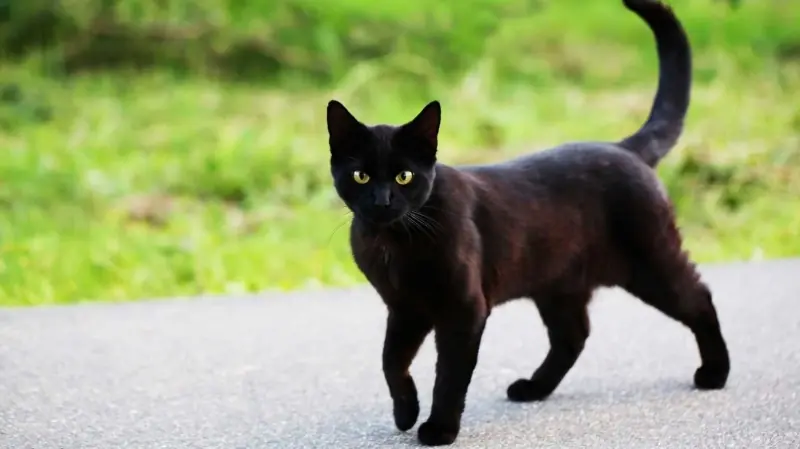
8. What If a Black Cat Keeps Returning to Your House?
A black cat that visits once may be curious.
But what if it returns every day?
What if it sits near your door every morning, waits outside your window, or repeatedly tries to enter your home?
There are several possible explanations.
It may associate your home with food.
If someone in the household has fed the cat before, it may return because it expects another meal.
It may feel safe around you.
Cats often develop preferences for people who approach them calmly and respect their boundaries.
It may have established a territory nearby.
Your garden, porch, or entrance may be part of its regular territory.
It may need assistance.
A cat that appears thin, injured, weak, or unusually distressed may need help.
If you suspect it is lost or abandoned, consider contacting a local rescue group or veterinarian.
Repeated visits are not proof of a supernatural connection.
They may simply indicate that the cat has discovered a place where it feels comfortable.
9. What Should You Do If a Black Cat Enters Your Home?
Regardless of whether you consider the visit lucky, the most important thing is to respond calmly and safely.
Here are some practical steps.
Step 1: Stay Calm and Give the Cat Space
Do not shout, chase, or make sudden movements.
A frightened animal may react defensively.
Allow the cat to explore only if the environment is safe and you can supervise it.
Step 2: Check Whether It Has Identification
Look for a collar or identification tag.
If the cat appears friendly, you may be able to check the tag without forcing contact.
If it has an owner, the information may help you reunite the animal with its family.
Step 3: Offer Water
If the cat appears thirsty, provide a clean bowl of fresh water.
Avoid giving cow's milk. Many cats cannot digest lactose properly, and milk may cause digestive problems.
If you choose to offer food, use appropriate cat food rather than assuming that ordinary human food is suitable.
Step 4: Keep Other Pets Separate
If you have cats, dogs, or other household animals, do not immediately introduce them to an unfamiliar visitor.
The newcomer may carry parasites or infectious diseases, and an unfamiliar encounter can cause stress or aggression.
Provide a separate, quiet space if you are temporarily helping the animal.