An apparently minor roof issue may turn out to involve a larger section of the structure.
For this reason, renovation budgets should include a contingency allowance.
The appropriate amount depends on the property's condition and the complexity of the work.
A professional cost estimate should explain which items are confirmed, which are provisional, and which remain uncertain.
Without this information, even a seemingly inexpensive project can become financially difficult.
Who Could Turn This House Into Something Extraordinary?
The property is unlikely to be ideal for someone who simply wants to purchase a house and move in next month.
It demands a different kind of buyer.
Perhaps an architect who enjoys unusual geometries.
Perhaps a contractor who understands complex renovations.
Perhaps a family with a long-term vision and enough financial flexibility to complete the work gradually.
Or perhaps someone who has always dreamed of living in a home that looks different from every other property on the street.
The Architecture Enthusiast
For an architecture enthusiast, the greatest attraction may be the opportunity to preserve a distinctive building.
Rather than purchasing a standard home and attempting to add character through decoration, the buyer starts with a structure that already has an identity.
The challenge is to understand that identity and develop it thoughtfully.
The Experienced Renovator
An experienced renovator may recognize opportunities that an ordinary buyer overlooks.
They may know how to coordinate contractors, compare material costs, identify structural problems, and avoid unnecessary design changes.
Their experience could be particularly valuable when working with curved walls and nonstandard construction.
The Creative Homeowner
A creative homeowner might see the unfinished interior as an opportunity to build a personalized living environment.
A library, studio, home office, or distinctive entertainment space could become part of the final design.
However, creativity must be balanced with practical considerations.
The best renovation is not necessarily the most dramatic one.
It is the one that combines architectural character with safety, comfort, durability, and a realistic budget.
The Transformation: What the Finished House Could Look Like
Imagine returning to the property after several months of carefully planned renovation.
The exterior remains largely unchanged.
The curved balcony has been repaired and refinished. The stonework has been cleaned. The roof has been inspected and restored where necessary. The unusual cylindrical feature remains the visual centerpiece.
But the interior has finally caught up with the ambition of the exterior.
The walls are finished in warm neutral tones. Natural light enters through carefully restored windows. The living room feels spacious rather than empty, and furniture has been selected to complement the curved architecture.
The kitchen combines modern functionality with simple natural materials.
The bedrooms are comfortable and quiet.
The bathrooms are fully finished, with reliable plumbing and good ventilation.
Outside, the lawn remains open, while carefully maintained shrubs and subtle lighting make the property feel welcoming.
This is the kind of transformation that could give the house a second life.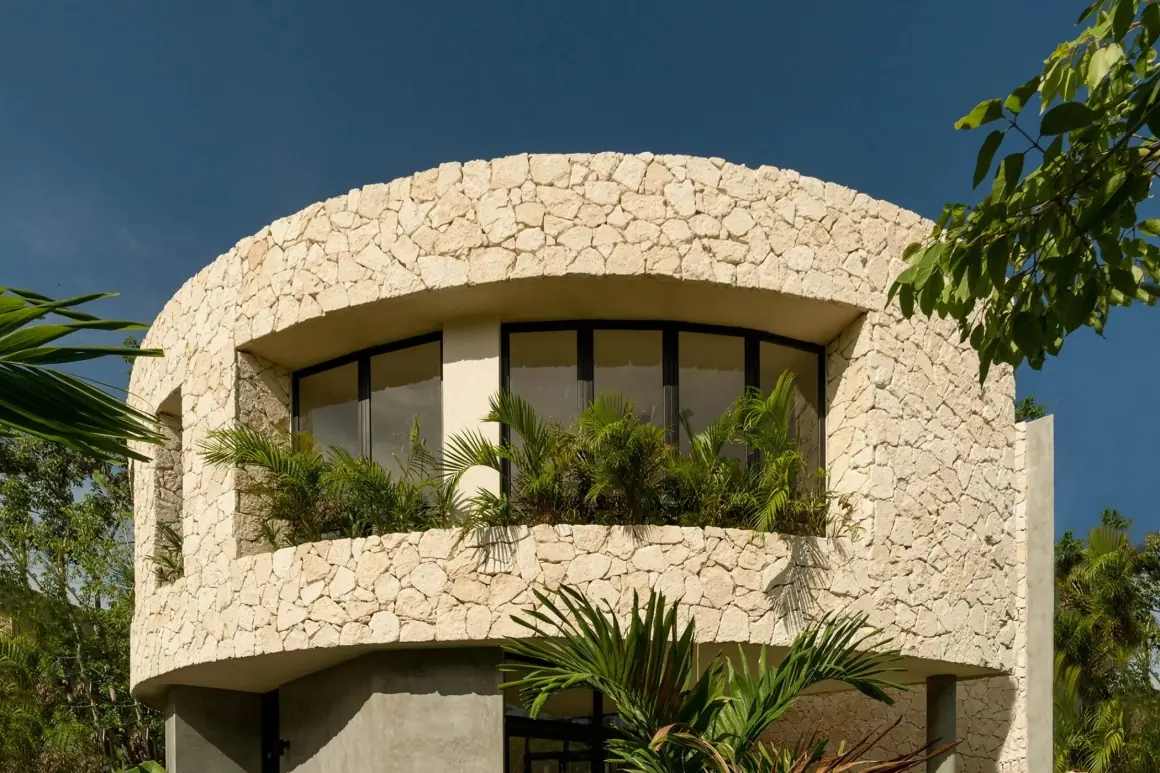
Why Preserving the Original Character Matters
One temptation during renovation is to remove every unusual feature and replace it with something conventional.
That might make the house easier to furnish, but it could also destroy the very reason someone wanted to purchase it.
The rounded walls, unusual roofline, and curved balcony are not minor decorative details.
They define the building.
A more thoughtful approach would preserve the features that remain structurally sound and modernize the elements that affect comfort and safety.
This balance is particularly important when renovating an architecturally distinctive property.
Modernization should not necessarily mean removing everything that makes the building different.
A Home That Could Become More Than a Residence
There is also an emotional dimension to a project like this.
A conventional renovation often focuses on making a house look newer.
An architectural restoration can have a different objective: bringing an unfinished vision to completion.
The buyer is not simply selecting paint colors or installing new furniture.
They are making decisions about how an unusual building should function for another generation.
Perhaps the rounded central space becomes a private library.
Perhaps the balcony becomes the family's favorite place to spend summer evenings.
Perhaps the living room becomes a bright gathering space where the building's unusual architecture can finally be appreciated.
These possibilities are what make the project so captivating.
But they remain possibilities until the building has been professionally inspected and the renovation has been completed.
The Truth Behind the $65,000 Story
There is one important detail that deserves clarification before drawing conclusions about this unusual property.
The online headline describes a fascinating $65,000 architectural renovation project. However, related coverage presents the $65,000 figure as a reported property asking price, not as a confirmed total renovation budget.
Some circulating descriptions also mention approximately 3,000 square feet, three bedrooms, and three bathrooms.
However, the available screenshot does not independently establish the property's address, complete listing information, construction history, or actual renovation expenses.
There is also no verified contractor estimate showing that the entire interior could be completed for $65,000.
Consequently, the figure should be treated as a reported price rather than proof that a complete architectural transformation can be achieved for that amount.
This distinction does not make the property less interesting.
In fact, it makes the central question even more important:
Would purchasing an unusual unfinished house at a relatively low price be a worthwhile opportunity once all the necessary work is considered?
The answer would depend on a structural inspection, the legal status of the property, local construction costs, and a realistic financial plan.
The architectural possibilities are attractive, but they should not be confused with confirmed renovation results.
Final Thoughts: An Unfinished House With an Unforgettable Identity
Some properties attract attention because of their location.
Others are memorable because of their size, luxury features, or spectacular views.
This house offers something different.
Its curved architecture, rounded central structure, broad balcony, and distinctive roofline give it a personality that is difficult to ignore.
The contrast between the polished exterior and unfinished interior makes the property even more fascinating.
For one buyer, it could represent an overwhelming construction challenge.
For another, it could be an opportunity to complete a remarkable architectural vision.
The most important thing is understanding what lies beneath the appearance.
A beautiful exterior cannot guarantee a sound foundation. A low asking price cannot guarantee an affordable renovation. And an unusual architectural design does not automatically translate into a comfortable home.
Nevertheless, the possibilities are difficult to dismiss.
With careful inspections, appropriate engineering, thoughtful interior planning, and realistic financial expectations, an unfinished property like this could potentially become a distinctive residence.
Perhaps that is the most interesting lesson behind the $65,000 story.
Sometimes the value of a house is not simply measured by how finished it looks today.
It is also measured by what it could become tomorrow.