He Smelled Something Strange in His House, Then Opened the Wall and Found This
After more than two decades in the pest-control business, Nick Castro had learned that houses can hide some remarkable surprises.
As the owner of Nick’s Extreme Pest Control in California, Castro had spent years investigating the kinds of problems most homeowners would rather never encounter. Animals could squeeze into spaces that seemed impossibly small. Insects could establish colonies behind walls without being noticed. Strange noises coming from an attic could turn out to have an explanation very different from what a homeowner initially imagined.
After more than 20 years on the job, there wasn't much that Castro believed could genuinely surprise him.
Then he received a call involving a woodpecker.
At first, the problem sounded relatively ordinary. A homeowner had noticed that a woodpecker was repeatedly drilling holes into the exterior siding of the house.
The visible damage was frustrating, but nothing about it suggested what was happening on the other side of those walls.
The bird wasn't simply pecking at the house.
It was using the structure for storage.
And by the time the wall was opened, the scale of what had accumulated inside was enough to astonish even an experienced pest-control professional.
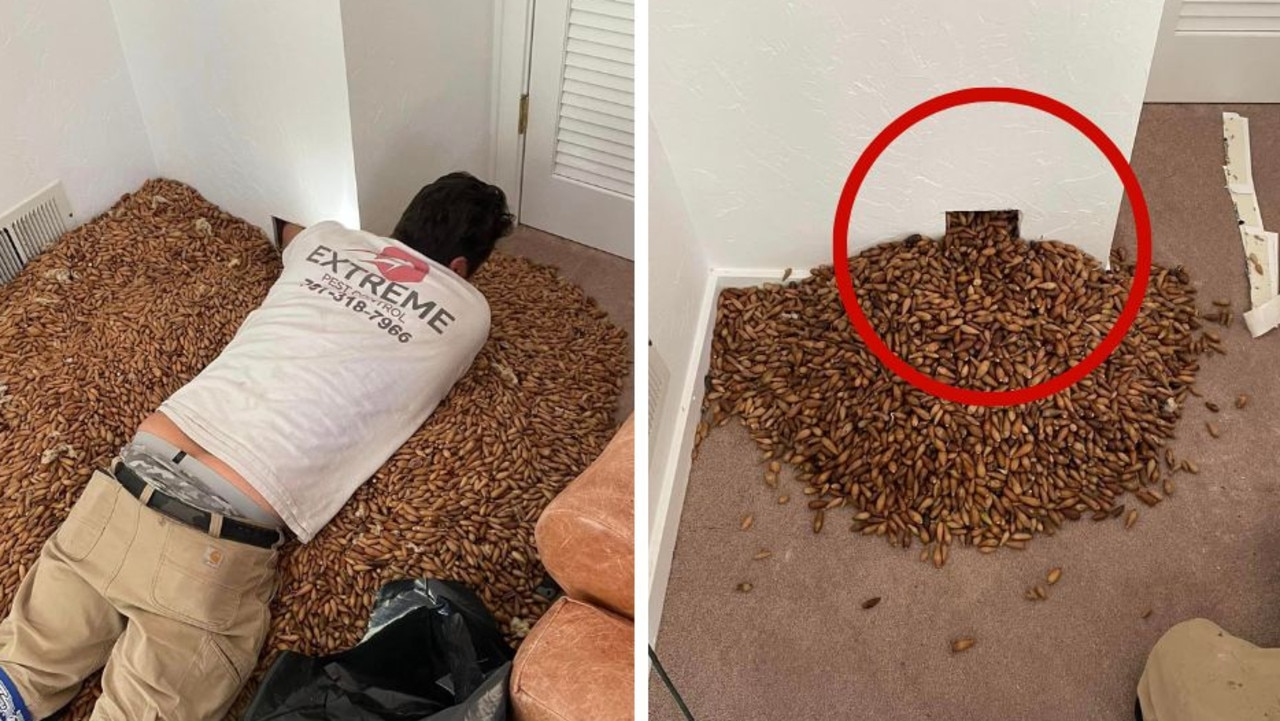
It Began With Some Suspicious Holes
From outside, the first signs of the problem didn't look particularly dramatic.
There were holes in the home's siding, apparently created by a woodpecker that had taken an interest in the property.
Woodpeckers peck at wooden surfaces for several reasons. Depending on the species and situation, they may be searching for insects, communicating, creating nesting cavities, or storing food.
In this case, food storage was the key.
The bird had been collecting acorns and pushing them into holes in the home's exterior.
An acorn here or there would hardly have been remarkable. Even several dozen might have seemed like little more than an unusual inconvenience.
But the design of the house created an unexpected problem.
The holes didn't function like shallow storage spaces.
Instead, they provided access to the hollow cavities behind the siding and inside the walls.
When the woodpecker inserted an acorn, gravity could pull it farther down into the structure.
The bird could then return with another acorn.
And another.
And another.
From the outside, all anyone could see were relatively small openings.
Inside the walls, however, a hidden collection had quietly been growing.
The First Opening Revealed Something Extraordinary
When Castro began investigating, he expected to encounter some acorns.
The evidence already suggested that the bird had been storing them around the house, so discovering a small collection would not have been surprising.
What happened when part of the wall was opened was another matter entirely.
Acorns began coming out.
Not just a few.
They poured from the wall cavity in a steady stream.
Imagine cutting into a section of drywall expecting to find perhaps a handful of nuts, only to discover that the space behind it has effectively become a reservoir.
The more material Castro removed, the more acorns appeared.
At first, the sight was amusing and unusual.
Then the scale of the accumulation became apparent.
This wasn't a bird's small emergency food supply.
There were enormous quantities of acorns hidden inside the structure.
The wall itself had essentially become a giant container.
The Acorns Had Spread Through the Wall Cavities
Finding a concentrated pile in one small area would have been remarkable enough.
But the investigation suggested that the problem extended much farther.
As additional sections were examined, Castro discovered that the acorns had accumulated through the cavities and reportedly reached toward the attic.
That detail transformed the story.
This wasn't something that had happened during a handful of visits.
The woodpecker had apparently returned again and again, repeatedly depositing food into the house.
Each individual trip probably seemed insignificant.
One bird carrying one acorn doesn't look capable of creating a major structural headache.
But repetition changes everything.
A single acorn becomes ten.
Ten become a hundred.
Hundreds become thousands.
And when the food continues dropping into spaces where it can't easily be seen—or retrieved—the accumulation can continue without anyone realizing what is happening.
For the homeowner, the evidence outside the house offered only a small clue.
Behind the siding was the real story.
Nearly 700 Pounds of Acorns Were Removed
Eventually, the amount removed from the property was estimated at roughly 700 pounds of acorns.
That number is what turned an already strange pest-control story into something almost difficult to imagine.
Seven hundred pounds is far beyond the amount most people would associate with a single bird's food-storage behavior.
According to accounts of the discovery, the enormous collection was enough to fill around eight large trash bags.
For Castro, it was unlike anything he had encountered during more than two decades in pest control.
That experience mattered.
Professionals in his field routinely see things hidden from ordinary homeowners: nests in attics, insects inside walls, rodents using crawl spaces, animals finding their way into chimneys, and all sorts of unexpected activity around buildings.
Yet a wall filled with hundreds of pounds of acorns was something different.
The house hadn't merely attracted an animal.
Part of it had inadvertently become an enormous pantry.
How Could One Bird Store So Much?
At first glance, the obvious question is how a woodpecker could possibly accumulate such an enormous amount of food.
The answer lies in persistence and the unusual structure of the storage location.
The bird was reportedly collecting acorns and placing them into holes in the exterior siding.