After more than two decades in the pest-control business, Nick Castro had already encountered plenty of unusual situations.
As the owner of Nick’s Extreme Pest Control in California, he had seen homeowners deal with all kinds of unexpected wildlife problems. Animals had found their way into places they didn't belong, insects had established hidden colonies, and properties had revealed surprises that were impossible to see from the outside.
Over the years, experiences like these can make even the strangest jobs seem somewhat predictable.
But one particular call was different.
It began with what sounded like a relatively ordinary complaint: a woodpecker was damaging the exterior of a house.
The bird had been repeatedly drilling holes into the home's siding, creating openings that the homeowner understandably wanted to have repaired.
At first, there was no obvious reason to think the situation was anything more than a nuisance involving a persistent bird.
But when Castro investigated the damage and eventually opened part of the wall, he discovered something that transformed a routine wildlife-control job into an extraordinary story.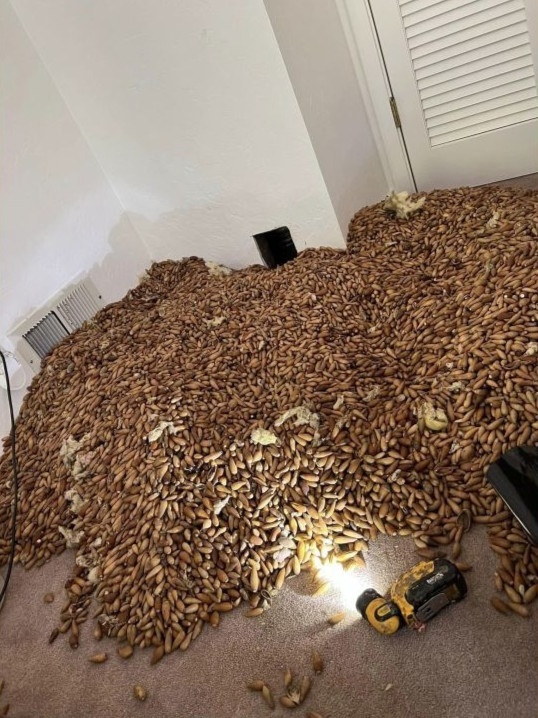
Acorns began pouring out of the wall.
And they didn't stop.
It Started With a Few Strange Holes
From the outside, the problem seemed fairly simple.
The homeowner had noticed holes appearing in the exterior siding of the house. The damage was consistent with the activity of a woodpecker repeatedly pecking at the structure.
Woodpeckers are well known for drilling into wood and other surfaces. They may do this while searching for insects, communicating, establishing nesting cavities, or engaging in other natural behaviors.
In some species, food storage can also be part of their behavior.
That last detail turned out to be particularly important.
The woodpecker wasn't simply creating random holes.
According to the account, she had been using the openings in the house to store acorns.
From the bird's perspective, the house apparently offered a convenient series of cavities.
But there was one major problem.
The holes weren't leading to a normal tree cavity.
They were connected to the hollow spaces inside the building.
And once the acorns entered those spaces, gravity took over.
The House Had Accidentally Become a Pantry
Imagine carrying one acorn at a time and placing it somewhere you believe is safe.
Then imagine doing it again.
And again.
And again.
For a bird, each individual acorn might seem insignificant.
But repeated thousands of times, those small pieces of food can become an enormous collection.
That appears to be what happened here.
The woodpecker had been repeatedly bringing acorns back to the house and placing them into holes in the siding.
Instead of remaining neatly stored near the surface, however, many of the acorns apparently fell farther into the wall cavities.
The bird could continue adding more without necessarily realizing just how much was accumulating below.
Over time, the hidden collection grew.
And grew.
And grew.
What had started with one small opening had apparently turned into an enormous storage system hidden inside the structure.
Castro Opened the Wall Expecting a Surprise—But Not This
When an experienced pest-control professional investigates animal activity inside a building, discovering some material inside the wall wouldn't necessarily be shocking.
There might be nesting material.
There could be a small amount of food.
There could even be evidence that an animal had been using the cavity for quite some time.
But according to the account, Castro was not prepared for what happened when he opened the wall.
Acorns began falling out.
At first, it was simply a surprising amount.
Then more appeared.
And more.
The discovery became increasingly difficult to comprehend.
Instead of finding a small cache, Castro was confronted with what appeared to be a massive accumulation of acorns packed into the building's interior spaces.
The hidden pantry was far larger than anyone had expected.
The Acorns Just Kept Coming
One of the most memorable aspects of the story is the sheer volume.
As more of the wall was opened, the acorns reportedly continued to emerge.
What initially looked like a strange but manageable collection became an enormous cleanup operation.
The acorns weren't sitting in one perfectly organized pile.
They had accumulated inside the cavities of the structure, where they could move downward and collect over time.
Every opening revealed the possibility of more.
For the people standing there, it must have been an extraordinary sight.
A wall that had appeared completely ordinary from the outside had effectively been hiding a giant food warehouse.
The Hidden Stash Extended Farther Than Expected
The initial discovery might have been impressive enough on its own.
But the story became even more remarkable when the extent of the accumulation became apparent.
According to the account, the acorns had traveled through the wall cavities and accumulated up toward the attic.
That meant this wasn't simply a small stash behind one section of siding.
The activity had apparently affected a much larger portion of the structure.
The woodpecker had been using the house repeatedly, while the acorns were gradually disappearing into the wall.
The result was essentially an invisible accumulation occurring behind the home's exterior.
From the outside, someone might see only a few holes.
Inside, however, an enormous amount of material was waiting.
Approximately 700 Pounds of Acorns
The final quantity reported in the story is what makes the incident particularly astonishing.
According to the account, approximately 700 pounds of acorns were eventually removed.
That's an extraordinary amount of food.
The collection reportedly filled around eight large trash bags.
Think about that for a moment.
A homeowner sees holes in the siding.
A professional arrives expecting to investigate bird activity.
The wall is opened.
And instead of finding a small nest or a few pieces of debris, nearly three-quarters of a thousand pounds of acorns are discovered inside.
For someone who had spent more than 20 years working in pest control, it was reportedly an experience unlike anything he had encountered before.
How Could One Bird Accumulate So Much?
The number may sound almost impossible at first.