This can happen with many types of wildlife activity.
An animal may enter through a tiny opening and then occupy a much larger area inside the building.
That's why recurring signs—such as holes, droppings, scratching noises, nesting material, or repeated animal activity—shouldn't always be dismissed as minor.
Sometimes the visible evidence represents only a small part of what is happening behind the scenes.
The Strange Connection Between a Woodpecker and a House
What makes this story particularly memorable is the contrast.
On one side, there is a relatively small bird.
On the other, there is a full-sized house.
Yet the bird managed to transform part of that house into a massive storage system.
One acorn at a time.
The situation illustrates something fascinating about animal behavior:
Wildlife can be remarkably persistent.
When an animal discovers a resource that works, it may return to that location repeatedly.
The homeowners may see a nuisance.
The animal may see a reliable food-storage opportunity.
Neither perspective is necessarily irrational.
They simply reflect two very different ways of interacting with the same environment.
A Routine Call Became an Unforgettable Discovery
For Castro, the incident reportedly stood out even after decades in the pest-control industry.
That's saying something.
People who work in pest and wildlife management regularly encounter situations that most homeowners never see.
They open walls.
They inspect attics.
They investigate crawl spaces.
They find nests, insects, droppings, damaged insulation, hidden animals, and all kinds of unexpected material.
Yet this particular discovery was memorable because of its sheer scale.
Nearly 700 pounds of acorns hidden inside a home is not an everyday pest-control problem.
What Homeowners Can Learn From the Story
The incident offers several practical lessons.
Pay attention to repeated damage
If an animal keeps damaging the same part of your home, there is probably a reason.
Don't focus only on the visible problem
A small hole may provide access to a much larger hidden space.
Inspect before sealing
If you seal an opening while an animal is still using the space, you may create another problem.
Use humane wildlife management
Whenever possible, identify what is attracting the animal and prevent access rather than causing unnecessary harm.
Repair the underlying weakness
A permanent repair is generally more useful than repeatedly patching the same damage.
The Most Incredible Part Wasn't the First Acorn
One acorn isn't remarkable.
Even a handful isn't particularly surprising.
The remarkable part was what happened after countless trips by a persistent bird.
Over time, small amounts accumulated into something enormous.
That's why the story is so fascinating.
It demonstrates how easily we can underestimate what is happening inside spaces we cannot see.
A few holes in the siding seemed like a minor inconvenience.
Behind them was a hidden collection reportedly weighing hundreds of pounds.
Nature Is Full of Unexpected Engineering
The woodpecker didn't have blueprints.
She didn't understand the architecture of the house.
She didn't know that the wall cavities could hold hundreds of pounds of food.
She simply discovered an opening and used it.
The rest happened through instinct, repetition, and the physical structure of the building.
In a strange way, the story demonstrates how animals can adapt to environments humans create.
They don't need to understand our buildings.
They only need to discover how those buildings can serve their needs.
A Tiny Bird, a Huge Pantry, and One Very Surprised Pest Expert
What began as a complaint about holes in a home's siding eventually revealed an astonishing hidden story.
A woodpecker had reportedly been using the house as an acorn-storage site.
The individual trips were small.
The consequences were not.
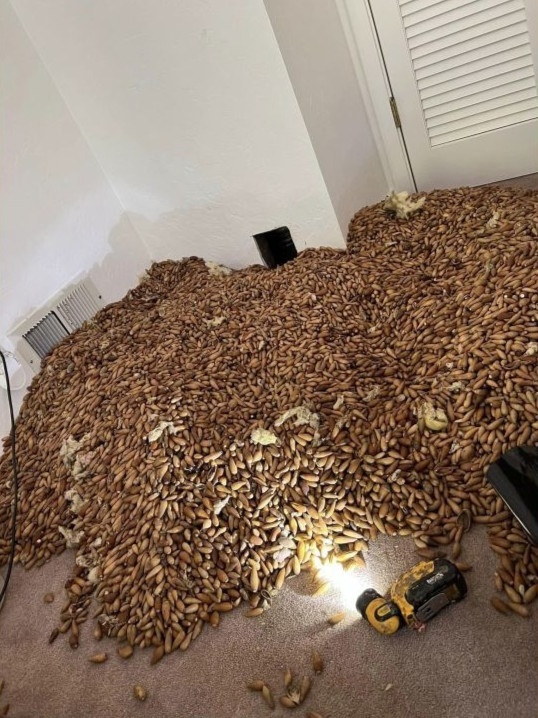
Over time, the acorns accumulated inside the wall cavities and reportedly reached toward the attic, eventually totaling around 700 pounds and filling approximately eight large trash bags.
For the homeowner, it was an unexpected property problem.
For the pest-control professional, it became one of those cases that is difficult to forget.
And for the woodpecker, it was simply a matter of finding what seemed like a convenient place to store food.
The bird wasn't trying to create chaos.
She had simply found an opportunity and kept using it.
The Lesson Hidden Inside the Walls
There is something almost poetic about the story.
A homeowner looked at a few holes and saw damage.
A pest-control professional opened the wall and discovered a hidden world.
And inside that wall was evidence of months or years of tiny decisions made by a wild animal simply trying to survive.
It is a reminder that our homes may be familiar to us, but they are not always as predictable as they appear.
Behind walls, beneath floors, inside attics, and around roofs, nature can sometimes find ways to coexist with human structures that we never anticipated.
Sometimes that coexistence is harmless.
Sometimes it creates a serious problem.
And sometimes, as in this extraordinary case, it produces a discovery so unusual that even an experienced professional has to stop and wonder.
A few holes in the siding had hidden an entire pantry.
And by the time the wall was opened, that pantry reportedly contained hundreds of pounds of acorns.
What looked like a small wildlife nuisance from the outside turned out to be an astonishing example of how much can accumulate when a determined animal finds the perfect hiding place.
Sometimes, you don't know what's really happening inside your walls until you open them.