This is one of the less visible realities of severe illness.
People often see the emotional side.
They see photographs from hospitals.
They read about the diagnosis.
They hear about the family asking for support.
But behind all of that are practical expenses that can continue month after month and year after year.
David eventually began sharing their story publicly and asking for support to help cover treatments and everyday expenses.
For him, telling their story meant doing something many people find difficult.
Admitting that they needed help.
Asking strangers, communities, and supporters to contribute.
Turning a deeply personal experience into a public appeal.
That cannot be easy.
There can be vulnerability in explaining the hardest parts of your life to people who don't know you.
Yet David did it because Bruna needed care and because the reality of their situation could not simply be ignored.
The Emotional Cost of Being a Caregiver
There is another kind of burden that often receives less attention.
The emotional one.
A caregiver can experience many conflicting feelings at the same time.
Love.
Fear.
Exhaustion.
Grief.
Hope.
Frustration.
Guilt.
Loneliness.
Relief when a difficult day goes well.
Fear of the future.
And sometimes even anger at circumstances that nobody caused.
Having these feelings does not make someone less loving.
It makes them human.
David's life had become almost entirely centered around Bruna.
That kind of responsibility can shrink the world.
The ordinary social life people once had may become difficult.
Travel may no longer be easy.
Spontaneous plans may disappear.
Work may no longer be possible.
Even something as simple as going somewhere for a few hours may require planning.
When caregiving becomes your entire routine, your own needs can slowly disappear from view.
A caregiver may stop asking:
“What do I want?”
and begin asking only:
“What does she need?”
Over time, that can become exhausting.
Yet David continued to organize his life around Bruna.
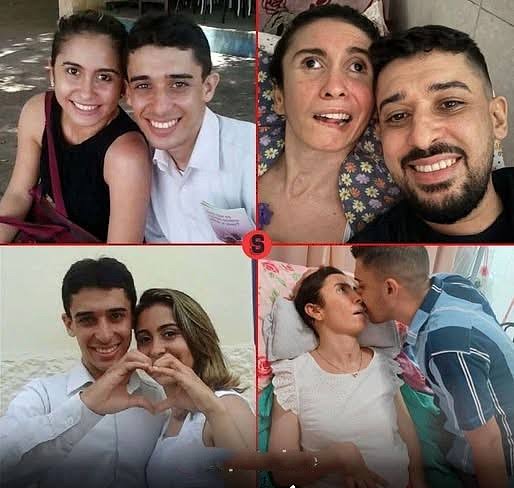
Their Marriage Was Changed, Not Erased
There is an important distinction between these two things.
The medical emergency changed their marriage.
But it did not erase their marriage.
Before 2018, David and Bruna were partners who could share plans, conversations, experiences, and decisions in ways that many couples take for granted.
After the emergency, many of those things were no longer possible in the same way.
Their relationship had to be redefined by circumstances neither had chosen.
But David continued to regard Bruna as his wife.
The woman he had married had not become less worthy of love because she had become dependent on others.
That may sound obvious.
But society often places enormous value on independence.
We admire people for what they accomplish, what they contribute, what they can do for themselves.
Severe disability challenges that thinking.
It reminds us that a person's worth does not disappear when their abilities change.
Bruna still mattered.
Her life still mattered.
And David continued to behave as though that truth was worth defending every single day.
Remembering the Woman Before the Illness
One of the most moving parts of David's story is the idea that he remembers who Bruna was before the medical emergency.
He remembers the woman he married.
The couple who had plans.
The person with whom he expected to grow older.
The ordinary life they were building before that day.
Those memories can be both comforting and painful.
They remind you of what existed.
But they can also become a source of strength.
David's commitment was not based on pretending that nothing had changed.
Everything had changed.
He simply refused to let the changes determine Bruna's value as a person.
He continued to treat her with dignity and care.
He continued to show up.
And in doing so, he maintained a connection to the promise that existed before the emergency.
What Happens When the Future You Planned Disappears?
Most people make plans without realizing how much faith those plans require.
We assume next year will resemble this year.
We imagine growing older.
We imagine anniversaries.
We imagine children, careers, homes, holidays, and countless other milestones.
We rarely imagine waking up one morning and discovering that none of those plans can happen in the way we expected.
That is part of what makes David and Bruna's story so difficult.
Their tragedy was not simply the medical emergency itself.
It was the destruction of an expected future.
The future they had imagined had to be replaced by something completely different.
And nobody handed David a manual explaining how to do that.
He simply had to learn.
One day at a time.