When present alongside irregular periods and increased facial hair, it may strengthen the reason to investigate possible metabolic or hormonal problems.
Changes in Mood, Energy, or Sleep
Hormonal transitions can influence sleep, mood, and energy.
Women approaching menopause may experience hot flashes, night sweats, and sleep disturbances.
PCOS may also coexist with mood difficulties and sleep-related problems.
However, these symptoms are nonspecific.
They should be evaluated according to the individual's circumstances rather than automatically attributed to chin hair or androgen levels.
9. How Doctors Investigate the Cause of Excessive Chin Hair
The process of evaluating facial hair growth usually begins with a conversation rather than immediately ordering every possible hormone test.
A good medical assessment considers the timing, distribution, and progression of hair growth.
It also examines whether other symptoms are present.
Medical History
A doctor may ask questions such as:
-
At what age did the facial hair first appear?
-
Has the amount increased recently?
-
Are the hairs limited to the chin?
-
Are menstrual cycles regular?
-
Has acne become more noticeable?
-
Is scalp hair thinning?
-
Have there been unexplained changes in weight?
-
Are there family members with similar hair growth?
-
What medications and supplements are being used?
-
Has there been any exposure to testosterone products?
These questions help determine whether the pattern is likely to be genetic, age-related, medication-associated, or hormonal.
Physical Examination
The healthcare professional may examine the face and other areas where androgen-related hair growth commonly occurs.
They may also assess acne, scalp hair distribution, skin changes, and signs of insulin resistance.
In some cases, a clinical scoring system called the modified Ferriman-Gallwey score is used.
This system evaluates terminal hair growth across several body regions.
It helps clinicians estimate the degree of hirsutism.
The score is not interpreted identically for every population, because normal hair distribution varies according to ethnicity and individual characteristics.
Blood Tests for Androgens
Depending on the clinical picture, doctors may recommend blood tests to evaluate androgen activity.
These can include:
Total testosterone: Measures the overall amount of testosterone in the blood.
Free testosterone: Estimates the fraction of testosterone that is not bound to proteins.
Sex hormone-binding globulin: Helps interpret how much testosterone may be biologically available.
DHEA-S: Provides information about adrenal androgen production.
The results need to be interpreted using appropriate laboratory ranges and testing methods.
A single hormone result does not necessarily explain the entire picture.
Other Hormone Tests
Additional tests may be recommended depending on the symptoms.
These can include:
-
Thyroid-stimulating hormone to assess thyroid function.
-
Prolactin to investigate certain menstrual and reproductive problems.
-
17-hydroxyprogesterone when nonclassic congenital adrenal hyperplasia is suspected.
-
Cortisol-related testing when Cushing syndrome is a possibility.
Not every woman needs all these tests.
The selection depends on the medical history and examination.
Ultrasound and Additional Imaging
When PCOS or an ovarian problem is suspected, a healthcare professional may consider pelvic ultrasound.
However, ovarian ultrasound findings alone do not establish PCOS.
Some women with PCOS do not have the typical ultrasound appearance.
Others have polycystic ovarian morphology without having the syndrome.
If hormone levels are markedly abnormal or symptoms develop rapidly, doctors may recommend additional imaging to investigate possible ovarian or adrenal causes.
The goal is to identify the source of the hormonal changes rather than simply label the facial hair.
10. How Can Women Manage Unwanted Chin Hair?
Once the cause has been considered, women have several options for managing unwanted facial hair.
The right choice depends on how much hair is present, how quickly it grows, skin sensitivity, personal preference, and whether an underlying hormonal condition needs treatment.
Some methods remove existing hair.
Others can reduce the rate of future growth.
Understanding the difference helps set realistic expectations.
Tweezing: A Practical Option for a Few Isolated Hairs
For women who have only a few coarse chin hairs, tweezing may be the simplest solution.
A clean pair of tweezers can remove individual hairs from the root.
The method is inexpensive and can be performed at home.
However, repeated tweezing may cause irritation, ingrown hairs, or inflammation.
Using clean equipment and avoiding excessive pulling can help reduce these problems.
Tweezing does not permanently stop a follicle from producing hair.
The same hair may return after a period of time.
Shaving Does Not Make Hair Grow Back Thicker
Some women avoid shaving their chin because they believe it will cause the hair to become thicker or darker.
This is a common misconception.
Shaving cuts the hair at the skin surface.
It does not change the follicle or increase androgen production.
When the hair grows back, its blunt tip may feel slightly rougher, creating the impression that it has become thicker.
For women who prefer a quick and convenient option, gentle facial shaving can be appropriate.
A clean facial razor and suitable skincare products can help minimize irritation.
Waxing and Threading
Waxing removes hair from the root, while threading uses twisted thread to remove individual hairs.
Both methods can provide smoother skin for longer than shaving.
However, they may cause temporary redness, irritation, or ingrown hairs.
Women with sensitive skin, active acne, or certain skin conditions should be cautious.
Repeated waxing can sometimes contribute to pigmentation changes, especially when the skin becomes inflamed.
Laser Hair Reduction
Laser hair reduction is one of the more effective options for reducing unwanted coarse facial hair.
The treatment uses concentrated light energy that targets pigment in the hair.
The energy damages the hair follicle and reduces its ability to produce new hair.
Multiple sessions are generally necessary because hair grows in cycles.
Laser treatment tends to work best on darker hair because the pigment absorbs the energy.
It may be less effective for blonde, white, gray, or very light-colored hair.
Different devices are suitable for different skin tones.
A qualified professional should assess the skin and hair before treatment to reduce the risk of burns or pigmentation changes.
It is important to understand that laser treatment usually provides long-term hair reduction rather than guaranteed permanent removal.
Hormonal conditions may also stimulate new follicles over time, meaning maintenance treatments can sometimes be necessary.
Electrolysis for Individual Hair Follicles
Electrolysis is another option.
It involves inserting a very fine probe into an individual hair follicle and applying electrical energy to destroy the follicle's ability to produce hair.
Unlike laser treatment, electrolysis can work on hair of different colors.
It is often considered for small areas, such as the chin, where individual coarse hairs are particularly noticeable.
Multiple sessions are usually needed because not all follicles are active at the same time.
The treatment should be performed by a trained professional.
Temporary redness and irritation can occur.
Prescription Creams That Slow Facial Hair Growth
Some women may benefit from a prescription cream containing eflornithine.
This medication slows an enzyme involved in hair growth.
It does not remove existing hair, but it can slow the rate at which facial hair grows.
Results generally take several weeks to become noticeable.
Hair removal methods may still be necessary while using it.
Eflornithine is not suitable for everyone, and availability varies by country.
A healthcare professional can discuss whether it is appropriate.
11. Can Hormonal Treatment Help Reduce Chin Hair?
When excessive facial hair is associated with androgen activity, treating the underlying hormonal problem may help.
However, hormonal treatment is not automatically necessary for every woman with unwanted chin hair.
The decision depends on the cause, symptom severity, reproductive plans, medical history, and potential medication risks.
Combined Oral Contraceptives
Combined hormonal contraceptives contain estrogen and a progestin.
For some women with PCOS-related hirsutism, these medications can help regulate menstrual cycles and reduce androgen activity.
They can increase sex hormone-binding globulin, which reduces the amount of biologically available testosterone.
Over time, this may slow the development of new coarse facial hair.
However, improvement is gradual.
Hair follicles already producing terminal hairs may continue doing so.
Combined contraceptives are not suitable for everyone.
Factors such as smoking, migraine with aura, blood clot history, blood pressure, and other medical conditions can affect whether they are appropriate.
A clinician should assess individual risks before prescribing them.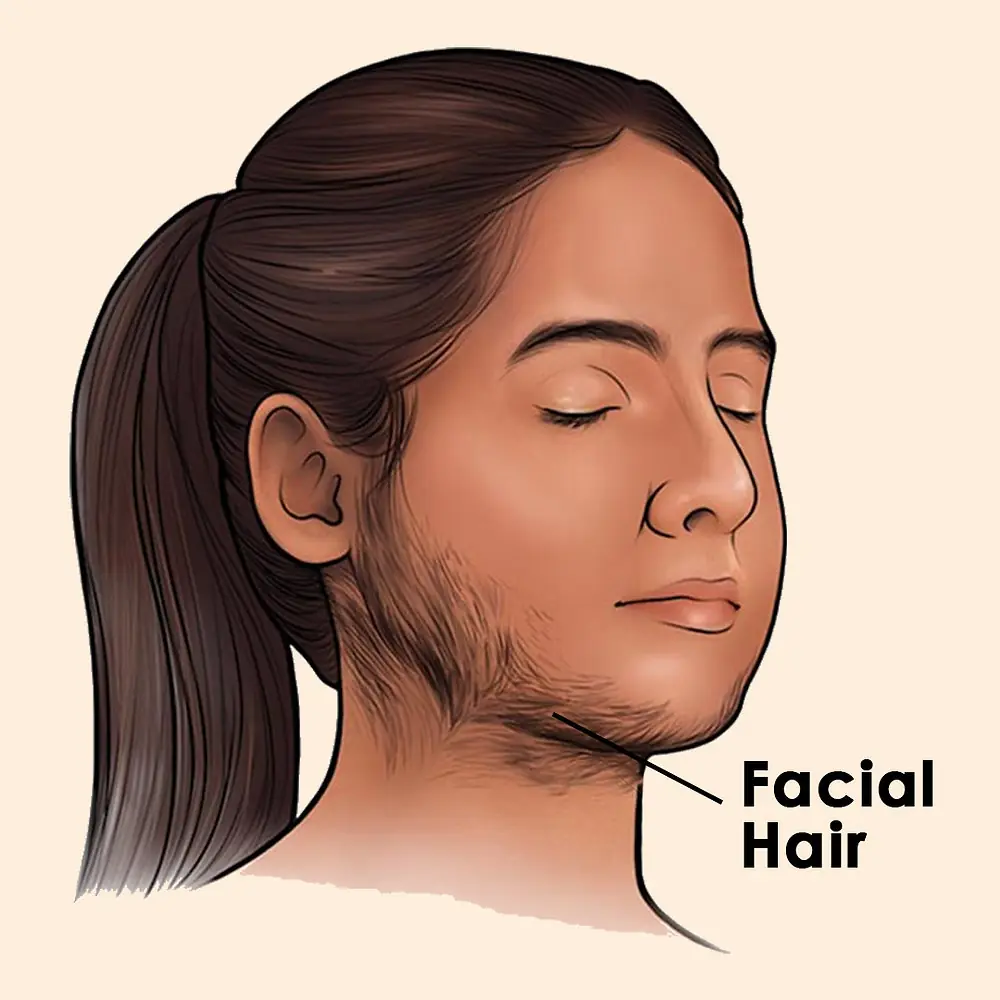
Anti-Androgen Medications
Certain medications reduce the effects of androgens on hair follicles.
Spironolactone is one example.
It blocks androgen receptors and can reduce androgen-related symptoms in some women.
It may be prescribed when excessive facial hair persists despite other treatments.
However, spironolactone requires medical supervision.
It can affect potassium levels and kidney function, and it may cause side effects such as dizziness, menstrual changes, or breast tenderness.