Approximately four minutes earlier, the same controller had provided another aircraft with wind information of 190 degrees at 19 knots, gusting to 22 knots.
Flight 7598 was not on that controller's frequency at the time.
Investigators will need to examine the circumstances surrounding this communication and determine its relevance to the accident.
It is important not to conclude that the missing wind advisory alone caused the crash.
The relationship between weather, aircraft performance, cockpit decision-making, and air traffic control procedures must be examined together.
The preliminary findings simply identify an issue that deserves further investigation.
A Runway Safety Question: The Absence of an EMAS System
Another important detail emerged from the NTSB's examination of Miami International Airport.
The report confirmed that Runway 30 did not have an Engineered Materials Arresting System, commonly known as EMAS, installed at its end.
EMAS is a specialized runway safety system designed to help stop aircraft that overrun a runway.
It generally consists of specially engineered materials that crush under the weight of an aircraft, absorbing energy and helping bring the aircraft to a controlled stop.
The system is particularly useful where the area beyond a runway is limited or where an aircraft could otherwise travel into roads, buildings, or other hazardous locations.
It is not a replacement for proper landing procedures, sufficient runway length, or effective braking systems.
Instead, it provides an additional layer of protection when an aircraft cannot stop within the available paved distance.
The absence of EMAS at the end of Runway 30 does not automatically mean the airport violated any safety requirement.
Airport design depends on many factors, including geography, runway layout, surrounding infrastructure, and applicable regulatory standards.
However, the accident makes the question of runway overrun protection particularly relevant.
After the aircraft left the paved surface, it continued into a grassy area, crossed a perimeter road, and struck vehicles.
An arresting system, where installed and appropriately designed, may help reduce the consequences of certain runway overrun events.
Whether such a system would have changed the outcome in this particular accident is a question that cannot be answered from the preliminary findings alone.
The NTSB will need to examine the airport environment and the aircraft's path as part of its broader investigation.
This issue also raises a wider question for airport operators.
How should airports protect surrounding roads and businesses when runways are located near areas used by employees and the public?
Runway safety is not limited to the aircraft itself.
It includes the entire area beyond the runway, the location of airport infrastructure, and the potential consequences when an aircraft travels outside its intended operating area.
The Miami accident provides a particularly painful example of why those considerations matter.
The Aircraft Was More Than 30 Years Old
The aircraft involved in the accident was manufactured in June 1994.
It was originally delivered as a passenger aircraft before being converted into a cargo configuration in June 2016.
At the time of the accident, the Boeing 767 had accumulated approximately 110,077 flight hours and 24,505 flight cycles.
Its engines were GE CF6 models.
The aircraft's age has attracted attention because the incident involved a freighter that had spent much of its operational life in commercial aviation.
However, an aircraft's age alone does not establish that it is unsafe.
Aircraft can remain in commercial service for decades when they are maintained, inspected, and operated in accordance with applicable safety requirements.
Many older aircraft have been converted from passenger service to cargo operations because their size and performance characteristics remain useful for freight transportation.
The Boeing 767 is a widebody twin-engine aircraft capable of carrying substantial quantities of cargo.
Its design has made it a common choice for long-distance cargo operations.
A passenger-to-freighter conversion involves modifications to the aircraft structure and interior to accommodate freight operations.
These changes may include a large cargo door, reinforced floor structures, and systems designed for the demands of cargo loading.
The NTSB's investigation will examine the aircraft's maintenance history and technical condition as part of determining what happened.
Investigators will also examine the aircraft's systems and engines.
The preliminary report records the damage to the right wing and engine, including substantial heat damage caused by the postcrash fire.
The nose landing gear was found displaced aft beneath the aircraft's belly, while the main landing gear assemblies were found in an extended and locked configuration.
The investigators also examined the aircraft's braking components.
The measurements of the brake wear pins showed remaining service life across all eight wheels.
That finding is relevant because it provides information about the condition of the braking components at the time of the accident.
But it does not, by itself, determine whether the entire braking system functioned as intended during the landing.
A complete assessment requires the examination of the recorded flight data, physical components, maintenance records, and operational history.
The investigation must also consider whether any mechanical or system-related issue contributed to the sequence of events.
The age of the aircraft is therefore one part of a much larger investigation, not proof of a particular cause.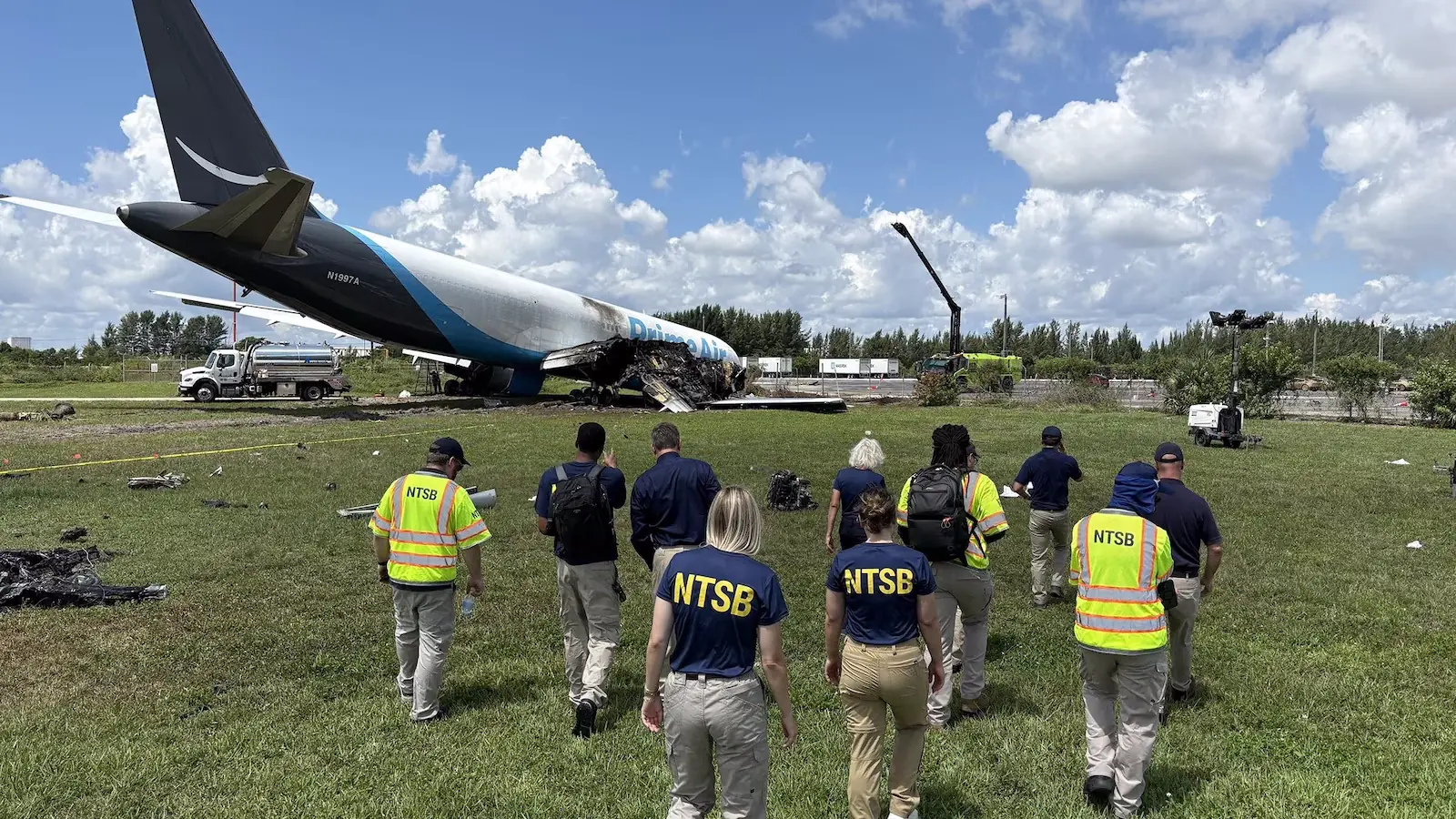
Amazon Takes Action After the Fatal Accident
The consequences of the Miami crash extended beyond the airport and the investigation.
Amazon announced on September 13, 2026, that it was pausing operations with 21 Air, the company that operated Flight 7598.
The decision came after Amazon reviewed the circumstances surrounding the accident and considered its response to the tragedy.
Amazon spokesperson Kelly Nantel said the company had spent time supporting the investigation and those affected before deciding to suspend its operations with the carrier.
The company also reiterated that safety remained a priority in its own operations and when working with transportation partners.
The decision was significant because 21 Air had been providing cargo services for Amazon since 2024.
Amazon uses multiple partner airlines to transport packages through its air cargo network. These companies help move shipments between major distribution centers and support the wider delivery system.
The suspension meant that Amazon would need to adjust some of its cargo operations and rely on other transportation partners to fill the gap.
For 21 Air, the decision represented an important commercial development while the company was cooperating with investigators.
The airline expressed condolences to the victims' families and said it remained focused on supporting those affected by the accident.
It also stated that it was cooperating with the NTSB and other partners involved in the investigation.
The company expressed confidence in its safety policies, procedures, and training.
It is important to understand that Amazon's decision to pause operations was not the same as a final determination of responsibility.
The NTSB had not yet completed its investigation, and the full causes of the accident remained under examination.
A commercial decision made while an investigation is ongoing should not be interpreted as a final finding about what caused the crash.
Nevertheless, the suspension demonstrated how seriously the accident affected the relationship between a major retailer and its cargo transportation partner.
It also highlighted the importance of safety oversight when companies depend on outside operators to carry out essential parts of their logistics networks.
The accident was not simply a matter of damaged aircraft or delayed deliveries.
Five people had died, families had lost loved ones, and the aviation industry was facing difficult questions about how the accident could have happened.
The Wider Impact on America's Cargo Transportation Network
Air cargo has become an essential part of modern commerce.
Consumers increasingly expect products to arrive quickly, businesses depend on reliable transportation, and retailers must coordinate complicated networks of warehouses, aircraft, trucks, and delivery vehicles.
Amazon is one of the companies that has invested heavily in developing its own logistics infrastructure.
Its cargo network connects distribution centers and transportation hubs across the United States and internationally.
Miami plays an important role in that network because of its geographical position and connections with Latin America and the Caribbean.
The city is a major gateway for international trade, with extensive air cargo operations serving businesses throughout the region.