The accident therefore attracted attention not only because of the loss of life but also because it involved an aircraft operating within a major commercial transportation network.
When a cargo airline experiences a serious accident, the consequences can affect several parts of the logistics system.
Other operators may need to take over scheduled flights. Cargo may be redirected through alternative airports. Warehouses may need to adjust their schedules, and delivery operations may experience delays.
Companies must also review their operational relationships and ensure that safety requirements are being followed.
Amazon's decision to pause its relationship with 21 Air demonstrated how quickly a major aviation accident can affect commercial arrangements.
However, the broader cargo industry cannot simply stop operating.
Businesses still need to move goods, medical supplies, electronics, food products, and countless other items.
The challenge is to maintain transportation services while ensuring that safety remains the highest priority.
The Miami accident serves as a reminder that behind every cargo flight is a network of people whose work supports the movement of goods.
Pilots, dispatchers, mechanics, airport employees, warehouse workers, and road transportation teams all contribute to that system.
When an aircraft accident occurs, the consequences can reach far beyond the people inside the plane.
What Investigators Still Need to Establish
As of November 14, 2026, the NTSB investigation remains ongoing.
The agency's public investigation page lists the case as an active investigation and records an update dated October 1, 2026.
The preliminary report provides substantial information about the flight, the aircraft, the weather, the runway, and the final moments before the accident.
However, a preliminary report is not the final accident report.
Investigators still need to evaluate multiple areas before determining the probable cause.
These include:
Aircraft performance: Investigators must reconstruct the aircraft's approach, touchdown, braking performance, and movement after leaving the runway.
Cockpit communication: The voice recording shows that the first officer repeatedly raised concerns about speed. Investigators must examine the full communication sequence and the decisions made by both pilots.
Weather conditions: The changing winds and thunderstorms need to be considered alongside the aircraft's approach and landing performance.
Air traffic control: The NTSB identified an issue involving the absence of wind information in the landing clearance. Investigators must determine its relevance and whether procedures were followed.
Aircraft systems: The braking system, speed brakes, thrust reversers, engines, and other components must be evaluated to determine whether any technical issue contributed to the accident.
Airport safety: The layout of Runway 30, the absence of an EMAS system, and the surrounding road infrastructure are also relevant to understanding the consequences of the overrun.
Human factors: Investigators must consider workload, communication, operational decision-making, training, and the circumstances affecting the flight crew.
These areas are interconnected.
For example, an aircraft approaching too fast may create a difficult landing situation. However, the reasons for the excessive speed and the decisions made during the approach must be examined separately.
Similarly, the absence of an arresting system may affect the consequences of an overrun without necessarily explaining why the aircraft left the runway.
This distinction is essential when discussing aviation accidents.
The purpose of an investigation is not to find the most dramatic explanation. It is to reconstruct the sequence of events using reliable evidence.
The NTSB also invited several organizations to participate in the investigation, including the FAA, Boeing, GE Aerospace, 21 Air, Miami-Dade Aviation Department, and representatives of the pilots' association and air traffic controllers.
Specialist groups were formed to examine aircraft structures, systems, engines, airline operations, human performance, air traffic control, airport safety, hazardous materials, and survival factors.
This broad approach reflects the complexity of a major commercial aviation accident.
A final report may take considerable time because investigators must analyze technical information, review evidence, and consider the findings of multiple specialist groups.
Until that work is completed, it would be premature to declare that one particular factor was solely responsible.
Lessons the Aviation Industry Cannot Ignore
The Miami accident raises several important questions about aviation safety.
The first concerns the importance of recognizing an unstable approach.
Commercial aircraft are designed to operate within defined performance limits. Pilots receive training to recognize when an approach is no longer suitable for landing.
When necessary, they can perform a go-around rather than continuing toward an unsafe touchdown.
This is a normal safety procedure and an essential part of modern aviation.
The second lesson concerns cockpit communication.
The first officer's recorded warnings about excessive speed demonstrate why clear communication between pilots is so important.
Both members of a flight crew must be able to identify concerns, communicate them effectively, and follow established procedures when a situation becomes unsafe.
The third concerns runway protection.
Airports must consider what could happen if an aircraft travels beyond the end of a runway.
Runway length, surrounding roads, terrain, buildings, and additional safety systems all form part of the wider airport safety environment.
The fourth lesson concerns emergency response.
The rapid arrival of airport firefighting units and local rescue teams was essential in managing the aftermath.
The ability to coordinate aircraft rescue operations, vehicle rescues, fire suppression, and medical assistance can make a significant difference during a complex emergency.
Finally, the accident highlights the importance of safety oversight in commercial aviation partnerships.
A company that relies on outside airlines must maintain effective systems for evaluating operational safety and responding when serious incidents occur.
Amazon's decision to pause operations with 21 Air illustrates how commercial relationships can change following a major safety event.
These lessons are relevant well beyond Miami.
Cargo aircraft operate around the clock at airports throughout the world. They often arrive during busy periods, operate under changing weather conditions, and share airport environments with passenger aircraft and ground vehicles.
Every landing requires careful coordination.
The Miami accident demonstrates what can happen when a sequence of events develops beyond the point where the aircraft can be safely stopped within the available runway.
Remembering the People Behind the Headlines
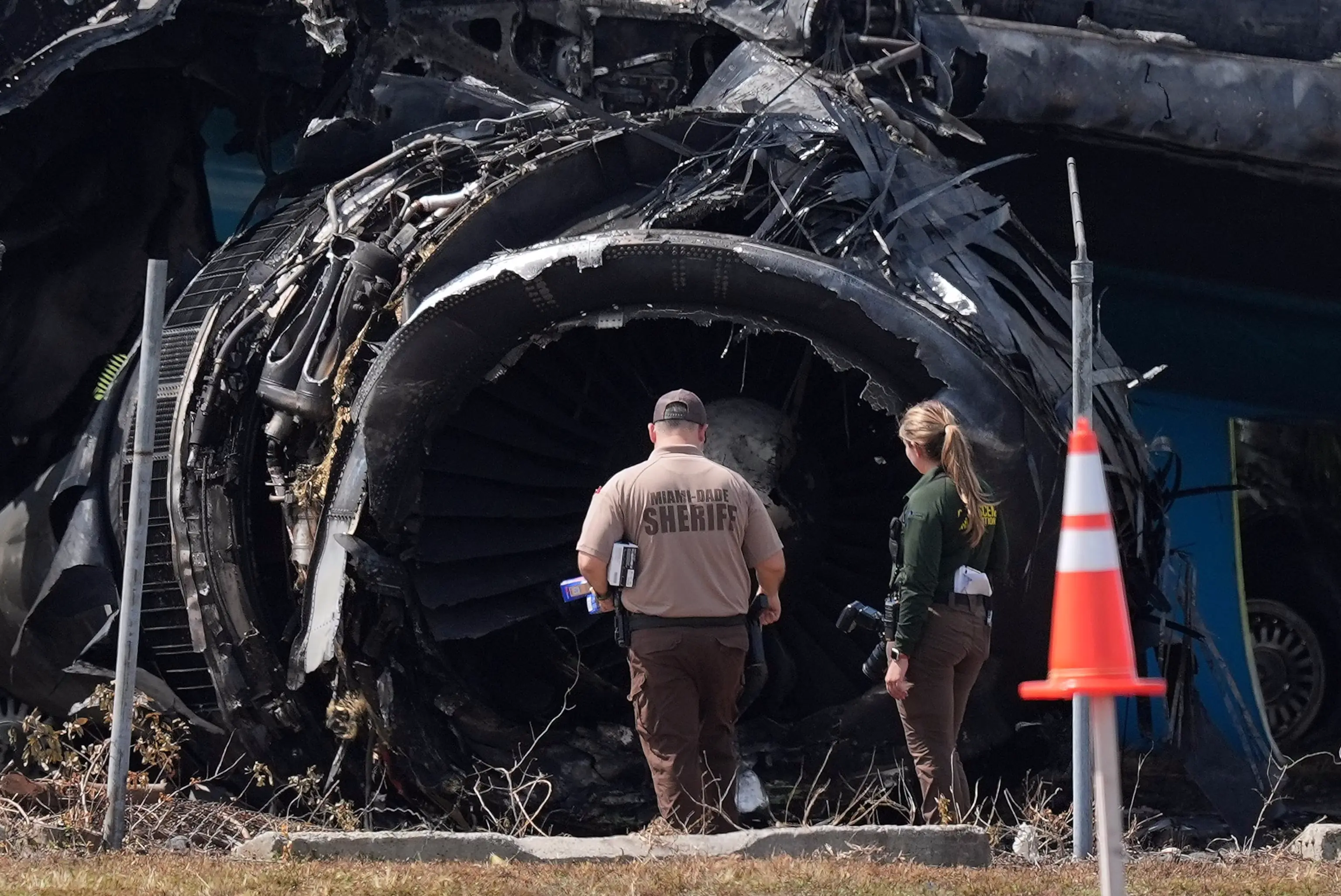
When photographs of the accident began circulating, much of the attention naturally focused on the aircraft and the enormous cloud of smoke.
The damaged Boeing 767 was a striking image.
It was easy to see why the photograph attracted attention. A large commercial aircraft had left the runway, flames had damaged its structure, and emergency vehicles were working around the wreckage.
But the most important part of the story was not the aircraft itself.
It was the people whose lives were affected.
Five people who were traveling in a van near the airport never returned home.
Two other occupants of that vehicle survived with serious injuries. Another person in an SUV was also seriously injured. The two pilots survived with minor injuries.
For the families of those who died, the accident will always be remembered as a devastating personal loss.
For the injured survivors, recovery may involve physical and emotional challenges long after the emergency vehicles have left the scene.
For airport employees, the incident serves as a painful reminder of the risks that can exist around busy aviation facilities.
For investigators, the responsibility is to establish what happened and identify whether changes are needed to prevent a similar accident in the future.
And for the aviation industry, the findings may help improve procedures, training, operational oversight, and runway safety.
The accident at Miami International Airport was not simply an unusual landing or a dramatic aviation video.
It was a serious tragedy involving a cargo aircraft, airport workers, public roads, and a chain of events that investigators are still working to understand.
The preliminary findings have already revealed troubling details about the approach speed, touchdown location, cockpit warnings, and the final landing sequence.
But the complete explanation must wait for the investigation to establish how those elements fit together.
Five people lost their lives in an accident that began with an aircraft approaching a runway. Their stories deserve to remain at the center of the discussion, while the investigation works toward answers that may help protect others in the future.