Photographs show workers wearing reflective clothing as they move around the accident area. Such equipment is particularly important when people are operating near roads, vehicles and uneven terrain.
Visibility helps other team members identify their colleagues, especially when several groups are working in different parts of the site.
The rescue process also requires coordination.
One group may examine the vehicle, another may search the surrounding area, while medical personnel prepare to receive injured passengers.
Police officers may be responsible for controlling access to the site and documenting important evidence.
These responsibilities must be managed together.
A poorly coordinated rescue can expose personnel to unnecessary danger and make it harder to identify which areas have already been examined.
The difficult conditions around the Sendamal River meant that emergency workers had to pay attention not only to the damaged bus but also to the landscape itself.
Loose rocks, steep ground and flowing water can create additional hazards.
A rescue worker carrying a stretcher needs a stable route. A medical team needs enough space to assess an injured person. Equipment must be positioned where it can be accessed without blocking other personnel.
The photographs show the physical effort involved in this work.
They also remind viewers that behind every reported casualty figure are emergency workers who must continue performing demanding tasks under extraordinary pressure.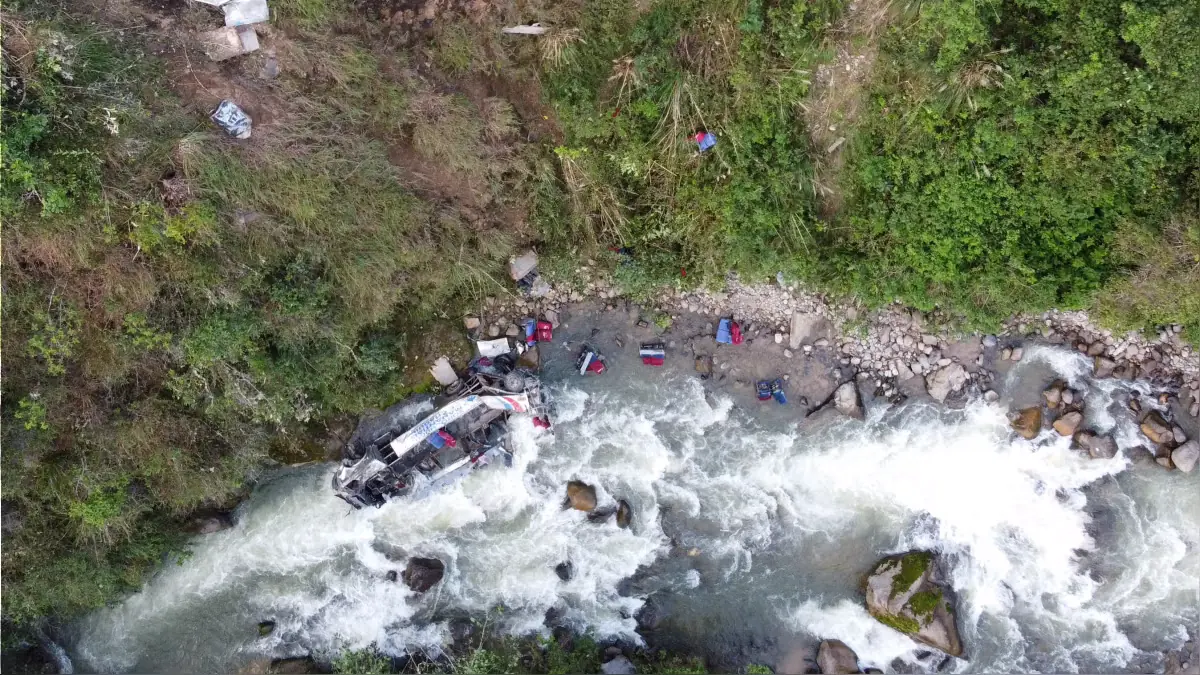
The Death Toll Increased as More Information Emerged
One of the most important details about this accident is the changing number of reported fatalities.
The first widely circulated reports stated that 23 people had died. This was the figure used in many early headlines and social media posts.
However, the situation developed as authorities gathered additional information.
Reuters reported on April 29, 2024, that the death toll had risen to 25, with 13 people injured.
Local Peruvian reports subsequently carried further updates. The Peruvian news agency Andina reported that the number of fatalities had reached 27.
These changing figures explain why different articles about the same accident may contain different numbers.
The earliest reports reflected information available during the initial emergency response. Later reports incorporated additional findings from police, medical facilities and local officials.
The difference between 23, 25 and 27 is not evidence that three separate accidents occurred.
It reflects the evolving information surrounding one devastating incident.
The final figures also illustrate the difficulty of reporting on a major disaster while rescue operations are still underway.
At the beginning of an emergency, officials may not know the exact number of passengers. Some victims may be difficult to reach, while injured people may be transported to different hospitals.
Information can therefore change several times within a relatively short period.
For families, these updates are more than statistics.
They determine whether someone is still missing, whether a relative has been located and whether an injured passenger has reached medical care.
For journalists, accuracy requires explaining when a figure was reported and whether a later update changed it.
That is particularly important when dramatic headlines continue circulating long after the original event.
In this case, the headline stating that at least 23 people died was consistent with the initial reports, but it did not reflect the subsequent increase in the reported death toll.
Families Waited for News of Their Loved Ones
While rescue workers were dealing with the wreckage, families were facing another kind of emergency.
They needed information.
When a bus accident occurs far from major cities, relatives may have very limited ways to determine whether someone was involved.
Passengers may not have been carrying identification that is immediately accessible. Mobile phones may have been damaged or lost. Some injured people may be unable to communicate with their families.
Even when hospitals begin receiving survivors, relatives may not immediately know which facility has admitted a particular person.
This uncertainty can become unbearable.
Imagine receiving a message that a bus traveling through the region has crashed, followed by a report that dozens of passengers may have been killed or injured.
If someone you love was expected to be on that journey, every passing minute becomes important.
People may contact transport companies, local authorities, hospitals and other relatives in an attempt to establish what happened.
Some may travel toward the crash area, hoping to receive information directly.
Others may gather near police stations or hospitals where emergency personnel are coordinating information.
Reports from the Cajamarca tragedy described relatives gathering near local authorities as they searched for news.
The local community was deeply affected.
The accident involved people who were traveling for ordinary reasons, including work, family responsibilities and everyday activities.
For many relatives, the journey would have seemed like a routine part of life.
No one expects a normal bus trip to become the last journey a loved one ever takes.
This is one reason why transportation disasters have such a profound impact on communities.
The immediate victims are not the only people affected. Families, friends, neighbors and colleagues must also deal with the consequences.
In the days following a tragedy, communities often face practical difficulties alongside grief.
They may need to arrange funerals, support injured relatives, travel to hospitals and communicate with authorities.
The emotional impact can continue long after the wreckage has been removed.
What Happened to the Injured Passengers?
The accident also left numerous people requiring medical attention.
Initial reports differed slightly regarding the number of injured passengers. Reuters reported 13 injuries in its April 29 update, while other early accounts mentioned different figures.
Some injured passengers were transported to nearby medical facilities, while those requiring more specialized treatment were taken to the Regional Hospital of Cajamarca.
The distance between the accident site and medical facilities presented another challenge.
In a major crash, the first stage of treatment often takes place before a patient reaches a hospital.
Emergency personnel must assess breathing, circulation, bleeding and possible traumatic injuries.
They may need to stabilize patients before transporting them across difficult terrain.
The types of injuries associated with a severe bus crash can vary considerably.
Some passengers may suffer fractures or cuts. Others may experience head injuries, chest trauma or damage to internal organs.
The impact can also produce injuries that are not immediately obvious.
For this reason, people who survive a major collision generally require medical assessment even when they initially appear able to walk or communicate.
The treatment process does not necessarily end when a patient leaves the emergency department.
Some survivors may need surgery, rehabilitation, psychological support or additional medical monitoring.
Families may also face difficult decisions about where to obtain treatment and how to support relatives during recovery.
For the people who survived the Cajamarca crash, the physical consequences were only one part of the experience.
A serious accident can also leave survivors with fear, sleep disturbances and emotional distress.
Some may struggle to return to public transportation. Others may experience anxiety when traveling along mountain roads or hearing the sound of a vehicle approaching a sharp curve.
These reactions can be part of the psychological aftermath of a traumatic event.
Recovery is therefore not always measured by the number of days spent in hospital.
It can involve a much longer process of rebuilding physical strength and emotional confidence.
Investigators Turned Their Attention to the Road and the Bus
Once the immediate rescue operation was underway, investigators needed to establish why the vehicle left the road.
A fatal accident involving a passenger bus requires more than an examination of the wreckage.
Investigators generally need to consider the driver's actions, the vehicle's mechanical condition, the road surface, visibility, weather and the circumstances surrounding the journey.
In the Cajamarca incident, authorities began examining the circumstances of the crash.
The route was described as a difficult, unpaved mountain road with potholes. Such conditions can increase the demands placed on drivers, particularly when they are operating a large passenger vehicle.
However, poor road conditions alone do not establish the precise cause of an accident.
A vehicle can leave a road for many reasons, and investigators must distinguish between confirmed findings and possible explanations.
Mechanical problems, excessive speed, driver fatigue and inadequate road infrastructure are among the factors that can be examined in a serious bus crash.
Each possibility requires evidence.