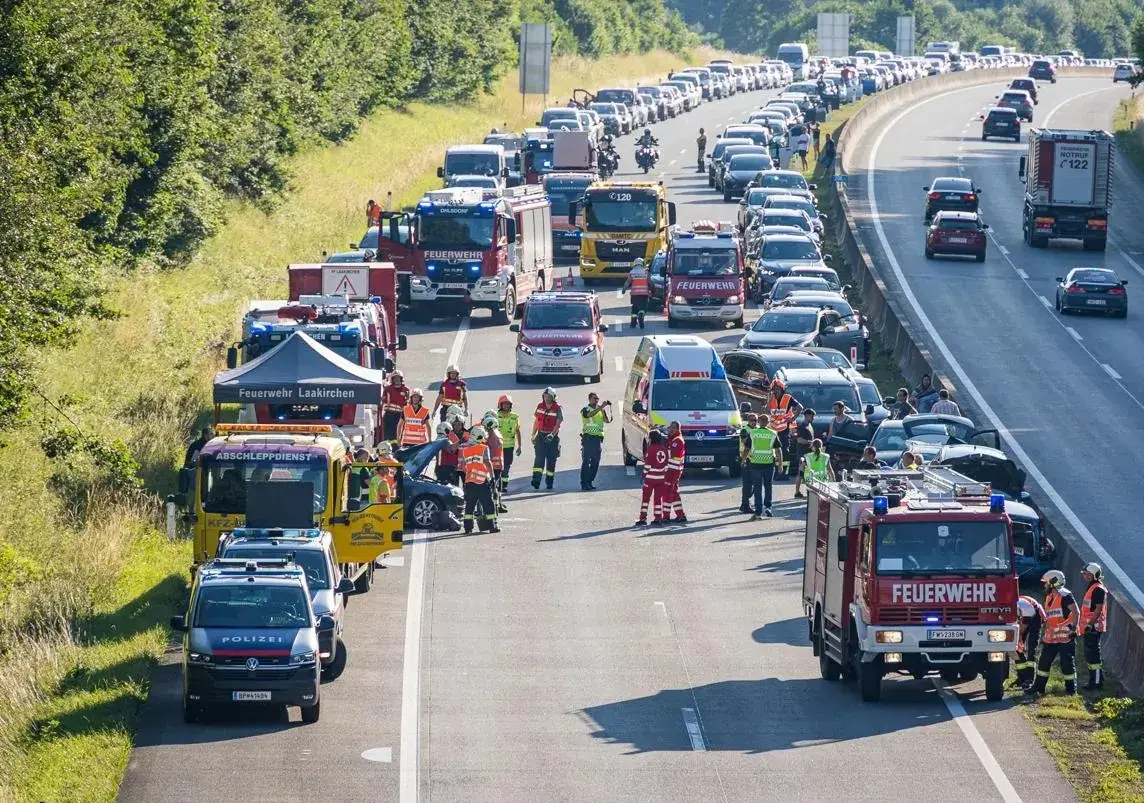
A responsible report would identify the photograph's source and explain whether it shows the actual location or is merely illustrative. If the image is a general road photograph, it should be described as such. If it is connected to a verified incident, the report should provide enough information for readers to understand that connection.
Without those details, the safest interpretation is that the picture shows a roadway and nothing more.
That may seem less dramatic than the headline, but accuracy is more valuable than an exciting guess.
4. How a developing story becomes a confirmed report
A developing story usually begins with an initial piece of information. It may come from a witness, a public announcement, an emergency call, a local authority or a journalist who notices an unusual event.
At the beginning, that information may be incomplete. A witness might know that traffic has stopped but not understand why. A driver may see emergency vehicles but not know whether anyone has been injured. A person nearby may hear a loud noise without seeing what caused it.
Journalists then have to establish what happened.
The first stage is identifying the basic facts: what, where and when. These details may sound simple, but they are essential. Without a location, it can be difficult to contact the relevant authorities. Without a reliable time, it may be impossible to distinguish a current event from an older incident. Without a clear description, different reports may accidentally refer to separate events.
The next stage involves checking the information with reliable sources. Depending on the subject, that may mean contacting police, fire services, ambulance services, transport authorities, local government offices or the organization involved in an announcement.
Journalists may also speak to witnesses. Their accounts can provide useful details about what they saw and heard, but witness statements need to be handled carefully. People can misunderstand events, see only part of a scene or remember details differently under stress.
Photographs and videos can help establish a sequence of events, but they also need verification. A video may be genuine while its caption is incorrect. A photograph may show a real incident but have been taken in a different location. A short clip may omit the moments before or after the most dramatic scene.
The final stage is bringing the information together into a report that distinguishes confirmed facts from unresolved questions.
This process takes time. A reliable report may initially contain fewer details than a viral post, but that does not make it less useful. In fact, a short report that accurately states what is known can be much more valuable than a long account filled with unsupported claims.
The screenshot's visible text refers to precisely this problem: early reports may contain limited information while journalists gather details, contact witnesses and check official statements. That is a reasonable description of how developing news should be handled.
The important point is that a developing story should become clearer as evidence is gathered. It should not become more dramatic simply because readers are waiting for an update.
5. Why social media can make an unclear story spread so quickly
Social media has changed the way people encounter breaking news. In the past, many readers learned about major events through television bulletins, radio reports or newspaper updates. Today, a headline may appear in a feed before a traditional news organization has published a detailed account.
That speed has advantages. People can share warnings, find eyewitness information and communicate with relatives during emergencies. A local community can quickly draw attention to a blocked road, severe weather or a missing person.
But the same speed can also spread confusion.
A person may share a headline without opening the article. Another user may copy the headline and add a more dramatic description. Someone else may repost an image with a claim that was never part of the original report. Within a short time, several versions of the same story may circulate, each containing slightly different details.
Readers can then struggle to determine which version is accurate.
This is particularly common when a post uses broad phrases such as “unexpected development,” “everyone is talking about it” or “more details are coming.” These expressions leave room for people to imagine what happened. They can encourage comments and sharing even when the central event has not been explained.
The screenshot includes sharing buttons for Facebook, Twitter and Pinterest. Those buttons are ordinary features of online publishing, but they also illustrate how easily a headline can travel beyond the page where it first appeared.
Once shared, the headline may be separated from its original context. People who encounter it later may not see the article's limitations. They may assume that the event has been confirmed because the same wording appears in multiple posts.
Repetition, however, is not verification.
If ten accounts repeat the same unconfirmed claim, that does not create ten independent sources. They may all be copying one original post. A reliable assessment requires independent confirmation, not simply a large number of reposts.
Readers can help reduce confusion by checking the date, looking for the original publisher and avoiding the addition of details that are not supported. If a post contains no clear location or source, it is better to ask for clarification than to fill in the missing information.
The goal should not be to stop people from sharing important news. It should be to make sure that what they share is useful and accurate.
6. The difference between a traffic disruption and a serious emergency
Because the screenshot includes a road photograph, some readers may naturally wonder whether the unexpected development involves a traffic incident. That is one possible subject for a road-related news story, but the image does not establish that it does.
It is nevertheless useful to understand why road developments can attract immediate public attention.
Roads connect workplaces, schools, hospitals, homes and commercial areas. A disruption on an important route can affect thousands of journeys. Even a relatively small incident may cause delays if it occurs at a busy intersection or on a highway with limited alternative routes.
A traffic disruption can have several causes. There may be road maintenance, a broken-down vehicle, a temporary traffic-control measure, an event, severe weather or a collision. Some disruptions are planned and announced in advance. Others happen unexpectedly and require an immediate response.
A serious emergency is different. It may involve injuries, a dangerous obstruction, a hazardous spill or damage to infrastructure. In those situations, emergency services may need to secure the area, assist people and prevent further harm.
The distinction is important because not every traffic slowdown is an emergency, and not every emergency results in a long road closure.
A responsible report should explain the nature of the disruption rather than using vague language that makes every event sound equally serious. If a route is closed for routine maintenance, that should be stated clearly. If emergency crews are responding to a collision, the report should identify what authorities have confirmed. If the cause is not yet known, it should say so.
Readers should also understand that early descriptions can change. A road may initially be closed because officials need to inspect a possible hazard. After inspection, the route may reopen without a major incident being confirmed. Alternatively, a seemingly minor obstruction may turn out to require a more extensive response.
The facts should guide the headline, not the other way around.