Next, follow the woman's outline. Identify her shoulders, back, arms and waist. Notice where her clothing meets the horse's body.
Then examine the background. Is there a shadow cast by a nearby object? Could a dark area be part of the stable, a trailer or another object outside the main subjects?
Finally, look at the photograph without reading the headline again. Ask what can actually be seen, rather than what the headline suggests should be there.
This process does not guarantee a perfect interpretation, especially if the image is low-resolution or cropped. But it helps separate direct observation from assumption.
The Role of Lighting and Perspective
Lighting is one of the most important elements in photography.
When sunlight falls on a subject, it creates highlights and shadows. The exact appearance depends on the direction of the light, the shape of the object and the surfaces surrounding it.
A horse's dark coat can absorb much of the light, while its mane may form an especially deep shadow. If the woman stands close to the animal, that shadow can fall across or behind her silhouette.
The camera records the resulting pattern without explaining where each part comes from.
Perspective adds another layer.
In real life, people can move around an object and view it from different angles. They can see that the horse is beside the woman, that its neck extends forward and that its mane hangs down.
A photograph removes that freedom. The viewer sees only the angle selected by the photographer.
An object in the foreground can hide part of another object behind it. Two separate outlines can merge. A shadow can appear to touch a person even when it falls on a surface behind them.
This is why photographers sometimes use perspective deliberately to create visual jokes. A person may appear to hold the sun in their hand, stand on top of a distant building or have an animal's ears growing out of their head.
These photographs are not necessarily edited. The illusion can be created simply by positioning subjects carefully and choosing the right camera angle.
The horse image may be producing a similar effect unintentionally.
Why People Keep Looking After the Mystery Is Revealed
There is another interesting feature of optical illusions: knowing the explanation does not always make the illusion disappear.
A viewer may understand that a dark outline is probably created by the horse's mane and shadow, yet still see something that resembles human arms.
This happens because visual perception is not controlled entirely by conscious reasoning.
The brain may continue to recognize the familiar pattern even after the viewer understands that the interpretation is misleading.
That is why optical illusions can remain fascinating. They demonstrate that seeing is not simply a matter of receiving information. The brain actively organizes and interprets what the eyes detect.
In the horse photograph, the dramatic headline adds another layer to the process. It encourages viewers to interpret the image emotionally before they have examined it carefully.
And that brings us to the most important question in the story: even if the photograph looks suspicious, what does it actually prove about the woman's relationship?
Chapter 4: Does the Photograph Really Prove There Was Another Person?
The short answer is no.
A photograph that contains an ambiguous dark shape cannot, by itself, establish that another person was present, let alone prove that an affair or betrayal occurred.
The viral story suggests that the husband interpreted the image as suspicious. But the photograph, as presented, does not provide enough evidence to confirm that interpretation.
There are several reasons for this.
First, the apparent human shape may be an optical illusion created by overlapping outlines.
Second, the image is a single frozen moment. It does not show the full scene from every angle.
Third, the photograph does not provide independent information about the people involved or the circumstances in which it was taken.
Fourth, the story does not provide verifiable evidence of the alleged marital argument or divorce request.
These limitations do not mean that every unusual photograph is harmless or that a person should ignore genuine concerns in a relationship. They mean that a conclusion should be proportional to the evidence.
A dark shape is not proof of an affair. A confusing photograph is not proof of dishonesty. And a dramatic headline is not independent confirmation that a marriage has ended.
The Difference Between Suspicion and Evidence
Suspicion is a feeling that something may be wrong.
Evidence is information that can support or challenge a particular conclusion.
The two can sometimes overlap, but they are not interchangeable.
A person may feel suspicious after seeing an unusual image. That feeling may be sincere. It may even lead them to ask reasonable questions.
However, the feeling itself does not establish what happened.
In this case, the most responsible interpretation is that the photograph creates an impression that some viewers may find suspicious, while the available material does not establish that a second person is actually embracing the woman.
The explanation involving the horse's body and shadow offers a plausible reason for the strange appearance.
To go further would require additional information, such as the original unedited image, photographs taken from other angles or a clear account from the people involved.
Without that information, claims about infidelity or the breakdown of a real marriage would be speculation.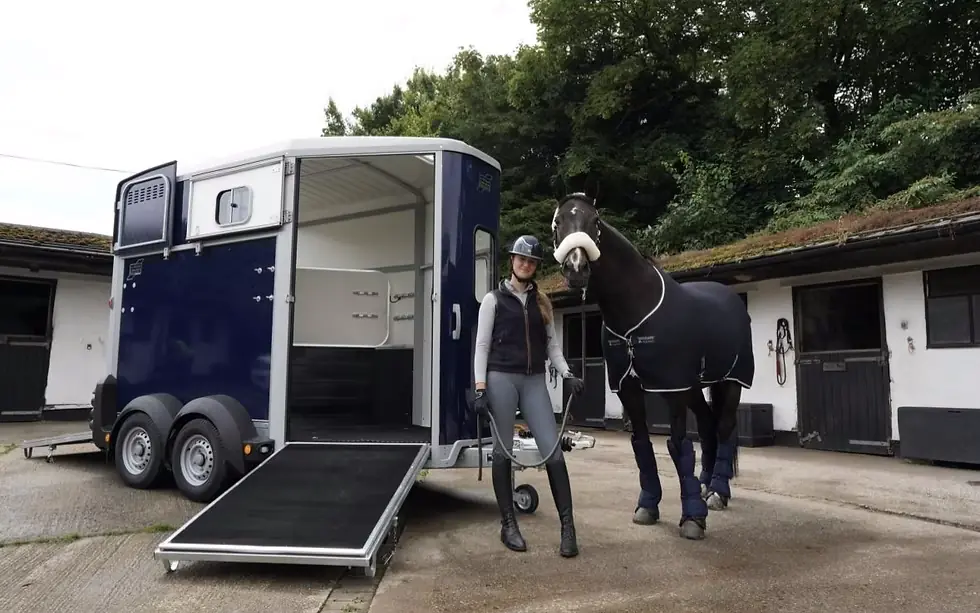
Why the Headline Changes the Way People See the Image
The wording of a headline can influence the way readers interpret a photograph.
Compare two descriptions:
"A woman stands beside a black horse at a stable."
"My Husband Saw This Photo and Immediately Asked for a Divorce."
The first description encourages viewers to look at the setting and the animal. The second introduces a relationship crisis before the photograph has been examined.
It tells the reader that something must be wrong. It also suggests that the hidden detail is serious enough to destroy a marriage.
That framing can make an ordinary shadow appear more significant.