Likewise, the person sharing the photograph should have an opportunity to explain the setting and the people involved.
This does not mean that every concern must be dismissed. It means that serious accusations require more than a shadow that happens to resemble a human figure.
The Hidden Detail, Explained
So, can you spot the hidden detail?
The suspicious shape appears near the woman's back and waist, where the dark outline of the black horse overlaps with her silhouette. Its mane, neck and shadow create a pattern that can resemble another person's arms.
The image encourages viewers to interpret that shape as someone standing behind her, but the available photograph does not confirm that interpretation.
The explanation associated with the viral story is that the apparent figure is an optical illusion caused by the horse's position and the shadows around it.
The story's claim that a husband immediately asked for a divorce should also be treated cautiously. The supplied material does not establish that this was a verified real-life event.
What remains is a fascinating example of how easily the human brain can turn an ambiguous shape into a familiar figure.
The next time a photograph seems to reveal something shocking, take a moment to examine the lighting, perspective and surrounding objects before accepting the first impression.
Sometimes the most surprising detail is not a secret person or a hidden betrayal.
Sometimes it is simply the way two ordinary shapes come together in a single photograph.
And in this case, the black horse may be responsible for far more of the mystery than viewers initially realize.
Chapter 6: How to Examine a Photograph Before Believing Its Story
The mystery also highlights a skill that has become increasingly useful: learning to look carefully at photographs before accepting the explanation attached to them.
Images travel quickly online. A picture may appear in a post with a dramatic headline, be copied into another group and then circulate with a completely different description. Each time it is shared, the surrounding explanation may become more confident, even when the original evidence has not changed.
The horse photograph is a good example of why readers should pause.
Start With What Is Actually Visible
When examining a confusing picture, begin by describing only the objects that can clearly be identified.
In this case, the visible scene includes a woman, a large black horse and a stable or horse-transport setting. The horse is close to the woman, and its dark mane and body create overlapping shapes around her silhouette.
Those are observations.
Saying that another person is embracing her is an interpretation. Saying that the woman is having an affair is an even bigger conclusion, one that the photograph does not establish.
Keeping observations and interpretations separate makes it easier to avoid jumping to conclusions.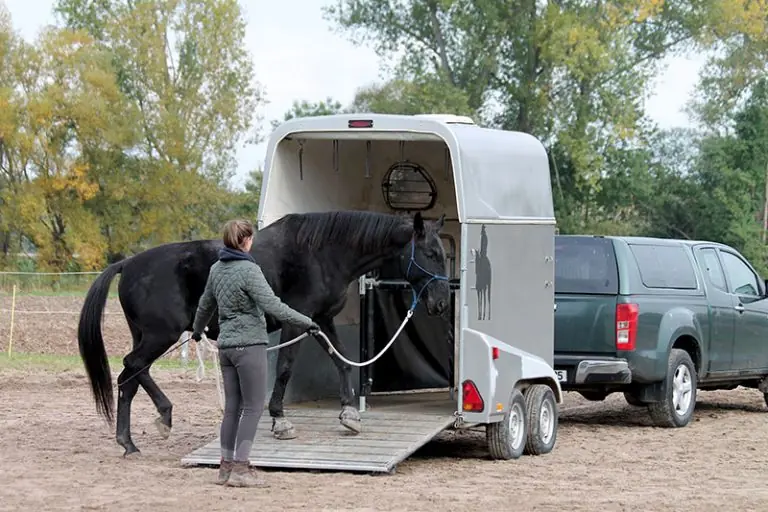
Look at the Edges of the Shapes
The boundaries between objects can reveal a great deal.
If a viewer believes a dark shape belongs to another person, it is worth tracing the outline carefully. Does the supposed arm have a clear connection to a shoulder? Is there a visible hand? Does the shape continue in a way that is consistent with a human body?
Or does it blend into the horse's mane, neck or body?
In an optical illusion, the apparent object may not have a consistent outline. A shape that looks like an arm from one angle may become part of an animal's mane when the surrounding area is examined.
That is why looking at the entire photograph is more useful than focusing only on the suspicious area.
Consider the Camera Angle
A photograph is not a three-dimensional view.
The camera captures the scene from one position, and objects at different distances may appear to touch or overlap. A horse standing slightly behind someone can create an outline that looks connected to the person's body.
If the photographer moved a few steps to the side, the apparent shape might look completely different.
This is one reason additional photographs can be valuable. Images taken from different positions may reveal whether an apparent figure is actually a separate person or simply an overlap of objects.
Be Careful With Cropped or Compressed Images
The version of a photograph shared on social media may not preserve every detail.
Cropping can remove context. Compression can blur edges. Low resolution can merge separate shapes into one dark area.
A small image may therefore create more uncertainty than the original photograph.
If the image is unclear, the honest answer may be that the detail cannot be identified with confidence.
There is nothing wrong with admitting uncertainty. In fact, it is more responsible than inventing an explanation.
Do Not Let the Caption Decide What You See
Perhaps the most important lesson is to examine the photograph before reading the dramatic caption again.
A headline about betrayal encourages one interpretation. A headline about an optical illusion encourages another. The photograph itself may not contain enough information to settle every question.
Readers can test this by looking at the picture without the headline and asking what they would naturally notice.
Then they can read the caption and see how their interpretation changes.
This simple exercise demonstrates how strongly language can influence perception.
The photograph has not changed. The viewer's expectations have.
A Puzzle Is Not Proof
There is nothing wrong with enjoying a viral visual puzzle. It can be entertaining to compare interpretations and discover how a shadow or reflection creates an unexpected shape.
The problem begins when an entertaining premise is presented as a confirmed personal scandal.
A real accusation can have consequences for the people involved. A photograph should not be used to make claims about someone's private life unless there is reliable evidence to support those claims.
In this case, the available material supports a discussion of an optical illusion. It does not verify the alleged divorce or establish that another person was embracing the woman.
That is the distinction readers should remember.
The hidden detail is intriguing, but the explanation should remain grounded in what the image can actually show.