Encountering a snake in your garden, on a hiking trail, near a river, or even inside your home can be an unsettling experience. Your first instinct may be to determine whether the animal is dangerous. Is it a harmless snake passing through? Could it deliver a medically significant bite? And are there visible clues that can help you tell the difference?
These are important questions, but the answers are not always as straightforward as people expect.
Some venomous snakes have bright, distinctive patterns, while others blend almost perfectly into their surroundings. Some nonvenomous snakes look surprisingly similar to dangerous species, and several widely repeated identification rules are unreliable. Head shape, body color, pupil shape, and tail appearance may offer clues in certain circumstances, but none provides a dependable way to identify every snake.
The most important safety rule is simple: never approach, touch, or attempt to capture a snake to determine whether it is venomous. Even if you believe a snake is harmless, misidentification can have serious consequences.
Learning about snake behavior, understanding the limitations of visual identification, and knowing what to do during an unexpected encounter can help protect you, your family, and the animal itself.
Here is what you need to know about venomous and nonvenomous snakes, common identification myths, the warning signs of a potential bite, and the safest way to respond when you encounter one.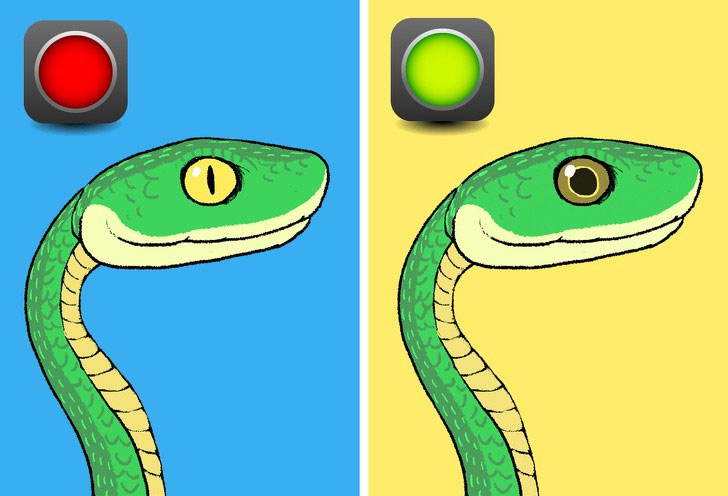
1. What Is the Difference Between a Venomous and a Nonvenomous Snake?
Before learning how to recognize potentially dangerous snakes, it helps to understand what makes them different.
A venomous snake produces venom, a biological substance containing proteins and other compounds that can interfere with the nervous system, blood clotting, tissue integrity, or other bodily functions. Depending on the species, venom may help the snake subdue prey, begin digestion, and defend itself when threatened.
Many venomous snakes deliver venom through specialized fangs. These teeth help introduce venom into a bite wound, although the structure of the fangs varies between groups.
A nonvenomous snake does not produce venom capable of delivering the same type of toxic bite. Many nonvenomous species capture prey by biting and swallowing it, while some use constriction to restrain their food.
However, the distinction between venomous and nonvenomous does not mean that every nonvenomous snake is completely harmless.
A nonvenomous snake can still bite when frightened or handled. Its teeth may cause puncture wounds, bleeding, or infection. Large constrictors can also injure people or pets if handled improperly. Some snakes release unpleasant-smelling secretions or behave defensively when cornered.
In addition, certain snakes produce toxic secretions or possess unusual biological defenses that do not fit neatly into the simple categories people commonly use.
For practical safety purposes, the question is not merely whether a snake is capable of producing venom. It is whether the animal can cause a medically significant injury and how a person should respond to it.
A snake that is considered relatively low-risk in one region may be confused with a dangerous species in another. That is why geographic location is important when identifying snakes.
For example, a harmless species in one part of the world may resemble a highly venomous snake found nearby. Familiarity with local wildlife can be useful, but even experienced people should avoid handling unidentified snakes.
The safest approach is to observe from a distance, give the animal an escape route, and contact a qualified wildlife professional when removal is necessary.
2. Can You Identify a Venomous Snake by Its Head Shape?
One of the most common pieces of advice about snake identification is to examine the shape of the head.
People are often told that venomous snakes have triangular heads while nonvenomous snakes have narrow, rounded heads.
Although this rule may appear useful for some species, it is not reliable enough to determine whether an unidentified snake is dangerous.
Some venomous snakes do have relatively broad heads. In certain species, glands associated with venom production contribute to the shape of the head and the area behind the eyes.
However, numerous nonvenomous snakes can flatten their heads when threatened, making them appear broader or more triangular than usual. Certain harmless species also naturally have wide heads.
Conversely, some venomous snakes have relatively narrow heads that do not fit the stereotypical triangular shape.
The result is a dangerous identification problem: a harmless snake may look venomous, while a venomous snake may not look particularly threatening.
Head shape also varies with age, body condition, posture, and the angle from which the animal is viewed. A photograph taken from above may create a different impression from one taken at ground level.
Even if a person learns the typical appearance of a local venomous species, relying on head shape alone can lead to serious mistakes.
Never approach a snake simply to get a better look at its head.
Trying to distinguish subtle differences in skull shape, scales, or facial features may bring you much closer to the animal than is safe.
If a snake is near your feet, remain calm and slowly increase the distance when it is safe to do so. Do not attempt to trap it, lift it, or force it into a container.
When identification matters, a clear photograph taken from a safe distance may help a qualified local expert. However, you should never risk a bite to obtain a picture.
3. Do Vertical Pupils Mean a Snake Is Venomous?
Another widespread belief is that venomous snakes have vertical, slit-like pupils while nonvenomous snakes have round pupils.
This idea is sometimes useful as a limited identification clue, but it is not a universal rule.
Pupil shape varies across snake species and is associated partly with visual adaptation and activity patterns. Some snakes with vertical pupils are venomous, but some are not. Likewise, some venomous snakes have round pupils.
Lighting conditions can also influence how pupils appear. In bright light, a pupil may contract and become less conspicuous, while in dim conditions it may look wider.
The viewing angle and image quality can further distort the appearance.
Even if the pupil shape is clearly visible, it cannot establish whether a snake is safe to approach.
Attempting to inspect a snake's eyes would be particularly dangerous because the observer would likely need to get much closer than necessary.
There is another reason this rule is problematic: many people encounter snakes in dim garages, gardens, wooded areas, or roadside vegetation. In such circumstances, the eyes may be difficult to see at all.
A person trying to identify a snake by pupil shape may waste valuable time while placing themselves at unnecessary risk.
The same principle applies to many other visual characteristics. A single feature rarely provides enough information for dependable identification.
If you encounter an unfamiliar snake, do not attempt to determine its danger level by examining its eyes. Treat it as potentially dangerous until a qualified person can identify it.