She wanted to ask dozens of questions. Where had they gone? Why had they chosen the abandoned building? Had they been afraid? Had someone encouraged them to go there? Why had neither of them called?
But she also understood that the boys had just been through a frightening experience.
She decided to begin with one simple question.
"Can you tell me what happened?"
Daniel looked down at his hands.
"We didn't think it would become like this."
That answer did not explain everything, but it was the beginning of a conversation.
Lucas faced a similar discussion with his father. He admitted that he and Daniel had left without considering how long they would be away. They had not properly explained their plans, and once they found themselves in an unfamiliar place, the situation became more difficult than they expected.
The abandoned building had seemed like a place they could explore. They had not fully considered the risks. They had also failed to think about how their families would react when they could not be reached.
In the fictional version of events, the teenagers had not intended to disappear permanently. Their decision had begun as an impulsive adventure, but it developed into a situation they could no longer control.
That distinction matters. A young person may leave home without intending to frighten anyone, yet the consequences can still be serious.
Parents are not always able to know what their teenagers are thinking. Young people may hide plans because they fear being told no, want to prove their independence, or believe that adults will not understand. Sometimes they simply make a quick decision without thinking through what could happen afterward.
But an abandoned building is not a safe place to explore.
A damaged roof can collapse. A floor can give way. An open shaft or stairwell may be difficult to see. Old electrical equipment, exposed wires, broken glass, and other hazards may remain even when a building has been empty for years.
The teenagers had been fortunate to leave without a serious injury.
Their families knew that the next step was not simply to punish them. It was to understand what had happened and make sure they understood the danger.
The Danger of Abandoned Buildings
The location at the center of the story was more than an empty structure. It represented a type of environment that can be deceptively dangerous.
An abandoned building may look quiet from the outside. There may be no visible activity, no people coming and going, and no obvious sign of immediate danger. But a building that is no longer maintained can deteriorate in ways that are not immediately visible.
A damaged staircase may still appear usable. A weakened floor may support someone's weight once before giving way. A loose section of ceiling may remain in place until disturbed. Dark rooms can hide holes, broken glass, sharp metal, or other hazards.
Teenagers exploring such a location may not recognize the risks.
They may assume that if a building is still standing, it must be safe enough to enter. They may also believe that they can leave whenever they want. But a blocked doorway, unstable floor, sudden fall, or loss of light can turn an ordinary exploration into an emergency.
This is why entering abandoned properties without permission is dangerous. It can also be illegal, depending on local laws and the circumstances.
If someone discovers that a person is trapped inside an unsafe structure, the right response is to contact emergency services rather than attempt a risky rescue alone. Untrained people can become injured themselves, creating a second emergency.
Professional search-and-rescue teams assess access routes, structural conditions, and hazards before entering dangerous areas. Their work may involve specialized equipment, communication systems, protective clothing, and technical rescue methods. The priority is to reach the person without exposing rescuers or victims to unnecessary danger.
The fictional rescue in this story reflects that principle: the searchers locate the teenagers, communicate with them, assess the route, and guide them out carefully rather than rushing into the building.
The fact that Daniel and Lucas were found unharmed does not mean the location was safe. It means they were fortunate.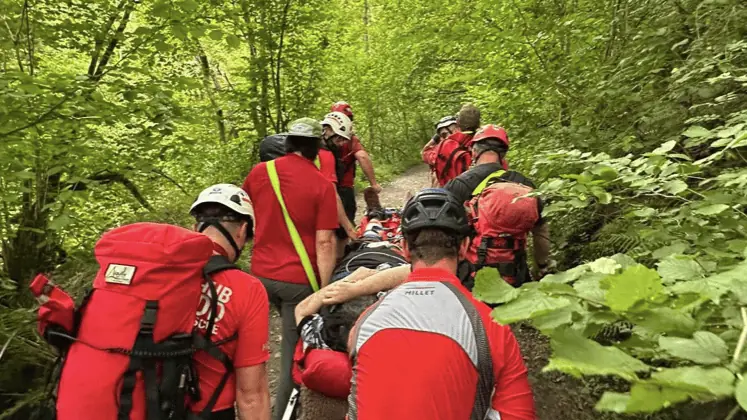
The People Who Refused to Stop Looking
Although the story focuses on the two teenagers, the search would not have reached its conclusion without the people who helped their families.
When someone disappears, relatives often experience a frightening combination of urgency and uncertainty. They may know the person's habits, favorite places, and usual friends, but that knowledge does not necessarily reveal where the person has gone.
The first hours can be especially difficult. Families may repeat the same calls, contact the same friends, and revisit the same locations because they are desperate to find one useful clue.
Neighbors can make a meaningful difference by sharing accurate information and helping families coordinate their efforts. One person may remember seeing someone near a particular road. Another may know about an unused property nearby. Someone else may be able to help contact people who have not yet been reached.
In the fictional search, every small contribution helped narrow the possibilities.
A neighbor checked the streets near the shops. A friend contacted classmates. Another volunteer helped the families communicate information to people searching in different directions.
No single person had all the answers. The search became effective because people shared what they knew.
But there is an important difference between helping and taking unnecessary risks. Volunteers should not enter unstable buildings, tunnels, wells, or other dangerous places without appropriate training and equipment. A missing-person search should be coordinated with the relevant authorities, who can determine which areas need to be checked and what resources are required.
The volunteers in this story helped by communicating, checking safe public areas, and supporting the families. The final approach to the abandoned building was handled cautiously.
When the teenagers were found, their safe return belonged to everyone who had refused to give up hope.
For Daniel's mother, the neighbor who had helped check the roads was no longer simply someone from the same street. He was one of the people who had stood beside her during the worst hours of uncertainty.
Lucas's father felt the same way about the friends and relatives who had responded when he asked for help.
The search had reminded them that a community can become a powerful source of support when a family faces an emergency.
The Emotional Impact on the Teenagers
Being found physically safe does not always mean that an experience is immediately over.
For Daniel and Lucas, the hours inside the abandoned building had been frightening. They had been separated from their ordinary routines and had gradually realized that their decision had become a serious problem.
Even after returning home, they might have struggled with embarrassment, guilt, or anxiety.
Daniel could remember his mother's voice when she finally reached him. He could also remember how frightened she had looked when he came out of the building.
Lucas had a similar memory of his father's expression. He had never seen him look so relieved and so upset at the same time.
These feelings can exist together. A parent can be grateful that a child is safe while also being angry about the choices that created the danger. A teenager can feel relieved to be home while also feeling embarrassed about what happened.