The most meaningful signs of attachment are often found in the broader relationship. A dog may greet you happily, seek interaction, relax when you are nearby, respond to your voice, and enjoy spending time with you throughout the day.
Sleeping beside you may simply be one of many ways your dog expresses that connection.
3. Your Dog Is Following Its Natural Social Instincts
Dogs have evolved from animals that lived in social groups. Although modern dogs are domesticated and their behavior is not identical to that of wolves, social connection remains an important part of their lives.
In group-living animals, resting near others can provide comfort, warmth, and a sense of security. Dogs may naturally gravitate toward people or other animals with whom they share a close relationship.
Your dog may not think about bedtime in the same way you do. Instead, it may simply recognize that nighttime is a period when the household becomes quiet and everyone settles down. Being near you may feel like the natural place to rest.
This behavior is especially common in dogs that are highly social or enjoy physical contact. Some dogs seem happiest when they can remain within a few feet of their favorite person. They may follow the owner from room to room during the day and choose the same general area at night.
In many cases, this is normal social behavior. Dogs are capable of forming strong bonds with humans, and proximity can be an important part of maintaining those bonds.
If your dog chooses to sleep beside you but can also relax independently when necessary, the behavior is generally not a reason for concern. It may simply reflect the dog's social nature and preference for companionship.
4. Your Dog Is Drawn to Your Body Heat
Comfort and temperature may be another important reason your dog sleeps beside you.
Dogs have different temperature preferences depending on their breed, size, coat, age, health, and environment. Some dogs enjoy cool surfaces, while others prefer warm blankets and close contact with their owners.
Your body produces warmth throughout the night. The bed may also provide a soft surface, familiar bedding, and a comfortable place to curl up. For a dog that enjoys warmth, sleeping beside a human can be an appealing choice.
Small dogs, short-haired dogs, older dogs, and dogs with certain health conditions may be particularly sensitive to cold temperatures. They may seek warmth by curling up near a person, resting beneath blankets, or choosing a heated area of the home.
Dogs often curl into a compact position when they sleep. This posture can help them conserve heat and protect their bodies. If your dog consistently curls against your legs or presses its body into your side, warmth may be one of the reasons.
You may also notice that your dog changes sleeping positions throughout the night. It might begin beside you, move toward the foot of the bed, and later return to another position. These movements may simply reflect changing temperature and comfort needs.
If your dog appears unusually cold, shivers frequently, or seems unable to get comfortable, consider whether the room temperature is appropriate and whether any underlying health issue could be affecting its ability to regulate body temperature.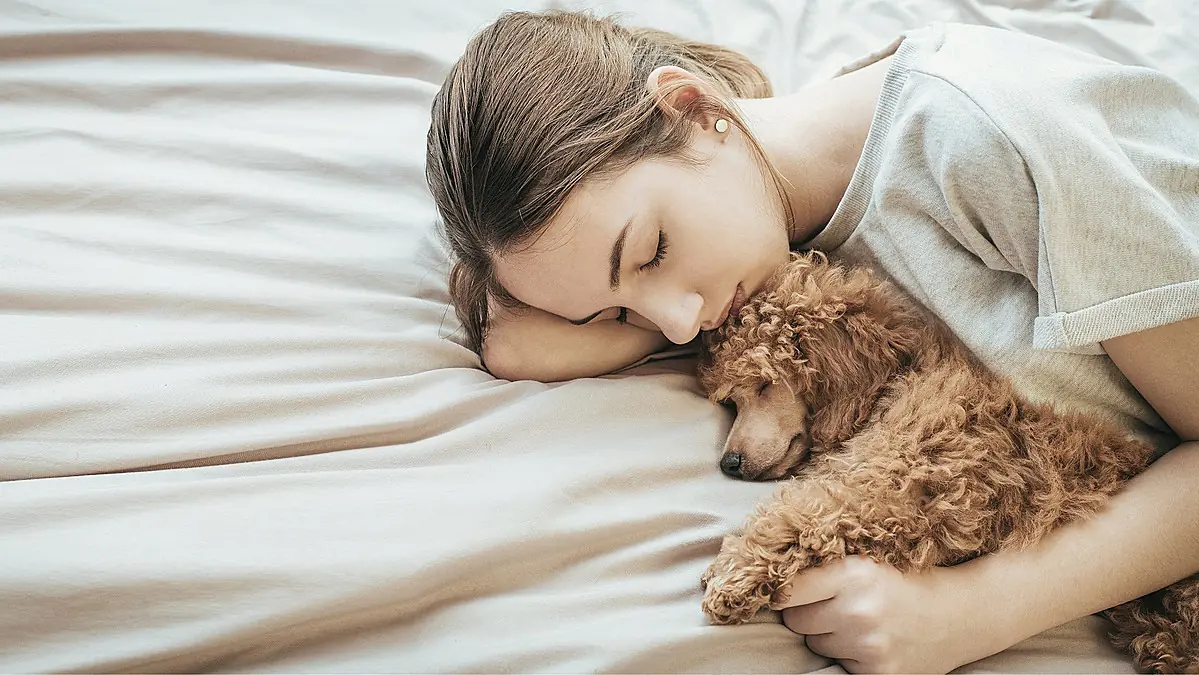
5. Your Dog Finds Comfort in Your Familiar Scent
Dogs have an extraordinarily powerful sense of smell. Their ability to detect and interpret odors is far more developed than that of humans, and familiar scents can play an important role in their emotional experiences.
Your bedding, clothing, pillows, and bedroom may contain familiar smells that help your dog feel comfortable. Your scent can be associated with positive experiences such as meals, walks, playtime, affection, and safety.
For some dogs, a familiar scent may help them relax when the environment is quiet or when they are separated from other members of the household. Your bed may become a place where several comforting sensory experiences come together.
This may explain why some dogs choose to sleep on their owner's clothing, especially when the owner is away. A shirt, blanket, or pillow that carries a familiar scent may provide comfort.
The behavior does not necessarily mean your dog is consciously thinking about missing you in the same way a human might. Dogs respond to familiar smells through associations and learned experiences, and those associations can influence where they choose to rest.
If your dog consistently selects your pillow, blanket, or side of the bed, the familiar scent may be part of what makes that location appealing.
6. Your Dog Wants to Stay Close to Its Favorite Person
Some dogs develop a particularly strong preference for one person in the household. They may follow that person around, wait near the door when the person leaves, respond more enthusiastically to their voice, or choose to sleep beside them.