If your dog suddenly becomes very interested in your private area, you may feel embarrassed or wonder whether there is something wrong with you. In most cases, however, this behavior is a completely normal part of canine communication and has much more to do with your dog’s powerful sense of smell than with illness.
Dogs experience the world through their noses in a way humans can hardly imagine. While we primarily rely on vision, dogs gather enormous amounts of information through scent. A quick sniff can tell them things about another animal—or a person—that would otherwise be invisible to us.
So when your dog approaches and starts sniffing your groin or another private area, it does not necessarily mean your pet has discovered a medical problem.
More often, your dog is simply investigating an area of the body that naturally produces strong and distinctive scents.
Why Are Dogs So Interested in Your Private Area?
The answer begins with anatomy.
Humans have apocrine sweat glands in several parts of the body, including around the groin and armpits. These glands produce substances that contribute to our individual body odor.
Dogs have an extraordinary sense of smell and are highly responsive to these kinds of chemical signals.
Your private area can contain a concentration of odors that is particularly interesting to a dog because of normal sweating, skin oils, clothing, and other everyday factors.
To your dog, there is nothing particularly strange about investigating these scents.
It is information.
Your dog may be learning who you are, how you smell today, where you've been, and whether something about your scent has changed.
Your Dog Isn't Being "Inappropriate"
Humans naturally interpret behavior through human social rules.
Dogs don't.
A dog does not understand that sniffing someone's groin is embarrassing or inappropriate in the same way a human does. The behavior is usually instinctive and exploratory.
Dogs routinely sniff other dogs around the face, rear end, and body. Scent investigation is an important part of their social communication.
When a dog sniffs a person's private area, it is often applying that same instinct to a different species.
In other words, your dog is not trying to embarrass you.
Your dog is simply gathering information.
Dogs Can Detect Tiny Changes in Scent
One reason dogs seem so curious about human bodies is that our scent changes constantly.
Exercise can alter body odor.
Hormonal changes can alter scent.
Stress can influence sweating.
Menstruation can produce changes in odor.
Changes in diet, medication, hygiene products, and even the environment can also affect the way a person smells.
A human might not notice these differences at all.
A dog may notice immediately.
That is why your dog might behave differently toward you after you've exercised, returned from a long day outside, or experienced another ordinary change in your routine.
Does Sniffing Mean Your Dog Detects a Disease?
This is where online stories often go too far.
You may see claims that a dog sniffing someone's private area means the person has cancer, an infection, a hormonal disorder, or another medical condition.
The reality is more complicated.
Dogs can detect certain odors and researchers have studied their ability to distinguish particular disease-related scent profiles under controlled conditions. However, a pet dog sniffing your private area is not a reliable medical test.
There are countless harmless reasons why a dog may become interested in a particular scent.
Your dog may simply find the smell stronger than usual.
You may have been sweating.
You may have changed soaps, detergent, or clothing.
You may have recently exercised.
Another animal may have left a scent on your clothing.
Or your dog may simply be curious.
Therefore, a single sniffing episode should not be interpreted as proof that you have a disease.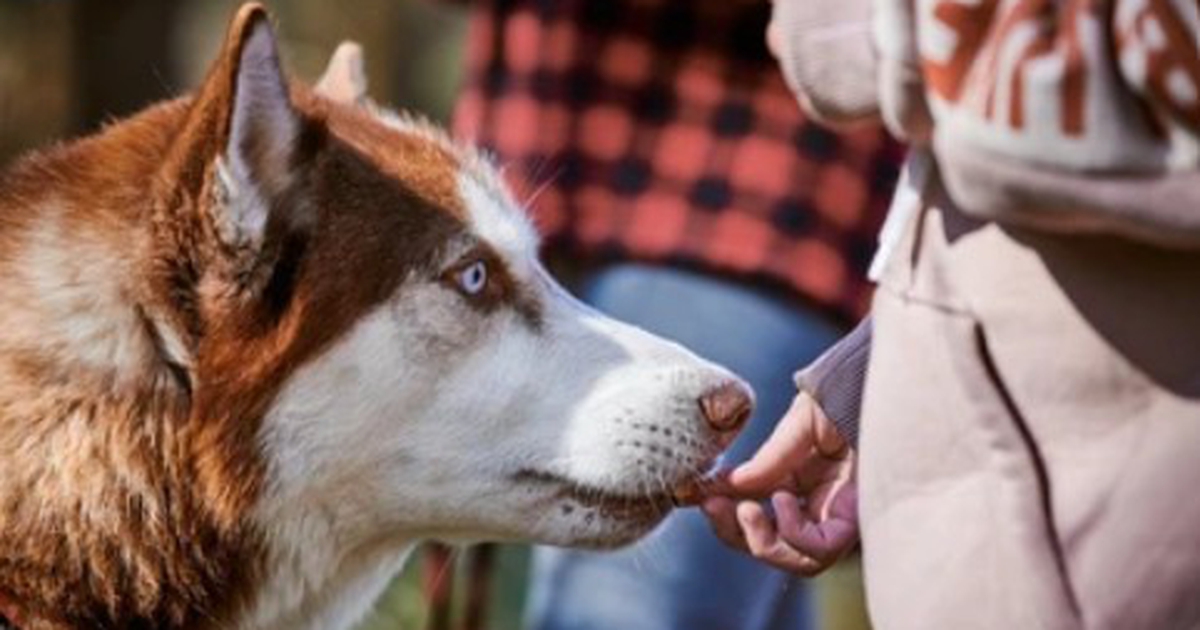
What About Hormonal Changes?
Hormonal changes can influence body chemistry and odor.
For example, some people notice changes in their body odor during menstruation, pregnancy, menopause, or other periods of hormonal fluctuation.
A dog's much stronger sense of smell may make those changes more noticeable to the animal than to humans.
Again, this does not mean that your dog can diagnose pregnancy, menopause, or a hormone disorder simply by sniffing.
It means your dog may notice changes in scent that you don't consciously perceive.
Why Does Your Dog Keep Coming Back?
Some dogs are especially persistent.
If your dog repeatedly returns to sniff the same area, several explanations are possible.
First, the scent may simply be particularly interesting.
Second, the dog may have learned that approaching you in this way gets a strong reaction. Laughing, pushing the dog away, talking loudly, or repeatedly saying “no” can sometimes make the behavior more interesting because your reaction itself becomes rewarding.
Third, the dog may simply have a strong investigative instinct.
Dogs often revisit scents that contain lots of information.
From their perspective, your private area is not necessarily “private.”
It is simply another source of scent.
Should You Stop the Behavior?
You can certainly set boundaries.
If your dog repeatedly sniffs your private area and you find it uncomfortable, calmly redirecting the dog is usually more effective than yelling.
You can ask the dog to sit, call the dog toward you, or offer a toy or another appropriate activity.
Reward the behavior you want.
For example, when your dog approaches calmly without jumping or excessive sniffing, praise the dog or offer a small treat.
This helps teach an alternative behavior without turning the interaction into a stressful confrontation.
Why Dogs Sniff People More After They Return Home
Have you ever noticed that your dog seems particularly interested in you after you've been away?
There is a simple explanation.
You return carrying an entire collection of new smells.
You may smell like the car, office, restaurant, outdoors, other animals, cleaning products, other people, or dozens of unfamiliar environments.
Your dog may spend several minutes investigating because your scent profile has changed.
The same principle applies to private areas.
The stronger or more distinctive the scent, the more likely an attentive dog may be to investigate it.
Your Dog May Also Be Responding to Sweat
Sweat itself is not necessarily strongly odorous when it first leaves the body. Odor can develop as skin microorganisms interact with compounds in sweat and other bodily secretions.
The groin is naturally a warm area with folds of skin and can therefore produce noticeable odors, especially after exercise or in hot weather.
From a dog's perspective, that creates an interesting scent source.
This is one reason a dog may become more interested after you've been active or have been outside in warm conditions.
What Should You Do If the Sniffing Suddenly Becomes Excessive?
A sudden change in your dog's behavior can be worth observing.
If your dog starts repeatedly focusing on one particular area of your body, don't immediately assume something is medically wrong. First consider ordinary explanations.
Have you changed your soap, deodorant, laundry detergent, or clothing?
Have you recently exercised more?
Are you using a new medication or topical product?
Has something changed in your normal hygiene routine?
Is there an obvious odor from sweat, food, or another environmental source?
These possibilities are much more common than a serious disease explanation.
However, if you notice symptoms such as unusual genital discharge, persistent itching, burning, sores, unexplained bleeding, a strong new odor, pain, swelling, or another concerning change, that is a reason to speak with a healthcare professional.
The important point is that the symptom—not your dog's behavior—is what should guide the medical evaluation.
Dogs and Their Incredible Sense of Smell
To understand this behavior, it helps to appreciate how different canine smell is from human smell.
A dog's nose is one of its primary sensory tools.
Dogs use scent to investigate objects, recognize individuals, follow trails, identify other animals, and gather information about their surroundings.
Some professionally trained dogs have even been studied for detecting specific odors associated with medical conditions.
But there is a major difference between a trained detection dog operating under controlled conditions and a household pet casually sniffing its owner's body.
A trained detection dog is working toward a specific scent target with a defined training protocol.
Your family dog is simply being a dog.
Why Punishing Your Dog Usually Isn't Necessary
Because this behavior can feel embarrassing, some owners instinctively scold their pets.
But punishment is usually unnecessary.
The behavior itself is natural.
What you need to teach is not that sniffing is “bad,” but that there are appropriate boundaries.
A simple interruption followed by redirection can work well.
For example:
“Come.”
“Sit.”
“Leave it.”
Then reward the dog when it follows the command.
Over time, your pet can learn that certain types of sniffing are not appropriate around people, even though investigating scents itself is perfectly normal.
When a Dog's Nose Becomes a Useful Health Clue
There is a fascinating scientific reason these stories persist.
Researchers have explored whether dogs can recognize certain disease-associated volatile organic compounds in breath, urine, skin, and other biological samples.
Some studies have produced intriguing findings.
But these techniques are not a substitute for standard medical screening and diagnosis.
The reliability of canine scent detection can depend on training, sample conditions, the specific disease, study design, and many other variables.
So while the science is interesting, it would be irresponsible to conclude:
“Your dog sniffed you, therefore you have a disease.”
That is not how medical diagnosis works.
Your Dog Knows More About Your Smell Than You Realize
A fascinating part of living with a dog is realizing how much information your pet receives from scent every day.
Your dog may know when you've been outside.
It may recognize your family members by smell.
It may notice when another animal has visited the house.
It can detect subtle differences in your scent that humans cannot consciously identify.
Your personal scent is part of how your dog recognizes you.
That is one reason dogs sometimes seem to “inspect” a person from head to toe.
They are gathering information about the world in their own language.
The Bottom Line
So, does your dog sniff your private area because something is wrong with you?
Usually, no.
In most cases, your dog is simply responding to naturally strong and information-rich scents around the groin. Sweat, skin oils, hormones, clothing, hygiene products, and normal changes in body chemistry can all influence what your dog smells.
There is interesting research into dogs detecting certain disease-related odors, but a household dog's sniffing behavior should never be treated as a diagnosis.
At the same time, paying attention to your own body is always wise. If you notice a persistent or unusual symptom—especially pain, itching, sores, discharge, unexplained bleeding, swelling, or a significant change in odor—seek appropriate medical advice rather than relying on your dog's behavior.
And when your dog gets a little too curious?
Remember that your pet probably isn't trying to embarrass you.
To your dog, you're simply a fascinating collection of smells—and your private area happens to be one of the most informative ones.