Never Sleep This Way: How Poor Sleeping Posture Can Affect Your Spine, Back, and Neck
You may spend seven or eight hours in bed every night and still wake up feeling as though your body has been working instead of resting. Your lower back feels tight, your neck is stiff, or your hips ache when you first stand up. You might blame your mattress, your age, or the stress of the previous day. But there is another factor that is easy to overlook: the position in which you sleep—and the support your body receives while you are sleeping.
The illustration accompanying this article highlights two common positions: lying flat on the back without support beneath the knees, and sleeping on the side without enough support between the legs. It contrasts them with adjusted positions that use pillows to help keep the body more comfortably aligned.
That distinction matters. Sleeping in an uncomfortable position does not automatically cause a spinal injury, and there is no single posture that is dangerous for everyone. However, staying for hours in a position that strains the neck, twists the lower back, or places pressure on sensitive joints can aggravate existing discomfort and make restful sleep harder.
The good news is that small changes may help. A pillow in the right place, a mattress that supports your body, and a few adjustments to your usual sleeping position can make a meaningful difference. To understand why, it helps to look first at what happens to your spine when you lie down—and then at the common sleeping habits that may leave you waking up sore.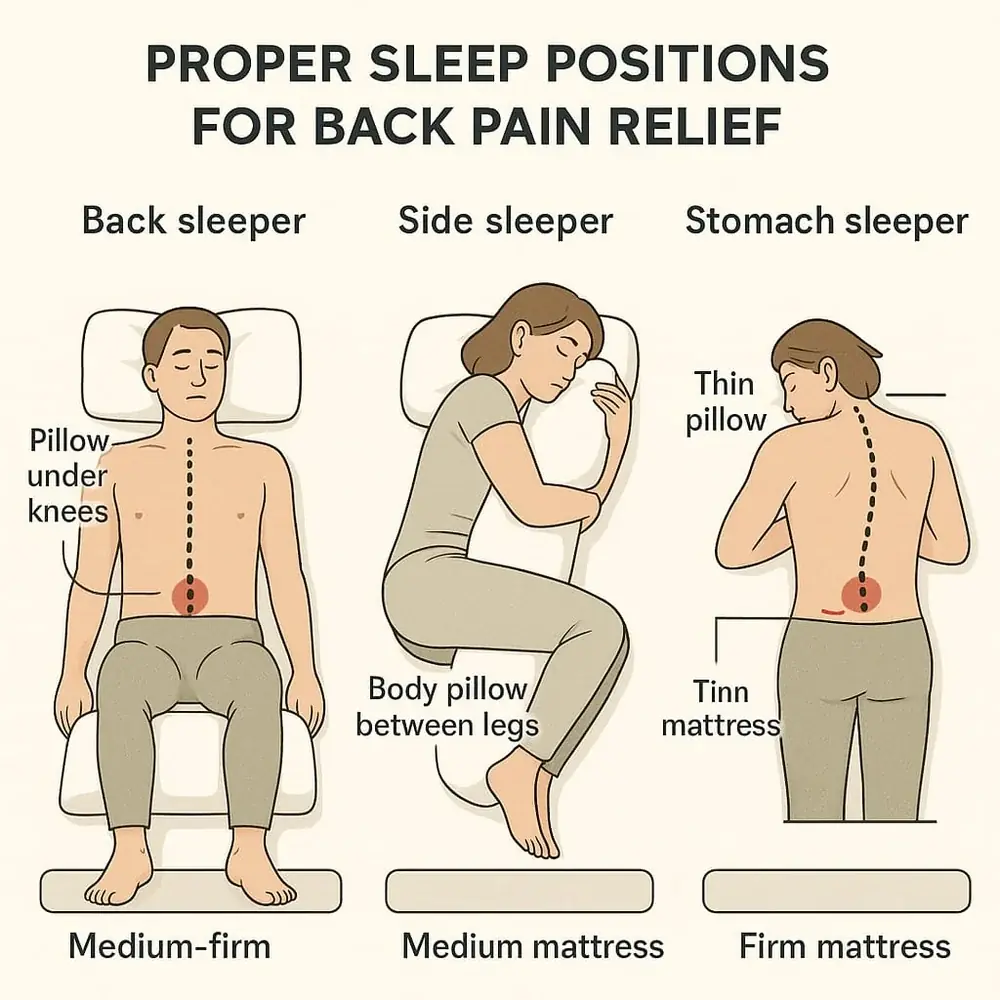
1. What the Illustration Is Warning You About
The image compares four sleeping arrangements. Two are marked with a red cross, while two are marked with a green check.
The first red-cross position shows a person lying flat on their back with the legs extended and no additional support beneath the knees. The green-check version shows the same person with a pillow supporting the knees. The second pair makes a similar comparison for side sleeping: the unsupported position allows the upper leg and hip to fall forward, while the recommended version places a pillow between the legs.
The message is not that lying on your back or side is inherently harmful. Both are common sleeping positions. The issue is whether the body is adequately supported.
When you lie on your back, a small pillow beneath the knees can slightly bend the legs and reduce tension around the lower back. When you lie on your side, a pillow between the knees can help prevent the upper leg from pulling the pelvis forward and twisting the lower spine.
These adjustments are recommended by medical organizations as options for people who experience back discomfort. They are not compulsory rules for every sleeper. If you wake up comfortable and have no pain, you may not need to change your position at all.
The most useful principle is to aim for a relaxed, neutral position: your head, shoulders, hips, and legs should be supported without forcing your body into an exaggerated curve or twist.
2. Sleeping Flat on Your Back Without Knee Support
Lying on your back is often considered a comfortable position because the mattress supports a large area of the body. Your weight is distributed across the back of your head, shoulders, torso, pelvis, and legs.
However, some people experience tension in the lower back when their legs remain completely straight for hours. The pelvis may tilt in a way that makes the natural curve of the lumbar spine feel more pronounced. This does not happen to everyone, but it can be uncomfortable for people who already have lower-back sensitivity.
The first position marked with a red cross in the illustration represents this unsupported arrangement.
Why straight legs may feel uncomfortable
The lower back has a natural inward curve. The shape of that curve differs from person to person, and it changes slightly depending on body position.
When you lie flat, the relationship between your pelvis, hips, and legs can influence how much tension you feel around the lumbar region. For some people, keeping both legs straight increases the sensation of pulling or pressure.
If you already have back discomfort, you may notice that lying flat makes it harder to relax. You might shift your hips, bend one knee, or turn repeatedly in search of a more comfortable position.
A pillow under the knees offers a simple alternative. It supports a slight bend in the legs and may help relax the muscles around the lower back.
Why a pillow under the knees can help
The second back-sleeping illustration shows a pillow placed beneath the knees. This support changes the angle of the legs and may make the lower back feel more relaxed.
The pillow does not need to be unusually thick. A comfortable, supportive pillow that keeps the knees slightly bent is often enough.
Try the following:
-
Lie on your back with your head resting on a suitable pillow.
-
Place a pillow beneath both knees, supporting them evenly.
-
Let your legs relax rather than actively holding them in position.
-
Check whether your lower back feels more comfortable.
-
Adjust the pillow's height if it creates pressure behind the knees or makes your hips uncomfortable.
The goal is not to lift your legs as high as possible. Excessive elevation can feel awkward and may create discomfort elsewhere. The best height is the one that allows your muscles to relax.
Should you place a pillow under your lower back too?
Some people find a small rolled towel beneath the natural curve of the lower back helpful. Others find that it creates too much pressure.
This is a personal adjustment, not a requirement. If you already have a comfortable position with a pillow under your knees, there may be no reason to add another support.
Avoid forcing a large cushion into the space beneath your waist. The purpose is to support a comfortable natural curve, not to push the spine into an exaggerated arch.
3. Sleeping on Your Side Without a Pillow Between Your Knees
Side sleeping is a natural and popular way to rest. It can be comfortable for people who prefer not to lie on their backs, and it may be a useful option for some people with back discomfort.
But side sleeping can also create alignment problems if the upper leg falls too far forward or downward.
The third illustration shows a side sleeper without support between the legs. The upper knee moves across the body, and the pelvis can rotate along with it. That position may create a twisting sensation through the hips and lower back.
How the upper leg affects the pelvis
When you lie on your side, your legs rest one above the other. If the top leg drops forward toward the mattress, it can pull the upper side of the pelvis out of alignment.
You may not notice this immediately because you are asleep. However, if you remain in that position for a long period, the muscles around the hip and lower back may feel tense when you wake.
Some people describe the result as stiffness around one side of the waist, discomfort near the hip, or an ache that becomes noticeable when they stand up.