One reason people struggle to improve their sleeping posture is that they try to change everything at once.
If you have slept on your stomach for decades, suddenly forcing yourself to remain on your back may make it harder to fall asleep. If you are accustomed to sleeping on one side, switching to the other side may initially feel unnatural.
A gradual approach is more realistic.
Begin with one small adjustment
If you usually sleep on your back, try placing a pillow under your knees for a few nights.
If you sleep on your side, start with a small pillow between your knees. Do not immediately buy several specialized products or replace your entire bed.
Pay attention to whether you feel more comfortable when you wake up.
Make the pillow easy to reach
A pillow placed between your knees may slide away during the night. If this happens, try a longer pillow or a design that stays in position more easily.
Some side sleepers prefer to hug a body pillow. This can provide support for the arms as well as the legs.
Do not force your body into an uncomfortable position
A posture that looks perfect in a diagram is not necessarily comfortable for every person.
If a new position causes pain, numbness, or a feeling of pressure, adjust it. Try a different pillow height or return to the position that allows you to sleep comfortably.
The purpose of the adjustment is to reduce strain, not to create another source of discomfort.
Give the change a little time
A new pillow or sleeping position may feel unfamiliar during the first night. Allow yourself time to adjust, but do not ignore persistent worsening symptoms.
If a position consistently makes your pain worse, it may not be suitable for you.
11. A Simple Nighttime Routine for a More Comfortable Back
Sleeping posture is only one part of how your body feels in the morning. What you do before bed can also influence comfort.
A calm routine may help you relax, reduce unnecessary muscle tension, and prepare for sleep.
Avoid going straight from prolonged sitting to bed
After spending hours sitting at a desk or watching television, your back and hips may feel stiff.
A few minutes of gentle movement can help you transition from sitting to resting. Walk around the room, move your shoulders, or perform comfortable stretches if they are appropriate for you.
Do not force a stretch through pain.
Keep your bedtime environment comfortable
A bedroom that is too hot, too bright, or too noisy can make it harder to sleep well.
Choose bedding that feels comfortable and avoid piling up so many pillows that your head and neck are forced into an awkward position.
Relax your shoulders and jaw
Stress can contribute to muscle tension. Some people unconsciously tighten their shoulders, clench their jaw, or hold their breath when trying to fall asleep.
Slow breathing and a few moments of relaxation may help reduce that tension.
Avoid treating pain as something you must simply endure
If pain repeatedly prevents you from sleeping, consider getting it assessed. Poor sleep and persistent pain can affect each other, making it harder to recover a comfortable routine.
You do not need to wait until symptoms become severe before asking for advice.
12. How to Get Out of Bed Without Twisting Your Back
The way you get out of bed can matter, particularly if you already have lower-back discomfort.
Sitting straight up from a flat position may feel difficult for some people. A gentler method is to roll onto your side first and use your arms to help lift your upper body.
Try this sequence:
-
Bend your knees slightly while lying on your back.
-
Roll onto your side, moving your shoulders and hips together.
-
Bring your legs toward the edge of the bed.
-
Push your upper body up with your arms as your feet move toward the floor.
-
Sit at the edge of the bed for a moment before standing.
This approach can reduce the need for a sudden twisting movement through the waist.
Move slowly, especially if you feel dizzy when getting up. If you have had spinal surgery or received specific movement instructions from a clinician, follow those instructions instead.
13. When Morning Back Pain Is More Than a Sleeping-Position Problem
It is tempting to blame every morning ache on the mattress or the way you slept. Sometimes that explanation is reasonable, but not always.
Back pain can arise from many sources, including muscle strain, joint changes, disc problems, nerve irritation, inflammatory conditions, and injuries.
Sleeping posture may aggravate an existing problem without being the original cause.
Pain that improves after gentle movement
Some people notice stiffness when they first get out of bed that gradually improves as they move around.
This can occur with several types of musculoskeletal discomfort. It does not identify a specific diagnosis by itself.
If the pattern happens regularly, becomes more severe, or limits your daily activities, seek medical advice.
Pain that repeatedly wakes you at night
Pain that interrupts sleep night after night deserves attention, especially if it is worsening or accompanied by other symptoms.
A clinician can ask about the location, duration, severity, and pattern of the pain and decide whether an examination or further tests are appropriate.
Warning signs that should not be ignored
Seek urgent medical care if back pain occurs with:
-
New loss of bladder or bowel control.
-
Numbness around the groin or saddle region.
-
New or progressive weakness in one or both legs.
-
Severe pain following a major accident or fall.
-
Fever or feeling seriously unwell alongside back pain.
Other symptoms, such as unexplained weight loss, a history of cancer, or pain that is persistent and unexplained, should also be discussed promptly with a healthcare professional.
These symptoms are not typical signs of simply sleeping in the wrong position.
14. A Practical Pillow Guide for Each Sleeping Position
You do not need a complicated collection of cushions to make your bed more comfortable. In many cases, one well-placed pillow is enough to test whether additional support helps.
For people who sleep on their backs
Start with a normal pillow that supports your head and neck. Then place another pillow beneath your knees.
The knee pillow should support both legs evenly. If it is too thick, reduce its height. If it slides away, try placing it slightly farther beneath the knees rather than directly beneath the calves.
Some people prefer a small rolled towel beneath the waist, but this should only be used if it feels comfortable.
For people who sleep on their sides
Use a head pillow that fills the gap between your shoulder and head. Add a second pillow between the knees.
If your upper leg still falls forward, a longer pillow may help. You can hug it against your chest while allowing your upper knee to rest on it.
Try to keep your hips stacked rather than allowing the top hip to roll toward the mattress.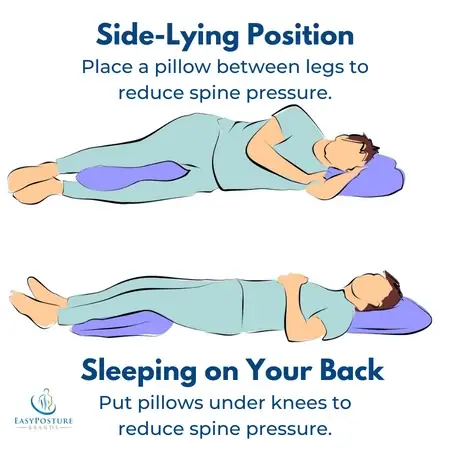
For people who sleep on their stomachs
If you cannot comfortably change positions, consider using a thin head pillow or no pillow, depending on what keeps your neck most comfortable.
A thin support beneath the pelvis or lower abdomen may reduce excessive arching in the lower back. Avoid a thick pillow beneath the head if it forces your neck into a sharply rotated or extended position.