If this posture regularly causes pain, consider gradually experimenting with side or back sleeping.
For people who change positions throughout the night
Many sleepers move between their back and sides. A long body pillow can be useful because it can support the legs when you turn and provide something to hug when you settle on your side.
You may need to reposition the pillow when you change sides. That is normal. The goal is to make comfortable movement easier, not to keep yourself locked in one posture.
15. Common Sleeping-Position Myths Worth Correcting
Sleep advice is often presented as a list of strict rules. But bodies differ, and a recommendation that helps one person may not suit another.
Myth 1: Everyone must sleep on their back
There is no universal requirement to sleep on your back. Side sleeping can be comfortable and may help some people with back discomfort, snoring, or other concerns.
The best position is one that allows you to breathe comfortably, keeps your body supported, and does not aggravate symptoms.
Myth 2: Sleeping on your side always damages your spine
Side sleeping is not inherently harmful. The problem may arise when the head, shoulders, pelvis, and legs are positioned in a way that creates discomfort or excessive twisting.
A suitable head pillow and a pillow between the knees can help some side sleepers feel more supported.
Myth 3: A pillow under the knees cures back pain
A pillow beneath the knees may reduce tension for some people who sleep on their backs. It is a comfort adjustment, not a cure for every cause of back pain.
If pain is caused by an injury, nerve compression, arthritis, or another medical condition, additional evaluation or treatment may be needed.
Myth 4: The hardest mattress is always the healthiest
A very firm mattress is not automatically best. The mattress should support the body while allowing the shoulders and hips to settle comfortably.
A surface that is too hard may create pressure points. A surface that sags excessively may make it difficult to maintain a comfortable position.
Myth 5: If you wake up sore, your sleeping position must be the cause
Morning discomfort can have many explanations. Activity during the previous day, muscle strain, health conditions, stress, and poor sleep quality can all play a role.
Changing your sleeping position may help, but it should not replace an assessment when symptoms persist.
Myth 6: You must remain in one position all night
Most people naturally move while sleeping. You do not need to force yourself to remain on your back or side simply because a diagram recommends it.
If you wake up and notice discomfort, adjust your position gently and find a more comfortable arrangement.
16. A Seven-Night Experiment to Find a More Comfortable Position
If you are unsure whether your sleeping posture contributes to morning discomfort, a simple experiment may help you notice patterns. It is not a medical test or a way to diagnose a spinal condition, but it can make your observations more useful.
Night 1: Notice your usual position.
Do not change anything yet. Pay attention to how your back, neck, shoulders, and hips feel when you wake up. Record whether discomfort is present and where you notice it.
Night 2: Adjust your head pillow.
Check whether your pillow keeps your neck comfortable. If you sleep on your side, make sure it fills the space between your shoulder and head. If you sleep on your back, avoid a height that pushes your chin toward your chest.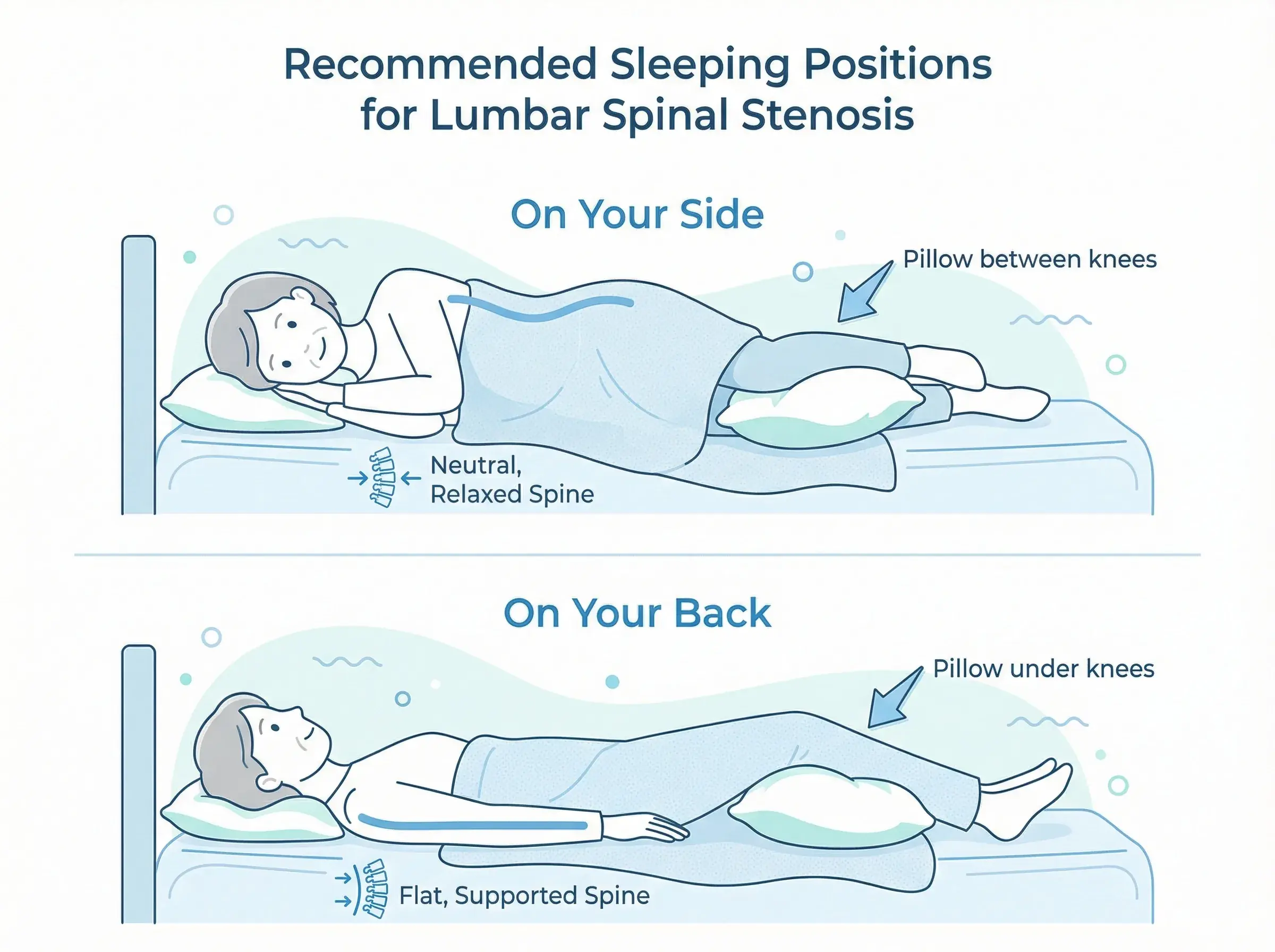
Night 3: Try a pillow beneath the knees.
If you normally sleep on your back, place a pillow beneath both knees. Notice whether the lower back feels more relaxed.
Night 4: Try a pillow between the knees.
If you sleep on your side, place a pillow between your knees. Keep your legs slightly bent and avoid pulling them tightly toward your chest.
Night 5: Check your mattress.
Notice whether the mattress sags, creates pressure around the hips or shoulders, or makes it difficult to find a comfortable position. Do not rush to buy a new one; simply observe how it feels.
Night 6: Make the smallest useful adjustment.
Choose the pillow arrangement that seemed most comfortable during the previous nights. Avoid changing several things at once, because that makes it harder to tell which adjustment helped.
Night 7: Review the pattern.
Ask yourself whether you woke up more comfortably, whether pain changed, and whether the position was easy to maintain.
If the experiment makes no difference, that does not mean you have failed. Your discomfort may have another cause, or you may need a different approach.
If symptoms are persistent, worsening, or accompanied by warning signs, speak with a healthcare professional rather than continuing to experiment on your own.
17. What the Red Crosses and Green Checks Really Mean
The central message of the supplied illustration is simple: a sleeping position may feel more comfortable when the body receives support in the right places.
For back sleepers, a pillow beneath the knees can help reduce tension around the lower back. For side sleepers, a pillow between the knees can help prevent the upper leg from pulling the pelvis forward.
The red crosses do not mean that lying on your back or side is dangerous. They indicate versions of those positions without the additional support shown in the green-check examples.
This distinction is important because alarming headlines can make ordinary habits sound more dangerous than they are. There is no evidence in the illustration that a particular posture will inevitably cause a serious spinal condition. Instead, it presents practical positioning suggestions that may help people who experience discomfort.
If you sleep comfortably, breathe normally, and wake feeling rested, there may be no reason to change your routine. If you often wake with stiffness or pain, experimenting with pillow placement is a reasonable first step.
The best sleeping posture is not the one that looks perfect in a picture. It is the one that allows your body to rest comfortably, keeps unnecessary strain to a minimum, and supports good-quality sleep.
18. The Small Change That May Make Your Mornings More Comfortable
A pillow may seem like a small detail, but its position can change how your body rests for hours at a time.
The illustration highlights two straightforward adjustments: support the knees when sleeping on your back, and place a pillow between the knees when sleeping on your side. These simple changes may help some people keep their hips and spine in a more comfortable position.
They are not guaranteed cures, and they are not necessary for every sleeper. But if you regularly wake with lower-back stiffness, hip discomfort, or a feeling of tension, they may be worth trying.
Pay attention to your head pillow, too. Your neck should feel supported rather than pushed forward or tilted sideways. Check your mattress for sagging and avoid forcing yourself to remain in a position that feels painful.
Most importantly, do not ignore persistent or severe symptoms. Sleeping posture can influence comfort, but it is only one part of spinal and overall health.
A better night may begin with something as simple as moving a pillow a few inches. Sometimes the most useful change is not a new mattress or an expensive sleep product—it is learning how to support the body you already have.