For 20 Years, an Eagle Equipped With GPS Puzzled Scientists: The Strange Journey Behind the Tracking Data
For two decades, a tiny tracking device appeared to tell an extraordinary story: an eagle crossing vast landscapes, doubling back over familiar ground, and following routes that seemed to make little sense. At first glance, the map looked like a record of aimless wandering. But animal movements rarely tell their stories at a glance. The real mystery lies in what scientists can—and cannot—learn from a line drawn across a map.
The image accompanying this story shows an eagle fitted with a tracking device, a map covered with winding route lines, and a photograph of a bird lying on the ground. Together, these images suggest a remarkable scientific investigation. Yet the visible headline is cut off, and the supplied text does not identify the eagle, the research project, its location, or the circumstances behind the bird's final photograph.
That matters. A genuine account of a 20-year tracking study should be tied to identifiable research, a species, a tracking period, and published findings. Without those details, it would be misleading to present every dramatic claim in the image as established fact. The article below explores the scientific questions raised by the story—how GPS tracking works, why an eagle's routes can look chaotic, what long-term movement data can reveal, and why a tracking map cannot by itself explain a bird's behaviour.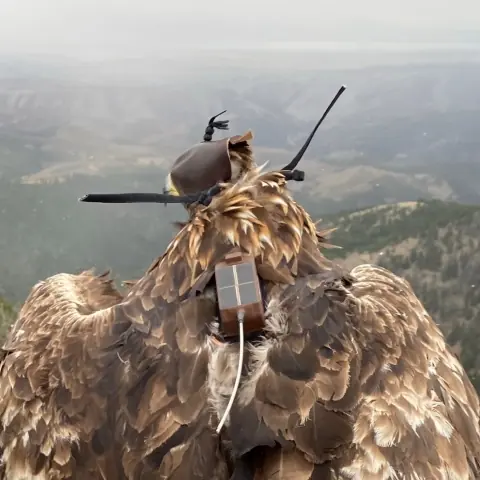
Chapter 1: The Eagle That Seemed to Have No Rules
Imagine watching an eagle disappear into the sky, knowing that you might never see it again. It could cross a mountain range, follow a river valley, circle above a forest, or travel hundreds of kilometres before landing somewhere completely unfamiliar. For generations, people could observe the beginning and end of such journeys, but the enormous spaces in between remained largely hidden.
Modern tracking technology changed that. By attaching small electronic transmitters to birds, researchers gained the ability to follow their movements over vast distances. A bird that once appeared briefly in a field notebook could now leave behind thousands of recorded locations, creating a detailed picture of its life across different landscapes.
That is the fascinating idea behind the viral headline about an eagle equipped with GPS for 20 years. The accompanying image shows a large bird carrying a tracking device, a map covered in winding lines, and another photograph that appears to show a bird lying on the ground. The combination creates an intriguing mystery: why would an eagle travel so far, repeatedly change direction, and follow routes that seem impossible to explain?
But there is an important correction. The viral claim that one individual eagle wore a GPS tracker and puzzled scientists for twenty years is not supported by the available evidence. The article associated with this headline acknowledges that the map was misinterpreted: it represents movements from multiple tracked eagles, rather than the twenty-year journey of a single bird. The same source also identifies its own dramatic narrative as fictional entertainment.
That clarification does not make the science less interesting. In fact, genuine research has revealed that eagles can travel in ways that are far more varied than many people expect.
One major study published in 2022 examined more than 500 golden eagles tracked over a ten-year period in western North America. Researchers identified 160 individuals that made unusual long-distance movements of more than 300 kilometres. Their combined data contained tens of thousands of daily tracks, showing how different individual birds used the landscape.
The real mystery, therefore, is not one eagle wandering around the world for two decades. It is how scientists discovered that a species famous for its strength and independence can follow so many different movement strategies.
To understand that story, we need to look at the technology, the birds, and the surprising reasons why a journey that looks random on a map may actually make perfect sense.
Chapter 2: What the GPS Device Really Records
The small device visible on the eagle's back is a wildlife tracking transmitter. Depending on the model, it can record information such as geographical position, altitude, movement, and sometimes other environmental or behavioural measurements.
A GPS receiver determines the bird's location using signals from satellites. The device can then store those coordinates or transmit them through a communication system, allowing researchers to access the information remotely.
This technology has transformed wildlife research.
In the past, scientists often relied on direct observation, identification rings, field surveys, and occasional sightings. These methods remain useful, but they cannot always reveal where an animal travels between observations.
Imagine studying an eagle that nests in a remote mountain valley. A researcher might visit the nesting area several times during the breeding season and observe the bird leaving to hunt. But where does it go? Does it travel to a nearby river? Does it cross a mountain ridge? Does it spend several days in a different valley before returning?
Without tracking technology, many of those movements would remain unknown.
A GPS transmitter can record locations at regular intervals, creating a sequence of points. When researchers connect those points on a map, the result becomes a flight track.
If the transmitter records frequently, the track may reveal detailed movement patterns. Scientists may identify where the bird stopped, how far it travelled, which areas it visited repeatedly, and whether it returned to a familiar location.
However, a GPS point is not a complete explanation of what the eagle was doing.
A location tells researchers where the bird was recorded. It does not automatically reveal whether the bird was hunting, resting, avoiding another animal, searching for a mate, or responding to changing weather.
That distinction is important.
A map can show an eagle circling above a particular area, but the reason for the circling must be investigated using other information. Researchers may compare the GPS records with terrain maps, weather conditions, vegetation, prey distribution, and observations from the field.
The technology provides clues. Scientific interpretation turns those clues into a meaningful explanation.
Why tracking devices are designed carefully
A transmitter must be small and light enough to be carried by the bird without creating an unacceptable burden.
Researchers also need to consider how the device is attached. Some transmitters use backpack-style harnesses, while other designs may use different attachment methods depending on the species and research objectives.
The equipment must be secure, but it should not interfere with the bird's normal movement.
Weight is particularly important. A large bird such as a golden eagle can carry more equipment than a small songbird, but researchers still need to minimize the additional load.
Solar-powered devices can help extend operating life by using sunlight to recharge their batteries. Other units depend on battery capacity and programmed transmission schedules.
Even advanced devices have limitations. Batteries can weaken, solar charging can be affected by weather or shade, and signals may occasionally disappear. A transmitter can also become damaged or stop communicating.
Therefore, a missing signal does not automatically mean that the bird has died.
It may indicate a technical problem, a temporary communication failure, or another circumstance that requires investigation.
Chapter 3: Why an Eagle's Route Can Look Completely Random
The most fascinating part of the tracking story is the appearance of the movement map.
A person looking at hundreds or thousands of GPS points may see a complicated web of lines. Some tracks seem to move in one direction, while others bend, cross, or return toward earlier locations.
It can look as if the eagle has no destination.
But animals do not travel according to the simple expectations people often apply to maps. Their movements are shaped by changing opportunities and environmental conditions.
For an eagle, a journey is not necessarily a direct flight from one fixed point to another. It may involve searching for food, exploring unfamiliar territory, responding to weather, avoiding danger, or moving between seasonal habitats.
A route that looks inefficient to a human observer may be the most practical option available to the bird.
Food can change the direction of a journey
Eagles are predators and scavengers, depending on the species and circumstances. Their food sources may be distributed unevenly across the landscape.