A single movement change does not prove that the environment has become unsuitable.
But repeated patterns across several individuals may provide valuable evidence.
The importance of curiosity
The greatest scientific value of the eagle story is the reminder that nature often behaves in ways that are more complicated than our first assumptions.
A route that looks random may reflect a series of practical decisions.
A bird that travels far from its familiar territory may be searching for future opportunities.
A missing GPS signal may indicate a technical problem rather than the end of an animal's life.
Good science begins by asking questions, but it also requires patience before accepting an answer.
Chapter 13: The Eagle's Journey Is Not Just About Distance
People often measure an animal's journey by the number of kilometres it travels.
Distance is easy to understand, and long journeys naturally attract attention.
But for researchers, the meaning of a journey is often more important than its length.
An eagle travelling 500 kilometres may be searching for a new territory. Another may travel the same distance as part of a seasonal migration. A third may move because its usual food source has become unavailable.
The distance alone cannot tell us which explanation is correct.
The importance of timing
When a bird moves can be as important as where it goes.
A journey during the breeding season may have a different meaning from a journey during winter.
Young birds may explore when they are not yet established in a territory.
Adults may travel differently depending on whether they are breeding, raising young, or remaining in a non-breeding area.
Researchers examine these seasonal patterns to understand the context of movement.
The importance of direction
Direction can also provide clues.
Some movements may follow north-south patterns associated with seasonal migration.
Others may be directed toward particular habitat types or regions with favourable conditions.
In the 2022 golden eagle study, long-distance movements were more frequent in north-south directions and in seasons other than winter.
However, that finding describes a pattern in the study population, not a rule that applies to every eagle everywhere.
The importance of stopping
A stopover can be an essential part of a long journey.
A bird may pause to feed, rest, or wait for favourable conditions.
A place where an eagle remains for several days may provide resources that are not available elsewhere.
These stops may be particularly important during migration or long-distance movements.
If a tracking map is interpreted only as a line between two distant points, these important locations can be overlooked.
Understanding the complete journey
To understand an eagle's movement, scientists need to examine the entire sequence.
Where did it begin? When did it leave? How long did it travel? Where did it stop? What were the weather conditions? Did it return?
The answers help distinguish between different movement strategies.
This is why tracking data becomes more valuable when collected over time and compared with other environmental information.
Chapter 14: Protecting the Birds Behind the Data
Tracking technology provides information, but it cannot protect wildlife by itself.
The value of the data depends on how people use it.
If researchers identify important feeding areas, conservation authorities may be able to protect those locations.
If tracking reveals dangerous routes, infrastructure managers may consider measures to reduce risks.
If the data show that certain populations are declining or experiencing difficulty reproducing, further investigation may be needed.
Protecting habitat
Eagles require suitable places to hunt, nest, and rest.
Habitat loss can reduce the availability of prey and suitable nesting sites.
Development, land conversion, and disturbance may alter areas that birds have used for generations.
Protecting habitat means considering the wider landscape, not only the immediate surroundings of a nest.
Reducing infrastructure risks
Some eagle species are vulnerable to collisions with vehicles, power lines, or other structures.
The risks vary by region and species.
Tracking data can help researchers identify where birds regularly interact with infrastructure.
This may support targeted measures such as improving the visibility of hazardous structures or changing the design of certain installations.
Understanding human disturbance
Activities such as construction, tourism, and recreation can affect wildlife, particularly near sensitive breeding locations.
Not every human presence causes harm, but repeated disturbance may influence where birds choose to feed or nest.
Tracking records can help researchers identify changes in habitat use that may be associated with human activity.
Supporting future research
Long-term tracking programmes require funding, specialist equipment, field expertise, and careful data management.
They also require cooperation between researchers, wildlife agencies, conservation groups, and local communities.
The information gathered can be useful for years after the original tracking period ends.
A well-maintained dataset may help answer questions that researchers did not originally anticipate.
That is one reason why long-term wildlife monitoring is so valuable.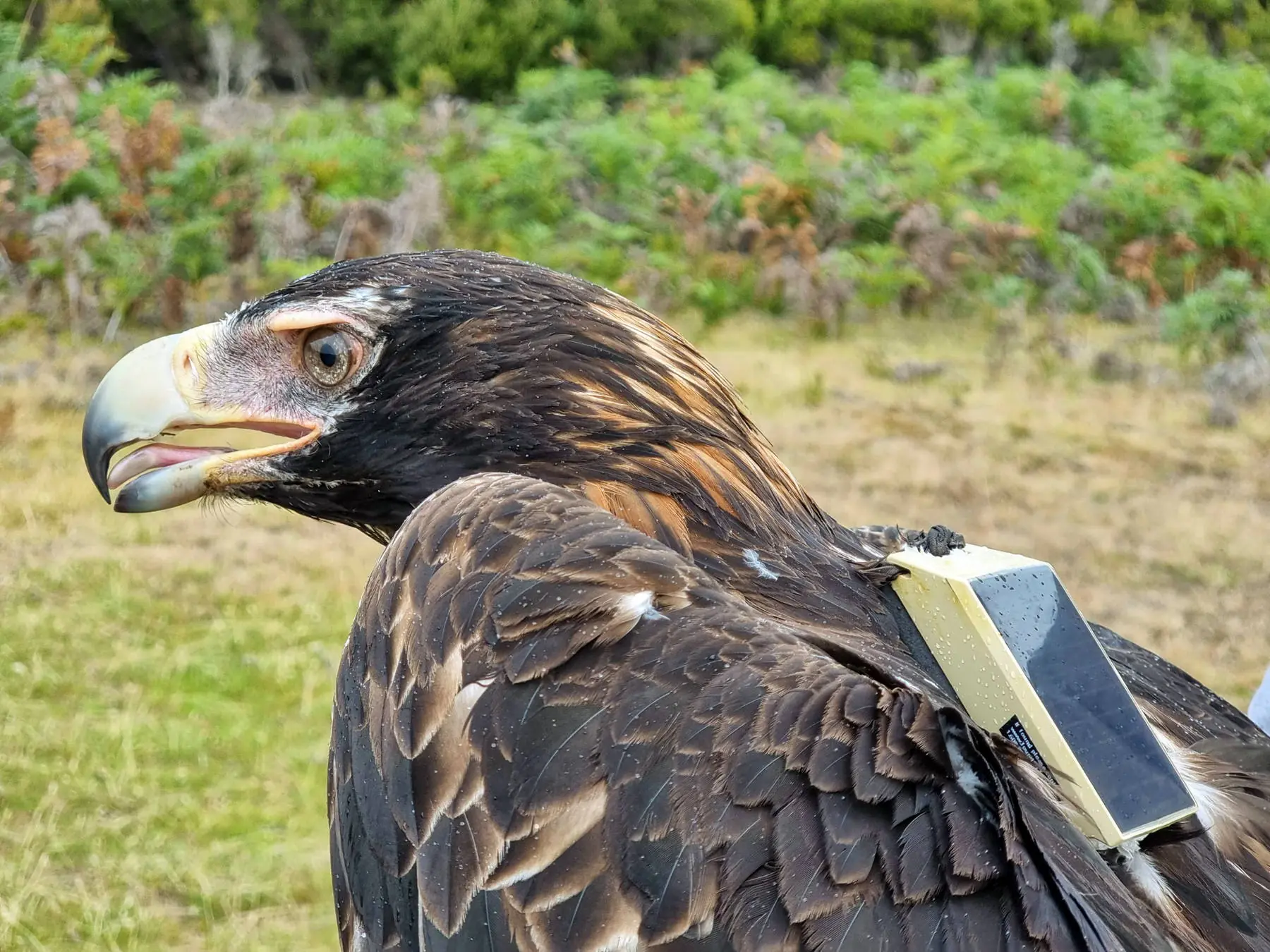
Chapter 15: The Real Answer Behind the Headline
So, what is the truth behind the story of the eagle that supposedly puzzled scientists for twenty years?
The most important answer is that the viral headline should not be taken literally.
The available source associated with the story explains that the map represents the movements of multiple tracked eagles, not one individual wearing a GPS device for two decades. It also describes the dramatic narrative as fictional entertainment.
Real scientific studies nevertheless show that eagle movements can be surprisingly varied.
Research on more than 500 golden eagles tracked over ten years in western North America found that many individuals made non-routine long-distance movements. Some travelled more than 300 kilometres from their initial capture locations.
The researchers found links between daily movement distances and the availability of rising air currents. They also identified differences associated with age, season, direction, and environmental conditions.
Other studies have shown that eagle populations may contain a mixture of residents, migrants, and nomadic individuals.
These discoveries help explain why a map filled with winding lines should not automatically be interpreted as a single bird behaving strangely.
Each line represents movement that must be understood in context.
A bird may be looking for food, exploring a new territory, responding to weather, or travelling between seasonal habitats.
The photograph of the eagle lying on the ground also requires caution. Without information about where and when it was taken, it cannot establish whether the bird was resting, injured, undergoing examination, or dead.
The science does not provide a dramatic final scene for the individual shown in the picture.
Instead, it offers something more useful: a better understanding of how researchers study wildlife and how much remains to be learned about the movements of large birds of prey.
Chapter 16: A Map Full of Lines, and a Much Bigger Story
The eagle in the viral image appears to carry a small device that has unlocked a huge mystery.
But the most important discovery is not that one bird spent twenty years travelling across continents.
It is that modern tracking technology has revealed the extraordinary variety of movement strategies used by eagles.
Some birds stay close to familiar territories. Others move seasonally. Young individuals may explore distant areas, while other birds follow changing food sources and environmental conditions.
A route that looks confusing to a human observer may be perfectly practical for an eagle responding to wind, terrain, prey, and the need to survive.
The winding lines on a map are therefore not simply evidence of unusual behaviour. They are clues to the complex relationship between animals and their surroundings.
They also remind us that conservation requires more than protecting a single nesting tree or a small patch of land.
An eagle's life may depend on a network of places spread across a vast landscape. Some are used every day. Others are visited only briefly during a particular season.
GPS tracking helps researchers identify those connections and understand why they matter.
The headline may promise the story of one mysterious eagle, but the real scientific story is much broader.
It is about hundreds of birds, years of careful research, and the discovery that wildlife does not always follow the predictable paths people expect.
And perhaps that is the most fascinating lesson of all: the natural world is full of patterns that remain invisible until someone takes the time to look closely.