If you're unsure what to do, contact a local wildlife authority or qualified wildlife-removal professional.
What If You Keep Seeing Snakes?
One snake doesn't necessarily mean there's a serious problem.
Repeated sightings, however, are worth investigating.
Possible contributing factors include:
-
Rodent activity
-
Dense vegetation
-
Standing water
-
Outdoor food sources
-
Open crawl spaces
-
Gaps in the foundation
-
Unsealed garage doors
-
Nearby habitat that supports snakes
Instead of focusing only on removing individual snakes, address the conditions attracting them.
That approach is usually more effective over the long term.
A Snake-Proof Home Doesn't Really Exist
It's important to keep expectations realistic.
If you live in an area where snakes naturally occur, completely eliminating the possibility of encountering one may not be realistic.
The goal should be reducing unnecessary opportunities for entry, not creating an impossible guarantee.
Regular property maintenance, appropriate sealing, rodent management, and responsible landscaping can all help.
The Most Important Rule: Don't Panic
Finding a snake inside your home can be startling.
Your heart may race.
You may immediately want to grab a broom and chase it outside.
But the safest response is usually much less dramatic.
Stop.
Step back.
Keep children and pets away.
Don't touch the snake.
Don't corner it.
Get professional assistance when necessary.
A snake in the house is certainly a problem that needs to be handled, but it doesn't automatically mean you're in immediate danger.
Frequently Asked Questions
Why would a snake come inside my house?
Usually because it is looking for food, shelter, water, warmth, or cooler conditions. Rodents and accessible entry points can also make a property attractive.
Should I try to catch it?
No. Unless you're a trained professional, attempting to catch an unfamiliar snake creates unnecessary risk.
What if I can't identify the snake?
Treat it cautiously and keep your distance. Contact a local wildlife professional or animal-control service.
What if the snake disappears?
Don't search dark spaces with your hands. Isolate the area if possible and seek professional assistance.
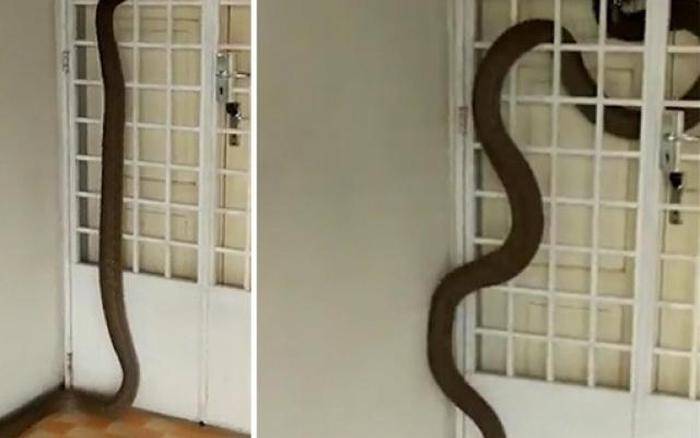
Can snakes climb?
Some species can climb remarkably well. Don't assume that a snake is restricted to the floor.
Can a snake come through a toilet?
This is a popular story, but while unusual wildlife encounters involving plumbing can occur in some circumstances, it's not something to assume every time you see a snake indoors. Snakes are more commonly associated with accessible gaps, doors, crawl spaces, garages, and other entry points.
Should I leave food out to lure it outside?
No. That could attract other wildlife and potentially make the situation worse.
Final Thoughts
A snake inside your home can be one of those experiences that makes your entire body go into panic mode.
But fear doesn't have to control the situation.
Most snakes aren't looking for a fight. They're usually trying to survive, find shelter, locate food, or escape from a threat.
The safest response is therefore surprisingly simple:
Give the snake space.
Keep people and pets away.
Avoid handling it.
Don't rely on risky internet tricks.
And if you cannot safely determine what to do, call someone who is trained to handle wildlife.
Once the snake is gone, focus on prevention. Check for gaps around the home, reduce clutter and potential hiding places, address rodent activity, and keep doors and vents properly secured.
You don't need to live in fear of snakes.
You simply need to respect them.
Because when an unexpected snake appears in your home, the smartest move isn't to be the bravest person in the room.
It's to be the calmest one.