If the irritation is mild and improves after avoiding the trigger, it may not indicate a serious problem.
However, chemical exposure, severe discomfort, or persistent redness should not be dismissed as ordinary irritation.
If a chemical enters the eye, begin flushing immediately with clean running water or saline and seek urgent medical advice. Do not delay irrigation while trying to identify the chemical.
When is redness concerning?
Redness accompanied by severe pain, light sensitivity, reduced vision, significant swelling, or a severe headache requires prompt medical assessment.
A red eye in someone who wears contact lenses also deserves particular caution because contact lens-related infections can threaten vision.
Sudden redness with significant pain or vision changes should be assessed urgently rather than treated with over-the-counter redness-relief drops.
3. What Is a Pinguecula, and How Is It Different From a Pterygium?
Pinguecula and pterygium are two surface conditions that can be confused with one another.
Both are associated with changes in the conjunctival tissue and may occur in people exposed to sunlight and environmental irritation.
However, there is an important difference.
A pinguecula usually remains on the white part of the eye and does not extend across the cornea.
A pterygium is a growth of tissue that can extend from the conjunctiva onto the cornea. It may look like a triangular or wing-shaped area of tissue, often growing from the side of the eye closest to the nose.
Small pterygia may cause few symptoms. Larger ones can cause irritation, redness, or changes in the shape of the cornea that affect vision.
If a pterygium grows far enough across the cornea, it may interfere with sight.
What causes these conditions?
Long-term ultraviolet exposure appears to be an important risk factor for both conditions.
Dry, dusty, windy environments may also contribute.
People who spend many hours outdoors without appropriate eye protection may have a greater likelihood of developing these changes.
However, environmental exposure does not guarantee that someone will develop either condition, and not every surface growth is a pinguecula or pterygium.
Should you be worried?
Most pingueculae are harmless, while pterygia vary in their effects.
Neither condition should be diagnosed solely from a photograph or a social media image.
If you notice a new growth on the eye, especially one that appears to be extending toward the colored part of the eye, schedule an examination with an eye-care professional.
Treatment depends on the diagnosis, symptoms, and whether the growth is changing.
4. Could Changes in Your Eyes Be Related to Aging?
The eyes undergo natural changes throughout life.
The lens gradually becomes less flexible, making it more difficult to focus on nearby objects. This change, called presbyopia, commonly becomes noticeable in middle age.
People may begin holding books farther away, increasing the size of text on their phones, or needing reading glasses.
Other age-related changes can affect the lens, retina, optic nerve, and tear film.
Some changes are expected and manageable, while others represent eye diseases that require monitoring or treatment.
Cataracts
A cataract occurs when the natural lens inside the eye becomes cloudy.
Symptoms may develop gradually and include blurred vision, glare, difficulty seeing at night, faded colors, or frequent changes in glasses prescriptions.
Cataracts are common with aging, but they are not the same as a yellow spot on the white of the eye.
A pinguecula is located on the surface tissue, whereas a cataract affects the lens inside the eye.
This distinction matters because the treatments are different.
Glaucoma
Glaucoma describes a group of conditions that damage the optic nerve.
Some forms develop slowly and may cause no obvious symptoms in the early stages. Peripheral vision can gradually be lost before a person realizes anything is wrong.
Other forms, particularly acute angle-closure glaucoma, can cause sudden severe eye pain, blurred vision, halos around lights, headache, nausea, and vomiting.
Acute symptoms require emergency assessment.
Because certain types of glaucoma can progress without obvious warning signs, regular eye examinations are important, particularly for people with relevant risk factors.
Age-related macular degeneration
Age-related macular degeneration affects the macula, the central part of the retina responsible for detailed central vision.
It may cause difficulty reading, recognizing faces, or seeing fine details.
Straight lines may appear distorted, or a central area of vision may become blurred or missing.
New distortion or sudden changes in central vision should be assessed promptly.
The key lesson is that aging can affect different structures of the eye in different ways. A visible spot on the surface cannot tell you whether you have cataracts, glaucoma, or macular degeneration.
Each condition requires its own evaluation.
5. Can High Blood Pressure Affect Your Eyes?
High blood pressure can affect blood vessels throughout the body, including those supplying the retina.
The retina is the light-sensitive tissue at the back of the eye. It converts light into electrical signals that travel to the brain through the optic nerve.
Long-standing or severe hypertension can damage retinal blood vessels, a condition known as hypertensive retinopathy.
Depending on the severity, changes may include narrowing of small blood vessels, alterations in their appearance, bleeding, or swelling.
Many people with high blood pressure do not notice obvious visual symptoms during the early stages.
That is one reason routine blood pressure checks are important.
However, a small yellowish spot on the white of the eye is not a reliable indicator of high blood pressure. Nor can someone determine their blood pressure by looking at the visible veins in their eyes.
A blood pressure measurement is necessary to assess blood pressure accurately.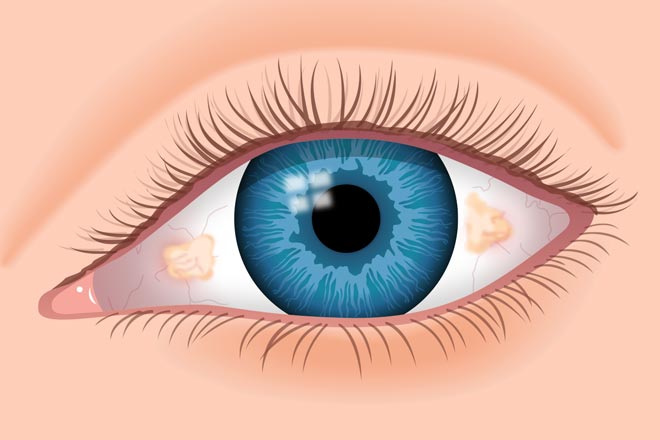
What should you do?
If you have hypertension, follow your healthcare professional's recommendations for monitoring and treatment.